About the neighborhood
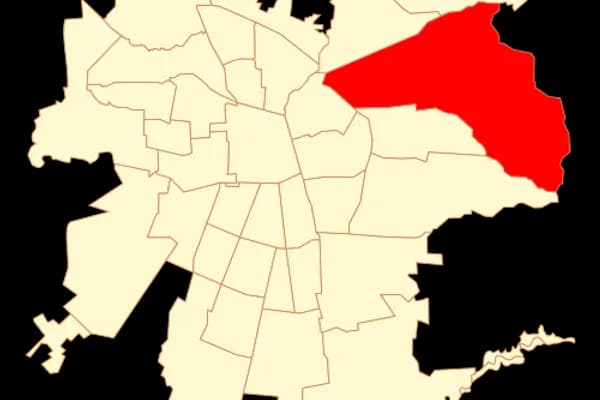
Commune in Santiago Metropolitan Region, Chile
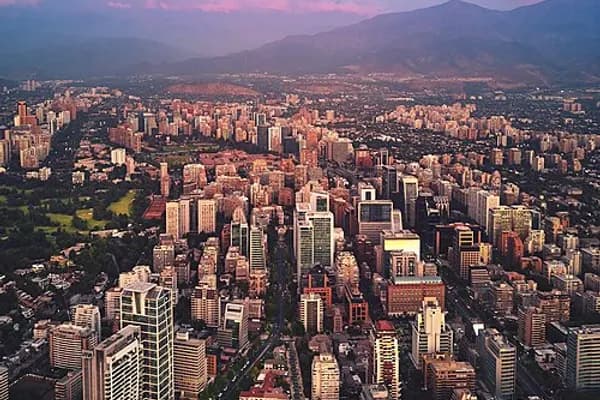
Las Condes is an affluent commune in northeastern Santiago, Chile, known as the country's main financial hub and one of Latin America's most prosperous urban districts. It concentrates corporate headquarters, luxury hotels, and high-rise offices in a sleek skyline locals call "Sanhattan"—a nod to its blend of Santiago and Manhattan. Beyond its business core, Las Condes is home to exclusive residential neighborhoods, top-ranked schools, and a cosmopolitan mix of international institutions and communities.
Etymology
The name "Las Condes" has two competing origins. The more widely accepted theory traces it to colonial-era haciendas owned by the Counts of Sierra Bella, whose lands were colloquially called "Las Condes" rather than the grammatically correct "Los Condes." Another theory suggests Quechua roots from "Cunti," referring to the western part of the Inca Empire's Antisuyu region.
History
Early settlement
The area's history dates to pre-Columbian times, with evidence of indigenous settlements from the Llolleo and Aconcagua cultures. The Inca Empire incorporated the region around 1470, establishing administrative control until Spanish conquest in the 1540s.
Colonial era to independence
During Spanish rule, the area comprised large agricultural estates. The Santa Rosa de Apoquindo manor, built in 1795, later became President Manuel Blanco Encalada's residence and now serves as a cultural center. The 19th century saw the area remain largely rural, with wealthy Santiago families maintaining country estates.
Modern development
Las Condes was officially established as a commune in 1901. Its transformation began mid-century as Santiago's expansion reached the foothills of the Andes. The 1970s-1990s witnessed rapid urbanization, with the emergence of high-rise office towers and upscale residential neighborhoods. In 1991, the commune was subdivided, creating the separate communes of Vitacura and Lo Barnechea.
Geography
Located in Santiago's northeastern sector at the foothills of the Andes, Las Condes ranges from 709 to 975 meters above sea level. The terrain transitions from the flat Santiago basin to the rising slopes of the precordillera, featuring hills like Cerro Calán and Cerro Apoquindo.
The commune experiences a Mediterranean climate with winter rainfall, though higher elevations show alpine characteristics. The Mapocho River flows through the area, supplemented by the Canal San Carlos irrigation channel.
Demographics
According to the 2017 census, Las Condes has 294,838 inhabitants, making it one of Santiago's most densely populated communes. It boasts Chile's highest socioeconomic indicators, with an average household income of US$67,672 (PPP) and poverty rates below 1%.
The commune hosts a significant Jewish community, with synagogues, schools, and the Estadio Israelita sports club. It also contains substantial populations of other immigrant groups, reflected in its international schools and cultural institutions.
Neighborhoods
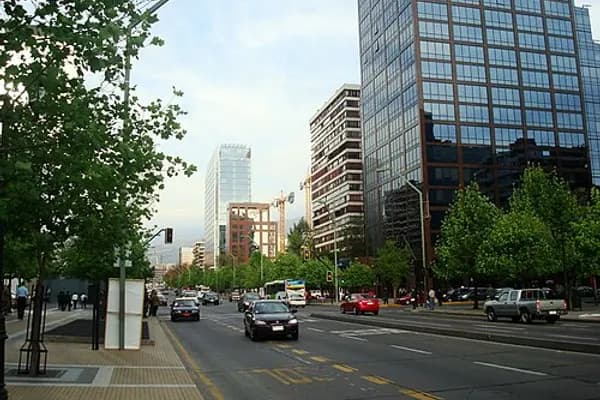
Las Condes comprises diverse neighborhoods, from the hyper-modern "Sanhattan" financial district to established residential areas like El Golf and Los Dominicos. The commune's rapid development has created a mix of luxury high-rises, single-family homes, and commercial centers.
Economy
Las Condes serves as Chile's primary business district, hosting headquarters of major corporations including:
LATAM Airlines Group and LAN Airlines
Google Chile
Microsoft Chile
Intel Chile
Movistar Chile
The "Sanhattan" area along Apoquindo Avenue contains numerous corporate towers, luxury hotels (Ritz-Carlton, Hyatt, Marriott, W Hotels), and the World Trade Center Santiago.
Real estate
The commune has experienced continuous real estate growth since the 1990s, with land values among Chile's highest. Recent metro expansions have spurred additional high-rise development, though creating traffic challenges that have prompted infrastructure improvements.
International presence
Las Condes hosts an extraordinary concentration of international entities:
Embassies: Over 30 diplomatic missions, including the United States, United Kingdom, China, Brazil, and European nations
International organizations: World Bank, UNICEF, and various UN agencies
Trade offices: Numerous national trade promotion agencies
Chambers of commerce: Binational business organizations representing most major economies
This international footprint reinforces Las Condes' status as Chile's global business gateway.
Education and culture
The commune contains several universities, including Universidad de los Andes, Universidad del Desarrollo, and branches of Universidad Andrés Bello and Universidad Mayor. International schools serve various foreign communities, including German, Italian, French, British, and American curricula.
Cultural institutions include the Las Condes Cultural Center, housed in a historic manor, and the Observatorio Astronómico Nacional on Cerro Calán.
Transport
Las Condes is served by multiple Santiago Metro lines:
Line 1: Tobalaba, El Golf, Alcántara, Escuela Militar, Manquehue, Hernando de Magallanes, Los Dominicos
Line 4: Francisco Bilbao, Cristóbal Colón
Future Lines 6 and 7 (under construction)
Major avenues include Apoquindo, Vitacura, Presidente Kennedy, and the Costanera Norte highway, providing connectivity throughout Santiago.
Sports and recreation
The Claro Arena (formerly Estadio San Carlos de Apoquindo) serves as home to Club Deportivo Universidad Católica and hosts concerts and events. The commune contains numerous private sports clubs, parks (including Parque Araucano and Parque Los Dominicos), and the Pueblito de Los Dominicos crafts market.
Sister cities
Miraflores, Peru
Petah Tikva, Israel
Gallery
See also
Santiago, Chile
Sanhattan
Providencia, Chile
Vitacura
La Reina
References
External links
Chile portal
(in Spanish) Municipality of Las Condes
Encyclopedic content adapted from the Wikipedia article on Las Condes, used under CC BY-SA 4.0.
What makes Las Condes special
Las Condes stands out among Santiago’s neighborhoods for its distinctive character: santiago at its most polished. Ranked #5 in Santiago, it offers the kind of experience that defines a great city trip — a place where the streets themselves tell a story and every block rewards curiosity.
Best for
Our take on Las Condes
Las Condes occupies a distinctive place in Santiago's neighborhood landscape. It is the kind of district that rewards travelers who venture beyond the obvious choices — quieter than the tourist-facing areas, richer in local character, and full of the small details that make a city trip memorable.
What makes Las Condes worth the visit is the texture of daily life here. It is a neighborhood that functions for the people who live in it — not just for the visitors who pass through. The shops serve local needs, the restaurants feed local appetites, and the streets have a rhythm that reflects genuine community rather than tourism infrastructure. That is the quality our editors prize most, and Las Condes has it in abundance.
Our editors recommend budgeting at least half a day here — enough time to walk the main streets, sit down for coffee, and discover the side streets where Las Condes's real character lives.
Living in Las Condes
Las Condes is connected to the rest of Santiago by public transit, and most visitors find it straightforward to reach from the city center or airport. Once you arrive, the neighborhood is best explored on foot — the scale is human and the streets reward wandering.
Day-to-day life in Las Condes has the rhythm of a genuine residential neighborhood. You will find grocery stores, pharmacies, cafés with morning regulars, and the kind of small independent shops that only survive where locals support them. For visitors, this means the infrastructure you need — good coffee, a decent meal, a quiet place to sit — is always within a short walk.
Accommodation in Las Condes ranges from boutique hotels to short-term rentals. We generally recommend staying within the neighborhood itself rather than commuting from a hotel elsewhere in Santiago — the experience of waking up inside a great neighborhood is fundamentally different from visiting one as a day trip.
What locals say about Las Condes
Long-term residents of Las Condes tend to describe their neighborhood with a mix of pride and protectiveness. Like any district with genuine character, Las Condes inspires loyalty — the kind of place people move to and never quite leave, or leave and spend years trying to get back to.
What locals appreciate most about Las Condes is its consistency — the feeling that the neighborhood works the same way on a Tuesday morning as it does on a Saturday night. It is not a place that performs for visitors and then goes quiet. The rhythm is genuine, the community is real, and the daily experience of living here is what draws people and keeps them.
Compared to the more famous districts in Santiago, Las Condes has maintained a lower profile, which many residents consider an advantage. The neighborhood evolves gradually rather than being reshaped by sudden attention, and the result is a community that still feels organic rather than curated.
Visitor tips
- Las Condes is located in Santiago, Chile. The neighborhood is accessible by public transport, taxi, or rideshare from most parts of the city.
- Morning is often the best time to explore — the streets are quieter, the light is better for photography, and cafes are at their most welcoming.
- Wear comfortable walking shoes — the best way to experience Las Condes is on foot, wandering the side streets and discovering what lies around each corner.
- Save the neighborhood's location on your phone before you arrive. Offline maps are especially useful for navigating the smaller side streets.