About the neighborhood
Capital and largest city of Chile
Santiago (/ˌsæntiˈɑːɡoʊ/ SAN-tee-AH-goh, US also /ˌsɑːn-/ SAHN-; Spanish: sanˈtjaɣo), also known as Santiago de Chile (Spanish: sanˈtjaɣo ðe ˈtʃile ), is the capital and largest city of Chile and one of the largest cities in the Americas. Located in the Chilean Central Valley within the Santiago Basin, between the Andes to the east and the Chilean Coastal Range to the west, it anchors the Santiago Metropolitan Region and its conurbation of Greater Santiago, which comprises more than forty communes and concentrates over a third of the national population and around 45% of Chile's GDP. Most of the city lies between 500 and 650 meters (1,640 and 2,130ft) above sea level, with recent urban growth extending into the Andean foothills.
The basin that Santiago occupies has been inhabited since at least the 10th millennium BC, with early agricultural villages established along the Mapocho River and later incorporated into the Inca sphere of influence. During the Spanish invasion of the Americas, conquistador Pedro de Valdivia founded the colonial city of Santiago del Nuevo Extremo on 12 February 1541, laying out a grid plan around the Plaza Mayor (now Plaza de Armas). Despite early food shortages, Indigenous attacks, floods, and devastating earthquakes—notably in 1647—the city consolidated as the capital of the Captaincy General of Chile. Santiago remained the political center during the Chilean War of Independence, beginning with the First Government Junta in 1810 and culminating in patriot victory at the Battle of Maipú in 1818, and subsequently expanded through 19th-century railway construction, state-building projects, and the creation of major educational and cultural institutions.
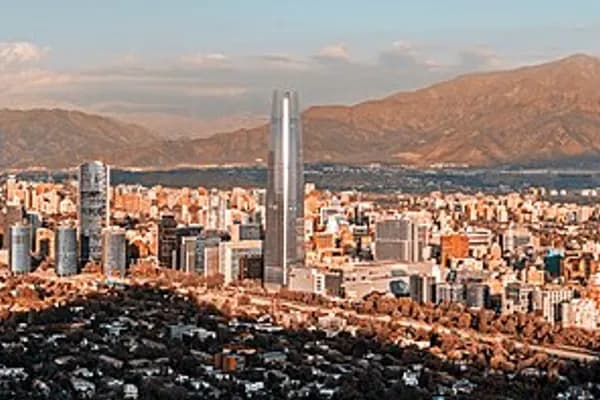
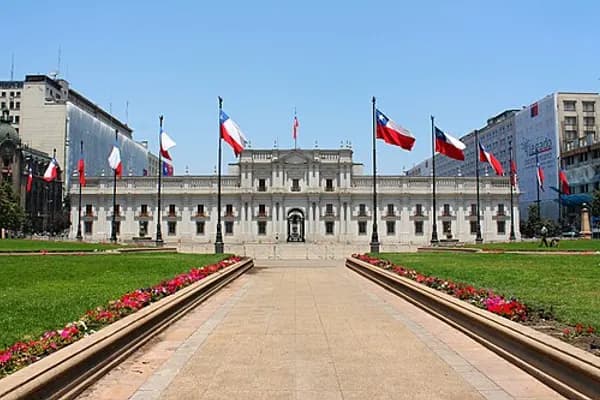
The city today is the political and administrative heart of Chile: it houses the presidential palace and the main organs of the executive and judiciary, while the National Congress meets primarily in nearby Valparaíso. Economically, Santiago is the country's principal industrial, commercial, and financial hub and a regional center for services, hosting the headquarters of major Chilean companies, regional offices of international organizations such as the Economic Commission for Latin America and the Caribbean (ECLAC), and several of the nation's leading universities and research institutes. Urban growth has been marked by the emergence of high-rise business districts such as Sanhattan, dominated by Gran Torre Santiago, the tallest building in South America and the second tallest building in Latin America (behind Mexico's T.Op Torre 1).
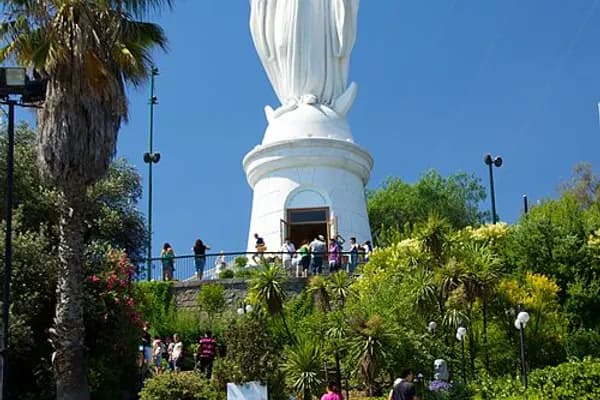
Santiago's urban landscape combines a 19th-century neoclassical core and surviving colonial churches with extensive modern residential districts, standalone hills such as Cerro Santa Lucía and Cerro San Cristóbal, and parklands along the Mapocho River, including Parque Forestal, Parque Bicentenario, and Santiago Metropolitan Park. The city has a cool semi-arid climate with Mediterranean characteristics, warm, dry summers and cool, wetter winters; its location in an enclosed valley contributes both to its scenic views of the high Andes and to chronic air pollution and winter smog. Santiago is served by Arturo Merino Benítez International Airport, a dense network of urban highways, and one of Latin America's most extensive metro systems.
Etymology
The name "Santiago" was chosen by the Spanish conqueror Pedro de Valdivia when he founded the city in 1541 as "Santiago del Nuevo Extremo", in reference to his home region of Extremadura and as a tribute to James the Great, the patron saint of Spain. The saint's name appears in various forms in Spanish, such as Diego, Jaime, Jacobo, or Santiago, with the latter derived from the Galician evolution of Vulgar Latin Sanctu Iacobu. Allegedly, there was no indigenous name for the area where Santiago is located, but the Mapuche language uses the adapted name Santiaw.
In Chile, several entities share the name "Santiago", which can often lead to confusion. The commune of Santiago, also referred to as Santiago Centro, is an administrative division encompassing the area occupied by the city during colonial times. It is governed by the Municipality of Santiago and led by a mayor. This commune is part of Santiago Province, which is headed by a provincial delegate appointed by the President of the Republic, and it is also part of the Santiago Metropolitan Region, governed by a popularly elected governor.
When the term "Santiago" is used without further clarification, it typically refers to Gran Santiago ('Greater Santiago'), the metropolitan area characterized by continuous urban development. This area includes the commune of Santiago and over 40 other communes, encompassing much of Santiago Province and parts of neighboring provinces. The definition of the metropolitan area has evolved over time as the city has expanded, incorporating smaller cities and rural areas.
Residents of the city and region are referred to as santiaguinos (for males) and santiaguinas (for females).
History
Prehistory
Archaeological evidence suggests that the first human groups arrived in the Santiago basin around the 10th millennium BC. These groups were primarily nomadic hunter-gatherers, traveling from the coast to the interior to hunt guanacos during the Andean snowmelt. By around 800 AD, the first permanent settlers established agricultural communities along the Mapocho River, where they cultivated crops such as maize, potatoes, and beans, and domesticated camelids.
The villages of the Picunche people (as they were known to Chileans) or the Promaucae (as referred to by the Incas) were under Inca rule from the late 15th century to the early 16th century. The Incas established a settlement of mitimas in the valley, located in the center of present-day Santiago, with fortifications such as Huaca de Chena and the El Plomo hill sanctuary. According to Chilean historian Armando de Ramón, the area served as a base for failed Inca expeditions to the south and was a junction along the Inca Trail.
Founding of the city
Pedro de Valdivia, a conquistador from Extremadura sent by Francisco Pizarro from Peru, arrived in the Mapocho valley on 13 December 1540, after a long journey from Cusco. Valdivia and his party camped by the river on the slopes of the Tupahue hill and gradually began interacting with the Picunche people who lived in the area. Valdivia later called a meeting with the local chiefs, during which he explained his plan to establish a city on behalf of Charles I of Spain. The city would serve as the capital of his governorship of Nueva Extremadura.
On 12 February 1541, Valdivia officially founded the city of Santiago del Nuevo Extremo ('Santiago of New Extremadura') in honor of the Apostle James, the patron saint of Spain. The city was established near Huelén, which Valdivia renamed Santa Lucía. He assigned the city's layout to master builder Pedro de Gamboa, who designed a grid plan. At its center, Gamboa placed a Plaza Mayor, which became the town's central hub. Surrounding the plaza, plots were designated for the cathedral, the jail, and the governor's house. The city was divided into eight blocks from north to south and ten blocks from east to west, between the Mapocho River and the Cañada with each quarter-block, or solar, granted to settlers. The colonial architecture following the grid plan consisted of one or two-story houses, adobe walls, tile roofs, and rooms around interior corridors and patios.
Valdivia left for the south with his troops months later, initiating the Arauco War. Santiago was left vulnerable, and a coalition of Mapuche and Picunche tribes led by chief Michimalonco destroyed the city on 11 September 1541, despite the efforts of a Spanish garrison of 55 soldiers defending the fort. The defense was led by Spanish Conquistadora Inés de Suárez. When she realized they were being overpowered, she ordered the execution of all indigenous prisoners, displaying their heads on pikes and throwing some towards the attackers. In response to this brutal act, the indigenous forces dispersed in fear. The city was gradually rebuilt, with the newly established city of Concepción gaining political prominence as the Royal Audiencia of Chile was established there in 1565. However, the ongoing threat of the Arauco War and frequent earthquakes delayed the establishment of the Royal Court in Santiago until 1607, which solidified the city's status as the capital.
During the early years of the city, the Spanish suffered from severe shortages of food and other supplies. The Picunches had adopted a strategy of halting cultivation and retreating to more remote locations, which isolated the Spanish and forced them to resort to eating whatever they could find. The shortage of clothing meant that some Spanish had to dress with hides from dogs, cats, sea lions, and foxes.
Colonial Santiago
Although Santiago was facing the threat of permanent destruction early on, due to attacks from indigenous peoples, earthquakes, and floods, the city began to grow rapidly. Out of the 126 blocks designed by Pedro de Gamboa in 1558, 40 were occupied. In 1580, the first major buildings in the city started to be erected, marked by the placement of the foundation stone of the first Cathedral in 1561 and the building of the church of San Francisco in 1572. Both of these structures were primarily made of adobe and stone. In addition to the construction of significant buildings, the city began to thrive as the surrounding areas welcomed tens of thousands of livestock.
During the 16th and 17th centuries, the growth of the city was hindered by a series of disasters including an earthquake, a smallpox epidemic in 1575, the Mapocho River floods in 1590, 1608, and 1618, and a devastating earthquake on 13 May 1647 which resulted in the death of over 600 people and affected over 5,000 others. Despite these setbacks, the capital of the Captaincy General of Chile continued to grow, with all the power of the country being centered on the Plaza de Armas in Santiago.
In 1767, the corregidor Luis Manuel de Zañartu launched one of the most significant architectural projects of the colonial period, the Calicanto Bridge, connecting the city to La Chimba on the north side of the Mapocho River. He also began constructing embankments to prevent river overflows. Although the bridge was completed, its piers were frequently damaged by the river. In 1780, Governor Agustín de Jáuregui hired the Italian architect Joaquín Toesca, who designed several important buildings, including the cathedral's façade, the Palacio de La Moneda, the San Carlos Canal, and the completion of the embankments during the government of Ambrosio O'Higgins. These works were officially opened in 1798. The O'Higgins government also opened the road to Valparaíso in 1791, connecting the capital with the country's main port.
Capital of the Republic
On September 18, 1810, the First Government Junta was proclaimed in Santiago, marking the beginning of Chile’s path to independence. The city, which became the capital of the newly formed nation, faced various challenges, particularly from military actions in the vicinity.
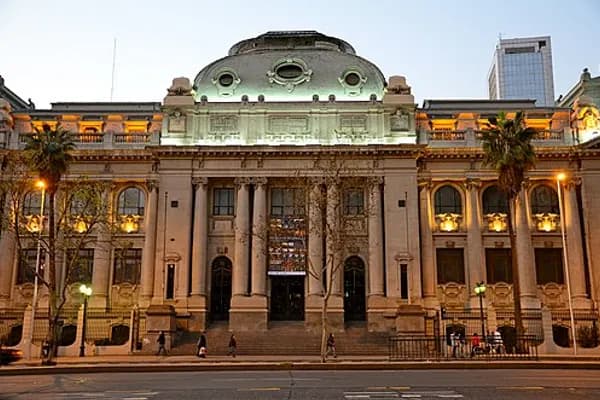
Although institutions like the Instituto Nacional and the National Library were established during the Patria Vieja, they were shut down after the patriots’ defeat at the Battle of Rancagua in 1814. The royal government continued until 1817, when the Army of the Andes emerged victorious at the Battle of Chacabuco and restored the patriot government in Santiago. However, independence was still uncertain. The Spanish army achieved further victories in 1818 and advanced toward Santiago, but their progress was finally halted at the Battle of Maipú on April 5, 1818, on the Maipo River plains.
With the end of the war, Bernardo O'Higgins was accepted as Supreme Director and, like his father, undertook several important projects for the city. During the Patria Nueva era, previously closed institutions were reopened. The General Cemetery was inaugurated, work on the San Carlos Canal was completed, and the drying riverbed in the south arm of the Mapocho River, known as La Cañada, which had been used as a landfill for some time, was transformed into an avenue now known as the Alameda de las Delicias.
Two earthquakes struck the city in the 19th century: one on November 19, 1822, and another on February 20, 1835. Despite these disasters, the city continued to grow rapidly. In 1820, the population was recorded as 46,000, but by 1854, it had risen to 69,018. By 1865, the census reported 115,337 residents. This significant increase was due to suburban expansion to the south and west of the capital, as well as the growth of the bustling district of La Chimba, which resulted from the division of old properties in the area. This new peripheral development marked the end of the previous checkerboard structure that had dominated the city center.
19th century
During the Republican era, several institutions were founded, including the University of Chile, the Normal School of Preceptors, the School of Arts and Crafts, and the Quinta Normal. The latter comprised the Museum of Fine Arts (now the Museum of Science and Technology) and the National Museum of Natural History. These institutions were established primarily for educational purposes, but also served as examples of public planning during that period. In 1851, the first telegraph system connecting the capital to the Port of Valparaíso was inaugurated.
During the "Liberal Republic" and the administration of Mayor Benjamín Vicuña Mackenna, a new phase in the urban development of the capital was initiated. One of the main projects during this period was the remodeling of Cerro Santa Lucía, which had fallen into disrepair despite its central location. In his effort to transform Santiago, Vicuña Mackenna initiated the construction of the Camino de Cintura, a road surrounding the entire city. The redevelopment of Alameda Avenue also took place during this time, turning it into the city's main road.
Also during this era, O'Higgins Park was established with the help of European landscapers in 1873. The public park, known for its large gardens, lakes, and carriage trails, became a landmark in Santiago. Other notable structures were also opened during this period, including the Teatro Municipal opera house and the Club Hípico de Santiago. In addition, the 1875 International Exposition was held in the Quinta Normal grounds.
Encyclopedic content adapted from the Wikipedia article on Bellavista, used under CC BY-SA 4.0.