About the neighborhood
Island in the Lake Mälaren in Stockholm, Sweden
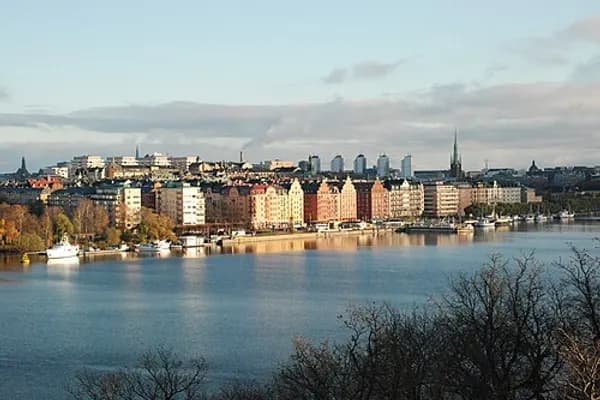
Kungsholmen is an island in Lake Mälaren in Sweden, part of central Stockholm, Sweden. It is situated north of Riddarfjärden and considered part of the historical province Uppland. Its area is 3.9km (1.5sqmi) with a perimeter of 8.9km (5.5mi). The highest point is at Stadshagsplan at 47 metres (154ft). The total population is 71,542 (December 31, 2020).
Administratively, it is subdivided into the five districts Kungsholmen, Marieberg, Fredhäll, Kristineberg and Stadshagen.
History
Establishment
Franciscan friars from the Grey Friar's Abbey, Stockholm, began living on the island in the 15th century. Because of this, the island was named Munklägret (the Monks' encampment). The monks subsisted on cattle-breeding and fishing. They also managed the brickyard Själakoret at Rålambshov. As a result of the Swedish Reformation, which was concluded at the parliament in Västerås 1527, the monks were expelled and the area became property of the crown.
At the end of the 16th century, Johan III (son of Gustav Vasa) established an additional brickyard on the northern bank of the island. In 1635 the first bridge to Munklägret was built.
A few years later Queen Kristina donated large areas of land in the western part of the island to some of the generals from the Thirty Years War. They built magnificent entails and laid out great gardens. 1644 the crown donated the eastern part of Munklägret to the authorities of the city of Stockholm, which then received its first city plan. Three years later the remainder of the island was donated.
In order to facilitate migration to Munklägret, privileges were given to artisans and manufacturers. For example, they were allowed to set up operations there without having to belong to the guilds and they were exempted from tax for ten years. In 1672 Munklägret became a separate parish (Kungsholmen) and the whole island was renamed Kungsholmen, meaning King's Island in Swedish.
Industrialization
When the Swedish Empire collapsed in the beginning of the 18th century the crown embarked on a generous economic policy to develop Kungsholmen, which was then largely empty of buildings. The entails were turned into factories and hospitals. In Hornsberg a cotton mill was established, at Marieberg a porcelain factory. In the early 19th century the military began to settle in Kungsholmen, which at the time was still a sparsely populated idyll.
When Samuel Owen settled in Kungsholmen, it had begun developing into a marked district of factories and workers. This development was accentuated when the Bolinder brothers started building up their business at Klara Sjö, west of the Kungsbron, (King's Bridge) in the mid-19th century. The company AB Separator was established at the end of the 19th century. AB Separator would soon become a worldwide group of companies and at the beginning of the 20th century had more than 2,000 employees.
The industrial breakthrough led to a huge population explosion. The population grew from just over 4,000 people in 1860 to 26,000 in 1890. During the 1880s several apartment blocks were built to remedy the housing shortage.
Modern Kungsholmen
In the early 20th century a radical structural change took place on Kungsholmen. The remnants of the old industrial district were swept away and replaced by housing and public institutions. St. Görans church was designed by architect Gustaf Améen (1864–1949) and built in 1910. At the division of the Kungsholmen parish in 1925, the new parish was named after the church.
The residential areas in Fredhäll and in Kristineberg were built in the 1930s after a functionalist city plan. The bridges Västerbron and Tranebergsbron were also built the same decade, and Sankt Eriksbron received its current dimensions. The Stockholm metro was drawn through Kungsholmen in the 1950s, first out to Vällingby and later also another line to Solna, Sundbyberg and Järvafältet. At this time the military moved out and the large hospital Serafen was supplanted (on another location) by the more modern Saint Göran Hospital.
Panorama of Kungsholmen, southern shore with the City Hall on the far right. Prominent buildings and structures
Saint Göran Hospital (Swedish: Sankt Görans sjukhus), one of Sweden's oldest hospitals.
Stockholm City Hall, built 1911–1923.
Stockholm Court House from 1909–1915.
Kristineberg Palace from around 1750.
DN-Skrapan, completed in 1964.
Rådhuset metro station, opened in 1975.
Bridges leading to Kungsholmen
From Norrmalm: Stadshusbron
Klarabergsviadukten
Kungsbron
Blekholmsbron
Barnhusbron
Sankt Eriksbron
From Solna: Ekelundsbron
From Bromma: Tranebergsbron
From Lilla Essingen: Mariebergsbron
Fredhällsbron (part of the Essingeleden motorway.)
From Södermalm: Västerbron
See also
Geography of Stockholm
History of Stockholm
Wikivoyage has a travel guide for Kungsholmen.
References
59°20′N 18°2′E / 59.333°N 18.033°E / 59.333; 18.033
Encyclopedic content adapted from the Wikipedia article on Kungsholmen, used under CC BY-SA 4.0.
What makes Kungsholmen special
Kungsholmen stands out among Stockholm’s neighborhoods for its distinctive character: waterfront living, quieter side. Ranked #5 in Stockholm, it offers the kind of experience that defines a great city trip — a place where the streets themselves tell a story and every block rewards curiosity.
Best for
Our take on Kungsholmen
Kungsholmen occupies a distinctive place in Stockholm's neighborhood landscape. It is the kind of district that rewards travelers who venture beyond the obvious choices — quieter than the tourist-facing areas, richer in local character, and full of the small details that make a city trip memorable.
The waterfront presence in Kungsholmen shapes everything about the neighborhood's character — the light, the air, the pace of life, the kind of restaurants that thrive here. But what elevates it beyond a simple beach district is the depth of the neighborhood behind the waterfront: the residential streets, the local markets, the café culture that exists independent of the views.
Our editors recommend budgeting at least half a day here — enough time to walk the main streets, sit down for coffee, and discover the side streets where Kungsholmen's real character lives.
Living in Kungsholmen
Kungsholmen is connected to the rest of Stockholm by public transit, and most visitors find it straightforward to reach from the city center or airport. Once you arrive, the neighborhood is best explored on foot — the scale is human and the streets reward wandering.
This is a neighborhood with strong residential roots, which means the infrastructure of daily life is well-established: grocery stores, pharmacies, parks, playgrounds, and the kind of quiet side streets where children play and neighbors greet each other. For visitors, this translates into a feeling of safety and belonging that more tourist-oriented districts rarely provide.
Accommodation in Kungsholmen ranges from boutique hotels to short-term rentals. We generally recommend staying within the neighborhood itself rather than commuting from a hotel elsewhere in Stockholm — the experience of waking up inside a great neighborhood is fundamentally different from visiting one as a day trip.
What locals say about Kungsholmen
Long-term residents of Kungsholmen tend to describe their neighborhood with a mix of pride and protectiveness. Like any district with genuine character, Kungsholmen inspires loyalty — the kind of place people move to and never quite leave, or leave and spend years trying to get back to.
What locals appreciate most about Kungsholmen is its consistency — the feeling that the neighborhood works the same way on a Tuesday morning as it does on a Saturday night. It is not a place that performs for visitors and then goes quiet. The rhythm is genuine, the community is real, and the daily experience of living here is what draws people and keeps them.
Compared to the more famous districts in Stockholm, Kungsholmen has maintained a lower profile, which many residents consider an advantage. The neighborhood evolves gradually rather than being reshaped by sudden attention, and the result is a community that still feels organic rather than curated.
Visitor tips
- Kungsholmen is located in Stockholm, Sweden. The neighborhood is accessible by public transport, taxi, or rideshare from most parts of the city.
- Morning is often the best time to explore — the streets are quieter, the light is better for photography, and cafes are at their most welcoming.
- Wear comfortable walking shoes — the best way to experience Kungsholmen is on foot, wandering the side streets and discovering what lies around each corner.
- Save the neighborhood's location on your phone before you arrive. Offline maps are especially useful for navigating the smaller side streets.