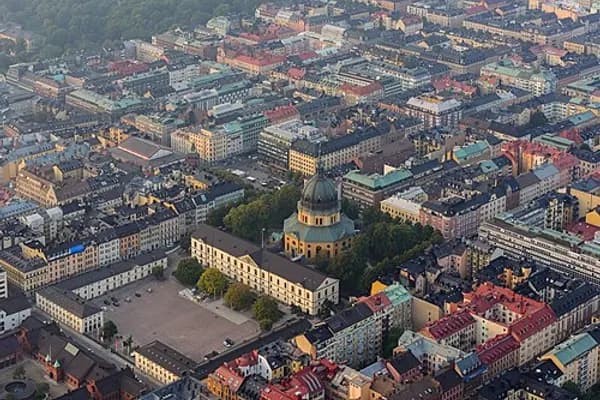
About the neighborhood
District Stockholm, Sweden
Östermalm (Swedish pronunciation: œstɛrˈmalm; lit.'Eastern city-borough') is a 2.56km large district in central Stockholm, Sweden. With 71,802 inhabitants, it is one of Sweden's most populous and exclusive districts. It is an extremely expensive area, having the highest housing prices in Sweden.
History
During the reign of the ruler of all of Scandinavia, king Eric of Pomerania in the early 15th century, a royal cowshed/barn was erected on the lands of the village Vädla. Since the town of Stockholm had grown and started to encroach on the borders of that village, there were many complaints about animals causing damage in the town. In the 17th century, the inhabitants of Stockholm were allowed to keep their cattle there. In 1639, parts of the allocated land for the cowshed/barn were put up for development. In 1672 the eastern part became a military exercise field. For the following 200 years, it was the home of some higher officers, but most inhabitants were poor.
A new town plan presented around 1880 implied a grid of streets and avenues that was to become lined with elegant houses, with 4–6 floors. When the plan was implemented, it ended the rustic appearance of the district. The old official name "Ladugårdslandet" (literal meaning "The Barn Land") was replaced with "Östermalm" (literal meaning Eastern Outer City). Since the Crown had been the owner of parts of the district for centuries, a number of official buildings, museums and higher public educational institutions were located in the area. In the 20th century, a large number of embassies, including those of America, Britain, France, Germany, Poland, Thailand, Norway and Malaysia were established in Östermalm.
The Berwaldhallen (1979), home of both the Swedish Radio Symphony Orchestra and the Swedish Radio Choir, is situated on Dag Hammarskjölds väg, Östermalm.
Sites of interest
Buildings
Berwaldhallen
Embassy of the United Kingdom
Engelbrekt Church
Kaknästornet
KTH Royal Institute of Technology
Maritime Museum
National Library of Sweden
Royal Dramatic Theatre, Dramaten
Sophiahemmet
Stockholm Olympic Stadium
Stockholms tekniska gymnasium
St Peter and St Sigfrid's Church, also known as the English Church in Stockholm
Swedish Armed Forces Headquarters
Neighbourhoods
Diplomatstaden
Eriksberg
Lärkstaden
Nedre Östermalm
Villastaden
Övre Östermalm
Railway stations
Karlaplan: metro 13
Stadion: metro 14
Stockholm Östra/Tekniska Högskolan: suburban railway 27, 28, 29 (Roslagsbanan) and metro 14
Östermalmstorg: metro 13, 14
Parks
Gustav Adolfsparken
Humlegården
Stureparken
Spiltan
Tessinparken
Berzelii Park
Nobelparken
See also
Wikimedia Commons has media related to Stockholm-Östermalm.
Wikivoyage has a travel guide for Östermalm.
Geography of Stockholm
References
59°20′15″N 18°05′20″E / 59.33750°N 18.08889°E / 59.33750; 18.08889
Encyclopedic content adapted from the Wikipedia article on Östermalm, used under CC BY-SA 4.0.
What makes Östermalm special
Östermalm stands out among Stockholm’s neighborhoods for its distinctive character: stockholm at its most luxurious. Ranked #3 in Stockholm, it offers the kind of experience that defines a great city trip — a place where the streets themselves tell a story and every block rewards curiosity.
Best for
Our take on Östermalm
Östermalm is one of the strongest neighborhoods in Stockholm, and it consistently appears in our editors' personal favorites lists. It may not always get the same attention as the city's most famous district, but among travelers who know Stockholm well, Östermalm is often the first recommendation.
What makes Östermalm worth the visit is the texture of daily life here. It is a neighborhood that functions for the people who live in it — not just for the visitors who pass through. The shops serve local needs, the restaurants feed local appetites, and the streets have a rhythm that reflects genuine community rather than tourism infrastructure. That is the quality our editors prize most, and Östermalm has it in abundance.
Our editors recommend budgeting at least half a day here — enough time to walk the main streets, sit down for coffee, and discover the side streets where Östermalm's real character lives.
Living in Östermalm
Östermalm is connected to the rest of Stockholm by public transit, and most visitors find it straightforward to reach from the city center or airport. Once you arrive, the neighborhood is best explored on foot — the scale is human and the streets reward wandering.
Day-to-day life in Östermalm has the rhythm of a genuine residential neighborhood. You will find grocery stores, pharmacies, cafés with morning regulars, and the kind of small independent shops that only survive where locals support them. For visitors, this means the infrastructure you need — good coffee, a decent meal, a quiet place to sit — is always within a short walk.
Accommodation in Östermalm ranges from boutique hotels to short-term rentals. We generally recommend staying within the neighborhood itself rather than commuting from a hotel elsewhere in Stockholm — the experience of waking up inside a great neighborhood is fundamentally different from visiting one as a day trip.
What locals say about Östermalm
Long-term residents of Östermalm tend to describe their neighborhood with a mix of pride and protectiveness. Like any district with genuine character, Östermalm inspires loyalty — the kind of place people move to and never quite leave, or leave and spend years trying to get back to.
What locals appreciate most about Östermalm is its consistency — the feeling that the neighborhood works the same way on a Tuesday morning as it does on a Saturday night. It is not a place that performs for visitors and then goes quiet. The rhythm is genuine, the community is real, and the daily experience of living here is what draws people and keeps them.
Compared to the more famous districts in Stockholm, Östermalm has maintained a lower profile, which many residents consider an advantage. The neighborhood evolves gradually rather than being reshaped by sudden attention, and the result is a community that still feels organic rather than curated.
Visitor tips
- Östermalm is located in Stockholm, Sweden. The neighborhood is accessible by public transport, taxi, or rideshare from most parts of the city.
- Morning is often the best time to explore — the streets are quieter, the light is better for photography, and cafes are at their most welcoming.
- Wear comfortable walking shoes — the best way to experience Östermalm is on foot, wandering the side streets and discovering what lies around each corner.
- Save the neighborhood's location on your phone before you arrive. Offline maps are especially useful for navigating the smaller side streets.