About the neighborhood
Capital and largest city of Hungary
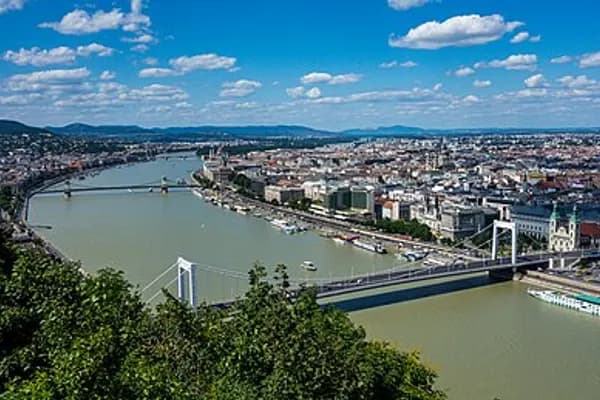
Budapest is the capital and most populous city of Hungary. It is Hungary's primate city with 1.7 million inhabitants and its greater metro area has a population of about 3.3 million, representing one-third of the country's population and producing above 40% of the country's economic output. Budapest is the political, economic, and cultural center of the country, among the ten largest cities in the European Union and the second largest urban area in Central and Eastern Europe. Budapest stands on the River Danube and is strategically located at the center of the Pannonian Basin, lying on ancient trade routes linking the hills of Transdanubia with the Great Plain.
Budapest is a global city, consistently ranked among the 50 most important cities in the world, belongs to the narrow group of cities with a GDP over US$120 billion, was named a global cultural capital as having high-quality human capital, and is among the 35 most liveable cities in the world. The city is home to over 30 universities with more than 150,000 students, most of them attending large public research universities that are highly ranked worldwide in their fields, such as Eötvös Loránd University in natural sciences, Budapest University of Technology in engineering and technology, MATE in life sciences, and Semmelweis University in medicine. Budapest also hosts various international organizations, including several UN agencies, the WHO Budapest Centre, IOM regional centre, the EU headquarters of EIT and CEPOL, as well as the first foreign office of China Investment Agency. Budapest opened the first underground transit line on the European continent in 1896, which is still in use as M1 Millennium Underground, and today the fixed-track metro and tram network forms the backbone of Budapest's public transport system and transports 2.2 million people daily, making it a significant urban transit system.
The history of Budapest began with an early Celtic settlement transformed by the Romans into the town of Aquincum, capital of Lower Pannonia in the 1st century. Following the foundation of Hungary in the late 9th century, the area was pillaged by the Mongols in 1241. It became royal seat in 1361, with Buda becoming one of the European centers of renaissance culture by the 15th century under Matthias Corvinus. The siege of Buda in 1541 was followed by nearly 150 years of Ottoman rule, and after the reconquest of Buda in 1686, the region entered a new age of prosperity, with Pest-Buda becoming a global city after the unification of Buda, Pest and Óbuda in 1873. By this time, Budapest had become the co-capital of the Austro-Hungarian Empire, a great power that dissolved in 1918 following World War I. The city was also the focal point of the Hungarian Revolution of 1848, Battle of Budapest in 1945, and Hungarian Revolution of 1956.
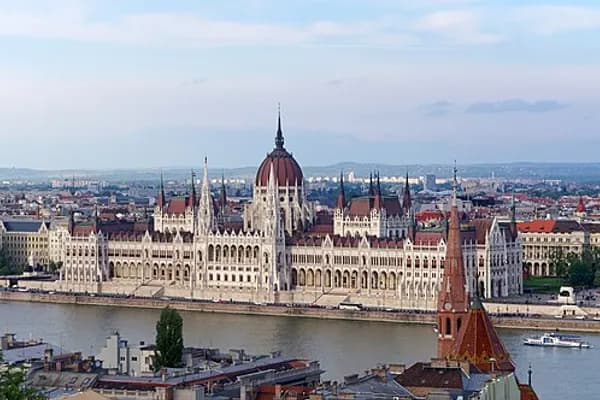
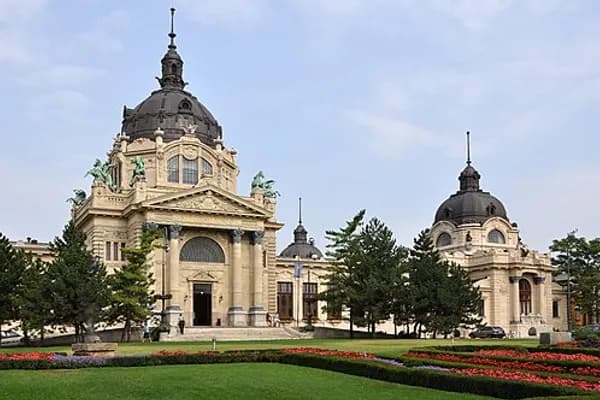
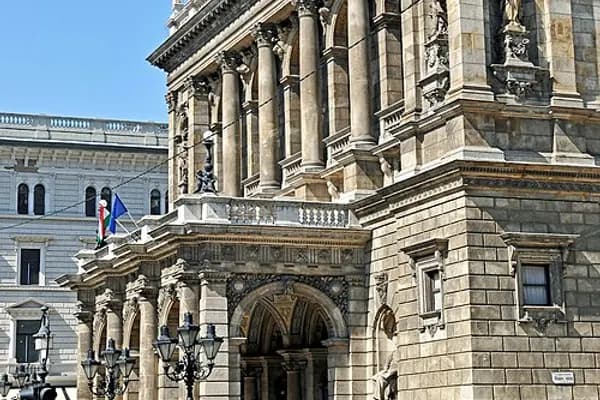
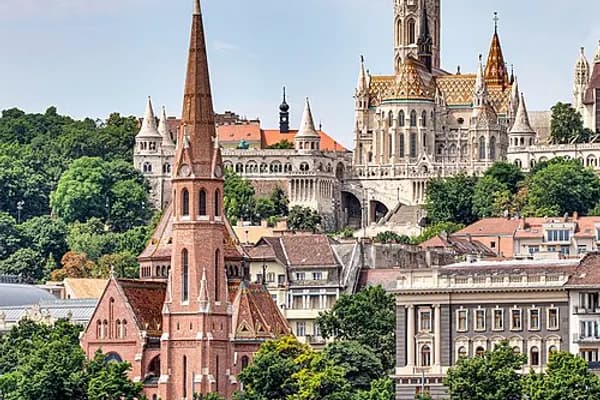
The historic center of Budapest along the Danube is classified as a World Heritage Site due to its numerous notable monuments of classical architecture, from the 13th-century Matthias Church to 19th-century landmarks such as Hungarian Parliament, State Opera House, the Museum of Fine Arts and St. Stephen's Basilica. Budapest has been a popular spa destination since Roman times and is considered the spa capital of Europe, with more than 100 medicinal geothermal springs and the largest thermal water cave system. The city is home to the second-largest synagogue and third-largest parliament building in the world, over 40 museums and galleries, nearly ten Michelin-starred restaurants, and named among the 50 best food cities globally for its focus on distinctive Hungarian cuisine. Budapest is also renowned for its nightlife, with ruin bars playing a significant role in it, moreover the city has become a center for Hollywood film production in recent years. Budapest regularly hosts major global sporting events, with the practically 70,000-seat Puskás Aréna serving as one of the venues, which hosted most recently the 2023 UEFA Europa League final, 2020 UEFA Super Cup, will host 2026 UEFA Champions League final and city hosted the 2023 World Athletics Championships, 2017 and 2022 World Aquatics Championships. Budapest attracted 6 million international overnight visitors in 2024, making it one of the most popular destinations in Europe.
Etymology and pronunciation
The previously separate cities of Buda, Óbuda, and Pest were officially unified in 1873 and given the new name Budapest. Before this, the towns together had sometimes been referred to colloquially as "Pest-Buda". Pest is often used pars pro toto for the entire city in contemporary colloquial Hungarian, although it is also used to refer to all parts of the city east of the Danube. Conversely, Buda colloquially means all districts to the Danube's west—including the former Óbuda. The Danube islands—including Csepel, the city's XXI. district—are part of neither Buda nor Pest.
All varieties of English pronounce the -s- as in the English word pest. The -u in Buda- is pronounced either /u/ like food (as in US: /ˈbuːdəpɛst/) or /ju/ like cue (as in UK: /ˌb(j)uːdəˈpɛst, ˌbʊd-, ˈb(j)uːdəpɛst, ˈbʊd-/). In Hungarian, the -s- is pronounced /ʃ/ as in wash; in IPA: Hungarian: ˈbudɒpɛʃt .
The origins of the names "Buda" and "Pest" are obscure. Buda was
probably the name of the first constable of the fortress built on the Castle Hill in the 11th century
or a derivative of Bod or Bud, a personal name of Turkic origin, meaning 'twig'.
or a Slavic personal name, Buda, the short form of Budimír, Budivoj.
Linguistically, however, a German origin through the Slavic derivative вода (voda, water) is not possible, and there is no certainty that a Turkic word really comes from the word buta ~ buda 'branch, twig'.
According to a legend recorded in chronicles from the Middle Ages, "Buda" comes from the name of its founder, Bleda, brother of Hunnic ruler Attila.
Attila went in the city of Sicambria in Pannonia, where he killed Buda, his brother, and he threw his corpse into the Danube. For while Attila was in the west, his brother crossed the boundaries in his reign, because he named Sicambria after his own name Buda's Castle. And though King Attila forbade the Huns and the other peoples to call that city Buda's Castle, but he called it Attila's Capital, the Germans who were terrified by the prohibition named the city as Eccylburg, which means Attila Castle, however, the Hungarians did not care about the ban and call it Óbuda [Old Buda] and call it to this day.
—Mark of Kalt: Chronicon Pictum
The Scythians are certainly an ancient people and the strength of Scythia lies in the east, as we said above. And the first king of Scythia was Magog, son of Japhet, and his people were called Magyars after their King Magog, from whose royal line the most renowned and mighty King Attila descended, who, in the 451st year of Our Lord's birth, coming down from Scythia, entered Pannonia with a mighty force and, putting the Romans to flight, took the realm and made a royal residence for himself beside the Danube above the hot springs, and he ordered all the old buildings that he found there to be restored and he built them in a circular and very strong wall that in the Hungarian language is now called Budavár [Buda Castle] and by the Germans Etzelburg [Attila Castle]
—Anonymus: Gesta Hungarorum
There are several theories about Pest. One states that the name derives from Roman times, since there was a local fortress (Contra-Aquincum) called by Ptolemy "Pession" ("Πέσσιον", iii.7.§2). Another has it that Pest originates in the Slavic word for cave, пещера, or peštera. A third cites пещ, or pešt, referencing a cave where fires burned or a limekiln.
History
Early history
The first settlement on the territory of Budapest was built by Celts before 1AD. It was later occupied by the Romans. The Roman settlement – Aquincum – became the main city of Pannonia Inferior in 106AD. At first, it was a military settlement, and gradually the city rose around it, making it the focal point of the city's commercial life. Today, this area corresponds to the Óbuda district within Budapest. The Romans constructed roads, amphitheaters, baths and houses with heated floors in this fortified military camp. The Roman city of Aquincum is the best-conserved of the Roman sites in Hungary. The archaeological site was turned into a museum with indoor and open-air sections. Meanwhile, settlement in the area east of the Danube, which was not part of the Roman Empire, remained Germanic and Sarmatian in character.
The Magyar tribes led by Árpád, forced out of their original homeland north of Bulgaria by Tsar Simeon after the Battle of Southern Buh, settled in the territory at the end of the 9th century displacing the founding Bulgarian settlers of the towns of Buda and Pest, and a century later officially founded the Kingdom of Hungary. Research places the probable residence of the Árpáds as an early place of central power near what became Budapest. The Mongol invasion in the 13th century quickly proved it is difficult to defend a plain. King Béla IV of Hungary, therefore, ordered the construction of reinforced stone walls around the towns and set his own royal palace on the top of the protecting hills of Buda. German settlers were invited to rebuild and inhabit both Buda and Pest. In 1361 it became the capital of Hungary.
The cultural role of Buda was particularly significant during the reign of King Matthias Corvinus. The Italian Renaissance had a great influence on the city. His library, the Bibliotheca Corviniana, was Europe's greatest collection of historical chronicles and philosophic and scientific works in the 15th century, and second in size only to the Vatican Library. After the foundation of the first Hungarian university in Pécs in 1367 (University of Pécs), the second one was established in Óbuda in 1395 (University of Óbuda). The first Hungarian book was printed in Buda in 1473. Buda had about 5,000 inhabitants around the year 1500.
The Ottomans conquered Buda in 1526, as well as in 1529, and finally occupied it in 1541. The Ottoman Rule lasted for more than 150 years. The Ottoman Turks constructed many prominent bathing facilities within the city. Some of the baths that the Turks erected during their rule are still in use 500 years later, including Rudas Baths and Király Baths. By 1547 the number of Christians was down to about a thousand, and by 1647 it had fallen to only about seventy. The unoccupied western part of the country became part of the Habsburg monarchy as Royal Hungary.
In 1686, two years after the unsuccessful siege of Buda, a renewed campaign was started to enter Buda. This time, the Holy League's army was twice as large, containing over 74,000 men, including German, Croat, Dutch, Hungarian, English, Spanish, Czech, Italian, French, Burgundian, Danish and Swedish soldiers, along with other Europeans as volunteers, artillerymen, and officers. The Christian forces seized Buda, and in the next few years, all of the former Hungarian lands, except areas near Temesvár (Timișoara), were taken from the Turks. In the 1699 Treaty of Karlowitz, these territorial changes were officially recognized as the end of the rule of the Turks, and in 1718 the entire Kingdom of Hungary was removed from Ottoman rule.
Contemporary history after Unification
The 19th century was dominated by the Hungarian struggle for independence and modernisation. The national insurrection against the Habsburgs began in the Hungarian capital in 1848 and was defeated one and a half years later, with the help of the Russian Empire. 1867 was the year of Reconciliation that brought about the birth of Austria-Hungary. This made Budapest the twin capital of a dual monarchy. It was this compromise which opened the second great phase of development in the history of Budapest, lasting until World War I. In 1849, the Chain Bridge linking Buda with Pest was opened as the first permanent bridge across the Danube and in 1873 Buda and Pest were officially merged with the third part, Óbuda (Old Buda), thus creating the new metropolis of Budapest. The dynamic Pest grew into the country's administrative, political, economic, trade and cultural hub. Ethnic Hungarians overtook Germans in the second half of the 19th century due to mass migration from the overpopulated rural Transdanubia and Great Hungarian Plain. Between 1851 and 1910 the proportion of Hungarians increased from 35.6% to 85.9%, Hungarian became the dominant language, and German was crowded out. The proportion of Jews peaked in 1900 with 23.6%. Due to the prosperity and the large Jewish community of the city at the start of the 20th century, Budapest was often called the "Jewish Mecca" or "Judapest". Budapest also became an important center for the Aromanian diaspora during the 19th century. In 1918, Austria-Hungary lost the war and collapsed; Hungary declared itself an independent republic (Republic of Hungary). On the 4th of August, 1919, the Romanian Army occupied Budapest, marking the end of the Hungarian-Romanian War. In 1920 the Treaty of Trianon partitioned the country, and as a result, Hungary lost over two-thirds of its territory, and about two-thirds of its inhabitants, including 3.3million out of 15 million ethnic Hungarians.
In 1944, a year before the end of World War II, Budapest was partly destroyed by British and American air raids (first attack 4 April 1944). From 24 December 1944 to 13 February 1945, the city was besieged during the Battle of Budapest. Budapest sustained major damage caused by the attacking Soviet and Romanian troops and the defending German and Hungarian troops. More than 38,000 civilians died during the conflict. All bridges were destroyed by the Germans. The stone lions that have decorated the Chain Bridge since 1852 survived the devastation of the war.
Between 20% and 40% of Greater Budapest's 250,000 Jewish inhabitants died through Nazi and Arrow Cross Party, during the German occupation of Hungary, from 1944 to early 1945.
Swiss diplomat Carl Lutz rescued tens of thousands of Jews by issuing Swiss protection papers and designating numerous buildings, including the now famous Glass House (Üvegház) at Vadász Street 29, to be Swiss protected territory. About 3,000 Hungarian Jews found refuge at the Glass House and in a neighboring building. Swedish diplomat Raoul Wallenberg saved the lives of tens of thousands of Jews in Budapest by giving them Swedish protection papers and taking them under his consular protection. Wallenberg was abducted by the Russians on 17 January 1945 and never regained freedom. Giorgio Perlasca, an Italian citizen, saved thousands of Hungarian Jews posing as a Spanish diplomat. Some other diplomats also abandoned diplomatic protocol and rescued Jews. There are two monuments for Wallenberg, one for Carl Lutz and one for Giorgio Perlasca in Budapest.
Encyclopedic content adapted from the Wikipedia article on Jewish Quarter, used under CC BY-SA 4.0.