About the neighborhood
District of Budapest in Central Hungary, Hungary
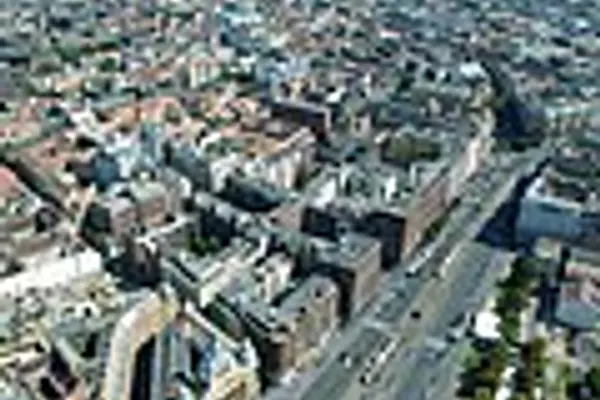
Erzsébetváros (Hungarian pronunciation: ˈɛrʒeːbɛtvaːroʃ; German: Elisabethstadt, lit. Elizabethtown) is the 7th district of Budapest, situated on the Pest side of the Danube. The inner half of the district was the historic Jewish quarter of Pest. The Dohány Street Synagogue, the largest functioning synagogue in Europe, is located in this district. Currently it is the most densely populated district of Budapest with 23,630 inhabitants per km.
Name
Erzsébetváros was named on 17 January 1882 after Queen Elisabeth (a.k.a. "The Empress Sissi"), the popular consort of Emperor of Austria and King of Hungary Franz Joseph I of the Habsburg Empire.
Until the unification of Budapest in 1873 this area was part of Terézváros. Between 1873 and 1882 it was named District VII without name.
History
In 1910 Erzsébetváros had 152,454 inhabitants. During the socialist era Erzsébetváros's population decreased rapidly, because young people and families moved to the newer "panelized" boom districts (Újpest, Újbuda, Óbuda, Kispest etc.). Gentrification and recovery started in the middle of the 2000s.
Demographics
Source: KSH Politics
The current mayor of VII. District of Budapest is Péter Niedermüller (DK).
The District Assembly, elected at the 2019 local government elections, is made up of 15 members (1 Mayor, 10 Individual constituencies MEPs and 4 Compensation List MEPs) divided into this political parties and alliances:
List of mayors
Twin towns – sister cities
Erzsébetváros is twinned with:
Karlovac, Croatia
Nevers, France
Požega, Croatia
Safed, Israel
Stari Grad (Belgrade), Serbia
Stavroupoli, Greece
Sveti Vlas (Nesebar), Bulgaria
Gheorgheni, Romania
Comrat, Moldova
See also
Gozsdu-udvar
List of districts in Budapest
Gallery
Notes
References
External links
Aerial photographs of Erzsébetváros
The old jewish quarter of Pest
Districts I. Várkerület
II. 2nd district
III. Óbuda-Békásmegyer
IV. Újpest
V. Belváros-Lipótváros
VI. Terézváros
VII. Erzsébetváros
VIII. Józsefváros
IX. Ferencváros
X. Kőbánya
XI. Újbuda
XII. Hegyvidék
XIII. 13th district
XIV. Zugló
XV. 15th district
XVI. 16th district
XVII. Rákosmente
XVIII. Pestszentlőrinc-Pestszentimre
XIX. Kispest
XX. Pesterzsébet
XXI. Csepel
XXII. Budafok-Tétény
XXIII. Soroksár
Events and traditions Budapest Fashion Week
Budapest Fringe Festival
Budapest Spring Festival
Budapest Opera Ball
Café Budapest Contemporary Arts Festival
Hungarian Cuisine
Hungarian National Ballet
LOW Festival
Sziget Festival
Universities Budapest Business School
Budapest University of Technology
Corvinus University
Eötvös Loránd University
Hungarian University of Fine Arts
Liszt Ferenc Academy of Music
Moholy-Nagy University of Art and Design
National University of Public Service
Óbuda University
Semmelweis University
University of Physical Education
Academy of Drama and Film
Andrássy University
Aquincum Institute of Technology
Budapest Metropolitan University
Budapest University of Jewish Studies
Central European University
International Business School
Károli Gáspár University of Reformed Church
Pázmány Péter Catholic University
Economy Budapest Stock Exchange
Economy of Budapest
List of companies based in Budapest
Budapest Metropolitan Area
Transport Budapest Ferenc Liszt International Airport
Budapest Metro
Budapest Tram Network
Budapest Commuter Railway
BuBi Bicycle
M0 Ring Road
Eastern railway station
Western railway station
Southern railway station
History of Budapest
Category
Wikimedia Commons has media related to Budapest District VII.
Encyclopedic content adapted from the Wikipedia article on Erzsébetváros, used under CC BY-SA 4.0.
What makes Erzsébetváros special
Erzsébetváros stands out among Budapest’s neighborhoods for its distinctive character: the beating nightlife heart of pest. Ranked #4 in Budapest, it offers the kind of experience that defines a great city trip — a place where the streets themselves tell a story and every block rewards curiosity.
Best for
Our take on Erzsébetváros
Erzsébetváros occupies a distinctive place in Budapest's neighborhood landscape. It is the kind of district that rewards travelers who venture beyond the obvious choices — quieter than the tourist-facing areas, richer in local character, and full of the small details that make a city trip memorable.
What strikes us most about Erzsébetváros is the depth of its food culture. This is not a neighborhood with a few good restaurants — it is a neighborhood where eating well is woven into daily life, where the corner places are as good as the destination spots, and where you could eat every meal for a week without repeating yourself or being disappointed.
Our editors recommend budgeting at least half a day here — enough time to walk the main streets, sit down for coffee, and discover the side streets where Erzsébetváros's real character lives.
Living in Erzsébetváros
Erzsébetváros is connected to the rest of Budapest by public transit, and most visitors find it straightforward to reach from the city center or airport. Once you arrive, the neighborhood is best explored on foot — the scale is human and the streets reward wandering.
The neighborhood transitions through distinct phases during the day. Mornings are quiet — coffee shops and bakeries set the pace. Afternoons bring more energy as the retail and café scene picks up. Evenings are when Erzsébetváros truly comes alive, with restaurants and bars filling steadily from around 7 PM onward. If you are staying in the neighborhood, embrace the rhythm rather than fighting it.
Accommodation in Erzsébetváros ranges from boutique hotels to short-term rentals. We generally recommend staying within the neighborhood itself rather than commuting from a hotel elsewhere in Budapest — the experience of waking up inside a great neighborhood is fundamentally different from visiting one as a day trip.
What locals say about Erzsébetváros
Long-term residents of Erzsébetváros tend to describe their neighborhood with a mix of pride and protectiveness. Like any district with genuine character, Erzsébetváros inspires loyalty — the kind of place people move to and never quite leave, or leave and spend years trying to get back to.
Residents value the neighborhood's evening energy but will quickly tell you that Erzsébetváros is more than its bars. The nightlife is an expression of the community, not a tourist attraction — locals know the bartenders by name, have their preferred corners, and treat the neighborhood's bars and restaurants as extensions of their living rooms.
Compared to the more famous districts in Budapest, Erzsébetváros has maintained a lower profile, which many residents consider an advantage. The neighborhood evolves gradually rather than being reshaped by sudden attention, and the result is a community that still feels organic rather than curated.
Visitor tips
- Erzsébetváros is located in Budapest, Hungary. The neighborhood is accessible by public transport, taxi, or rideshare from most parts of the city.
- The neighborhood comes alive in the evening. Plan to arrive after sunset to experience the best of the local bar and dining scene.
- Wear comfortable walking shoes — the best way to experience Erzsébetváros is on foot, wandering the side streets and discovering what lies around each corner.
- Save the neighborhood's location on your phone before you arrive. Offline maps are especially useful for navigating the smaller side streets.