About the neighborhood
1st District of Vienna in Austria
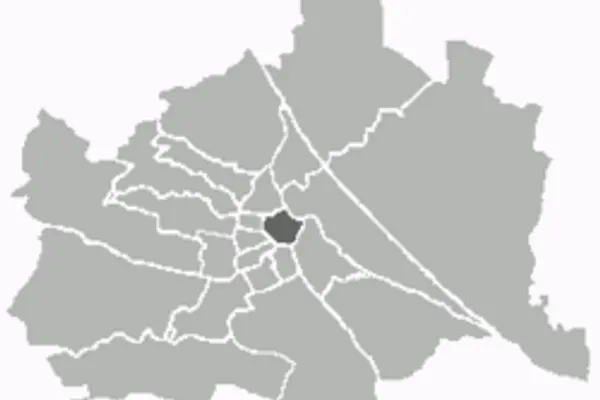
The Innere Stadt (German pronunciation: ˈɪnərə ˈʃtad ; Viennese: Innare Stod; "Inner City") is the 1st municipal district of Vienna (German: 1. Bezirk) located in the center of the Austrian capital. The Innere Stadt is the old town of Vienna. Until the city boundaries were expanded in 1850, the Innere Stadt was congruent with the city of Vienna. Traditionally it was divided into four quarters, which were designated after important town gates: Stubenviertel (northeast), Kärntner Viertel (southeast), Widmerviertel (southwest), Schottenviertel (northwest).
The Ringstraße circles the Innere Stadt along the route of the former city walls.
The first district is, with a workforce of 100,745, the largest employment locale in Vienna. This is partially due to tourism, as well as the presence of many corporate headquarters due to the district's central location.
Geography
Innere Stadt is the central district of Vienna. It borders Leopoldstadt in the northeast, Landstraße in the east, Wieden and Mariahilf in the south, Neubau and Josefstadt in the west, and Alsergrund in the north. The district border, starting at Urania, follows Wienfluss, Lothringerstraße, Karlsplatz, Gedreidemarkt, Museumsplatz, Museumstraße, Auerspergstraße, Landesgerichtsstraße, Universitätsstraße, Maria-Theresien-Straße and the Donaukanal.
History
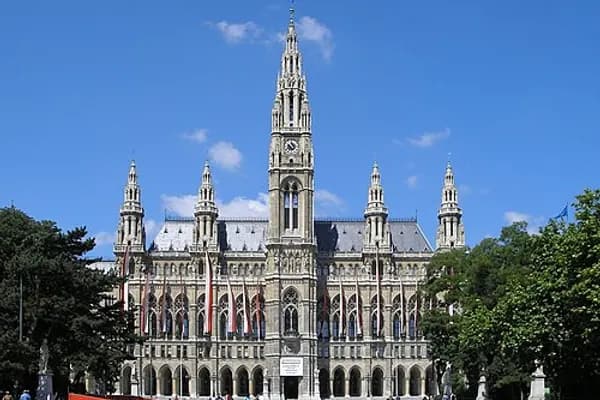
The origins of the Innere Stadt date back to a Celtic settlement and later Roman legionary camp of Vindobona and its canabae. Until the incorporation of the suburbs in 1850, Vienna's history was largely that of today's 1st district. The Innere Stadt remained the political, economic, and spiritual centre of the city, home to Vienna City Hall, the Hofburg Palace, the official residence of the president, and St. Stephen's Cathedral, the cathedral of the Archdiocese of Vienna.
Places of interest
Albertina
Burgtheater
Friedrich-Schmidt-Platz
Graben
Hofburg Imperial Palace
Kapuzinergruft
Kärntner Straße
Lutheran City Church
Museum of Art History
Museum of Natural History
Maria am Gestade Church
Palais Ephrussi
Pestsäule (a plague column)
Peterskirche
Rathaus, Vienna
Ruprechtskirche
Schottenstift
Stadtpark, Vienna
Stephansdom
Vienna State Opera
Virgilkapelle
Parliament Building
Palace of Justice
Main Building of the University of Vienna
Volksgarten
Demographics
Population has been declining ever since its peak of 73,000 in 1880, until it hit the lowest recorded value of 15,774 in 2025. Although population has been increasing slightly in early 2000s, Innere Stadt continues to remain the least populated district in Vienna.
In 2001, 28.1% of the district's population was over 60 years of age, above the city average of 22.2%. The percentage of people under 15 years of age was 9.8%. The female population of 53.3% was also above city average.
Origin and language
At 15.5%, the percentage of foreign residents in Innere Stadt was 2% under city average for the year 2001. 2.8% of the population had EU citizenship (Germany excluded), 2.7% were citizens of Serbia and Montenegro, and 2.2% were German citizens. In total, 25.6% of the population were born in a foreign country. 79% of residents listed German as their language of choice. 4.0% spoke primarily Serbian, 1.8% Hungarian, and 1.4% Croatian. 14.3% spoke other languages.
Religion
Roman Catholics made up 51.3% of the Innere Stadt population in 2001, followed by 6.6% Protestants, 5.1% Orthodox Christians, 3.3% Jews. 22.7% were listed as non-confessional.
Politics
The Bezirksvorsteher (district director) has been a member of the conservative ÖVP since 1946. Former Bezirksvorsteher Ursula Stenzel has spoken out against holding events in the city, citing concerns regarding noise pollution. Her comments have drawn criticism from other parties, especially the social democratic SPÖ.
Coat of arms
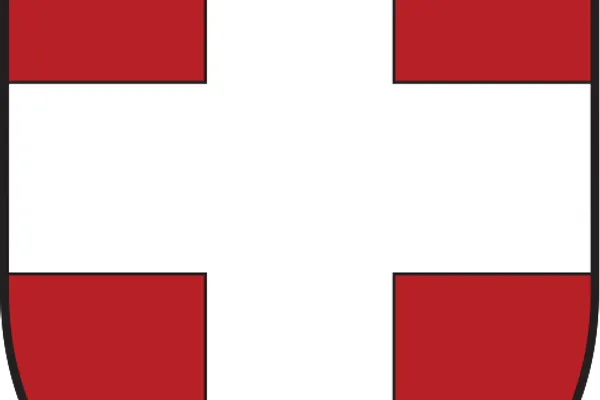
The first district's coat of arms is a white cross on a red background. It is also the coat of arms for the City of Vienna and the State of Vienna. The current coat of arms dates back to around 1270, when it first appeared on the minted "Wiener Pfennige" coins. It may have been based on the flag of the King of the Romans' forces during the Middle Ages, as the combat flag of Rudolph I of Germany featured a similar design.
Notes
References
"Wien - 1. Bezirk - Innere Stadt", Wien.gv.at, 2008, webpage (15 subpages): Wien.gv.at-innerestadt Archived 2010-09-01 at the Wayback Machine (in German).
Grabovszki, Ernst: Innere Stadt, Wien, 1. Bezirk. Verlag Sutton, Erfurt 2002, ISBN3-89702-467-5
External links
Wikivoyage has a travel guide for Vienna/Innere_Stadt.
Media related to Innere Stadt at Wikimedia Commons
(in German) History of Innere Stadt at the City of Vienna homepage.
(in English and French) UNESCO rationale for inclusion of Vienna inner district into world cultural heritage list.
(in German) General information about Innere Stadt from the Green party.
(in German) Historical core of Vienna
48°12′35″N 16°22′12″E / 48.20972°N 16.37000°E / 48.20972; 16.37000
Encyclopedic content adapted from the Wikipedia article on Innere Stadt, used under CC BY-SA 4.0.