About the neighborhood
Historic district in Georgia, United States
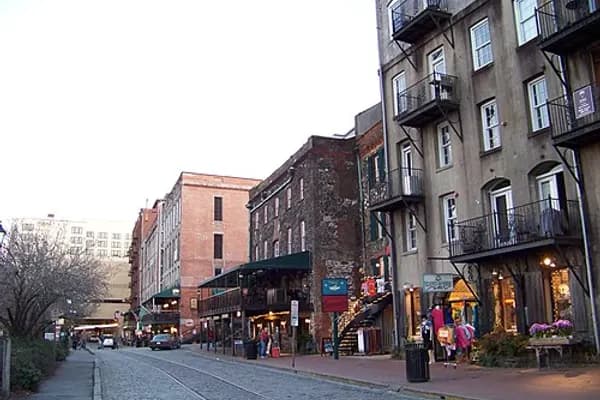
The Savannah Historic District is a large urban U.S. historic district that roughly corresponds to the preCivil War city limits of Savannah, Georgia. The area was declared a National Historic Landmark District in 1966, and is one of the largest urban, community-wide historic preservation districts in the United States. The district was established in recognition of the Oglethorpe Plan, a unique model of urban planning begun in 1733 by James Oglethorpe at Savannah's founding and propagated during the first century of the city's growth.
The plan of the historic portions of Savannah is based on the concept of a ward, as defined by Oglethorpe. Each ward had a central square, around which were arrayed four trust lots and four tythings. Each trust lot was to be used for a civic purpose, such as a school, government building, church, museum, or other public venue, while the tythings were each subdivided into ten lots for residential use. The wards were oriented in a rectilinear grid with north–south and east–west alignments. In a typical ward, the trust lots were set east and west of the square, and the residential lots of the tythings were extended north and south of the trust lots and the square, each tything divided into two rows of five lots and separated by alleys. In the early years of the Province of Georgia, the ward organization was in part military, with each ward's inhabitants organized into militia units, and the central squares acting as a gathering point for refugees from outside the city walls.
Each year, the Savannah Historic District attracts millions of visitors, who enjoy its eighteenth- and nineteenth-century architecture and green spaces. The district includes the birthplace of Juliette Gordon Low (founder of the Girl Scouts of the United States of America, see Juliette Gordon Low Historic District), the Telfair Academy of Arts and Sciences (one of the South's first public museums), the First African Baptist Church (the oldest African American Baptist congregation in the United States), Temple Mickve Israel (the third-oldest synagogue in America), the Central of Georgia Railway roundhouse complex (the oldest standing antebellum rail facility in America), Christ Church (the Mother Church of Georgia), the old Colonial Cemetery, Cathedral of St. John the Baptist, Old Harbor Light, and Factors Row, a line of former cotton warehouses, along its waterfront, some built from ships' ballast stones.
Other buildings in the district include the Isaiah Davenport House, the Green-Meldrim House, the Owens–Thomas House, the William Scarbrough House, the Sorrel–Weed House, and the United States Customhouse. Notable green spaces in the district include Savannah's 22 squares, the 30-acre Forsyth Park (at the southern limit of the district), and Emmet Park, part of The Strand, near the city's riverfront, in what was known as the Old Fort neighborhood.
See also
Buildings in Savannah Historic District
List of National Historic Landmarks in Georgia
National Register of Historic Places listings in Chatham County, Georgia
References
External links
Wikimedia Commons has media related to Savannah Historic District (Savannah, Georgia).
Rogers, Jerry L. (January 23, 1969). "Savannah Historic District: Nomination Form" (PDF). National Register of Historic Places. National Park Service via National Archives and Records Administration Catalog for Georgia.
Search for Savannah GA photosets here, at Historic American Buildings Survey
Official Savannah info regards the district
Encyclopedic content adapted from the Wikipedia article on Historic District, used under CC BY-SA 4.0.
What makes Historic District special
Historic District stands out among Savannah’s neighborhoods for its distinctive character: savannah's 22 famous squares. It tops our ranking of the best neighborhoods in Savannah, it offers the kind of experience that defines a great city trip — a place where the streets themselves tell a story and every block rewards curiosity.
Best for
Our take on Historic District
Historic District is the neighborhood we send friends to first when they visit Savannah. It earns the top spot in our ranking not because it is the most famous district in the city, but because it delivers the most complete neighborhood experience — the kind of place where every block rewards curiosity and every return visit reveals something new.
What makes Historic District worth the visit is the texture of daily life here. It is a neighborhood that functions for the people who live in it — not just for the visitors who pass through. The shops serve local needs, the restaurants feed local appetites, and the streets have a rhythm that reflects genuine community rather than tourism infrastructure. That is the quality our editors prize most, and Historic District has it in abundance.
Our editors recommend budgeting at least half a day here — enough time to walk the main streets, sit down for coffee, and discover the side streets where Historic District's real character lives.
Living in Historic District
Historic District is connected to the rest of Savannah by public transit, and most visitors find it straightforward to reach from the city center or airport. Once you arrive, the neighborhood is best explored on foot — the scale is human and the streets reward wandering.
Day-to-day life in Historic District has the rhythm of a genuine residential neighborhood. You will find grocery stores, pharmacies, cafés with morning regulars, and the kind of small independent shops that only survive where locals support them. For visitors, this means the infrastructure you need — good coffee, a decent meal, a quiet place to sit — is always within a short walk.
Accommodation in Historic District ranges from boutique hotels to short-term rentals. We generally recommend staying within the neighborhood itself rather than commuting from a hotel elsewhere in Savannah — the experience of waking up inside a great neighborhood is fundamentally different from visiting one as a day trip.
What locals say about Historic District
Long-term residents of Historic District tend to describe their neighborhood with a mix of pride and protectiveness. Like any district with genuine character, Historic District inspires loyalty — the kind of place people move to and never quite leave, or leave and spend years trying to get back to.
What locals appreciate most about Historic District is its consistency — the feeling that the neighborhood works the same way on a Tuesday morning as it does on a Saturday night. It is not a place that performs for visitors and then goes quiet. The rhythm is genuine, the community is real, and the daily experience of living here is what draws people and keeps them.
Like any neighborhood that has earned attention, Historic District is navigating the tension between popularity and preservation. Rents have risen, new businesses have arrived, and long-time residents occasionally grumble that the neighborhood is not what it was. But the fundamentals — the walkability, the food, the community — remain strong, and most locals we speak to believe the neighborhood is still gaining more than it is losing.
Visitor tips
- Historic District is located in Savannah, United States. The neighborhood is accessible by public transport, taxi, or rideshare from most parts of the city.
- Morning is often the best time to explore — the streets are quieter, the light is better for photography, and cafes are at their most welcoming.
- Wear comfortable walking shoes — the best way to experience Historic District is on foot, wandering the side streets and discovering what lies around each corner.
- Save the neighborhood's location on your phone before you arrive. Offline maps are especially useful for navigating the smaller side streets.