About the neighborhood
Public park in Savannah, Georgia
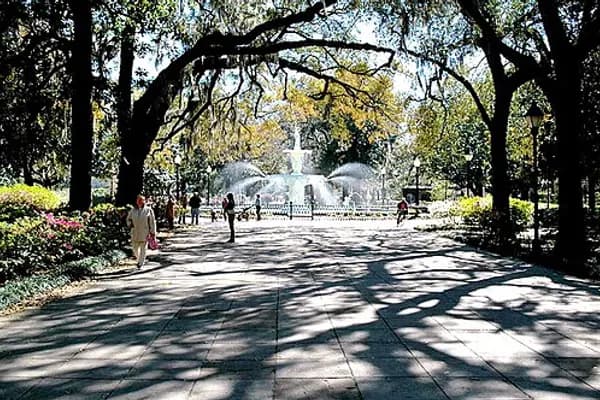
Forsyth Park (formerly known as Forsyth Place and Ward and the Military Parade Ground) is a large city park that occupies 30 acres (0.12km) in the historic district of Savannah, Georgia, United States. The park is bordered by Gaston Street to the north, Drayton Street to the east, Park Avenue to the south and Whitaker Street to the west. It contains walking paths, a children's play area, a Fragrant Garden for the blind, a large fountain, tennis courts, basketball courts, areas for soccer and Frisbee, and home field for Savannah Shamrocks Rugby Club. From time to time, there are concerts held at Forsyth to the benefit of the public.
Development
The park was originally created in the 1840s on 10 acres (0.04km) of land donated by William Brown Hodgson. In 1851, the park was expanded and named for Georgia Governor John Forsyth. By 1853, all original planned wards of Savannah were occupied. A large 18.9 acre Parade Ground was added south end of the park and sold to the Military Captains Association officially in 1859. Two ordinances, one in 1914 and the other in 1923, affirm this. The owners granted that the city use the land for public enjoyment, in exchange for property tax exemption and general maintenance and security of the land in perpetuity. This park was anticipated by General James Oglethorpe's plan and was made possible by a donation of 20 acres (81,000m) of land owned by Forsyth.
Regarding the Southern Extension Chain of Ownership:
On August 11, 1853, the Mayor and Aldermen of Savannah adopted an ordinance dedicating as a Military Parade Ground that portion of the 'Old Cantonment Area' with borders of Park, Montgomery, Gwinnett, Whitaker "that the control, custody, and management of the said Parade Ground shall be vested in the Captains for the time being, of the several Volunteer Companies of the City of Savannah, who shall have exclusive charge thereof, subject to Savannah police regulations.
On November 10, 1859 by an Act of Council of the City of Savannah, following an agreement with the Military Commanders, that property, the Military Parade Ground, formerly a part of the Old Cantonment, was exchanged for the trace of land, 18.9 acres known as the (southern Forsyth) Park Extension. The Committee on Sales and Public Lots was given power to set with regard to the land obtained for the Military and in their reports to Council they recited that the City had profited by the exchange and from the sale of the subdivided lots to the extent of many thousands of dollars and that the Military of Savannah now possessed a "handsome, permanent, and attractive Parade Ground wherein Company and Regimental drills may at all times be had, the reference being to the present Parade Ground, Forsyth Park Extension." The former Military Parade Ground at the Cantonment Oglethorpe site was subsequently subdivided and developed into Lloyd Ward. Under date of July 22, 1914 there was a clarifying ordinance passed by City Council in connection with the fact that portions of the Park Extension were being used as playgrounds. This Act states that such use "shall not be a relinquishment of any right which the Military Companies of Savannah may have in said Parade Ground, or in the use thereof, the right sof the Volunteer Companies being hereby confirmed and preserved."
Finally, there was "an Ordinance passed by the Mayor and Aldermen, in Council assembled, July 11, 1923, and on file in the office of the Clerk of Council" which reads in part as follows: "NOW THEREFORE, in view of the fact that the City of Savannah made the exchange mentioned and has received the benefits, and yet has failed to make any formal transfer, it is hereby ordained by the Mayor and Aldermen of the City of Savannah in Council assembled, that the title and right of the Military companies of Savannah through their Commanding Officers, in the ground known as the Parade Ground or Forsyth Park Exension, the same being bounded on the north by Forsyth Park proper, on the east by Drayton Street, on the south by Park Avenue and on the west by Whitaker Street, as a Military Parade Ground, are fully recognized and confirmed as fully and as completely as if a deed of exchange had been made. Be it furth ordained that all ordinances and parts of ordinances in conflict with this ordinance be and the same are hereby repealed."
The Civil War Memorial
Built in 1874, Forsyth Park hosts a large monument to Confederate dead. One of the first and largest in the state, the monument was unveiled in 1874, with the bronze statue of a Confederate soldier added several years later in 1879.
Spanish-American War Memorial
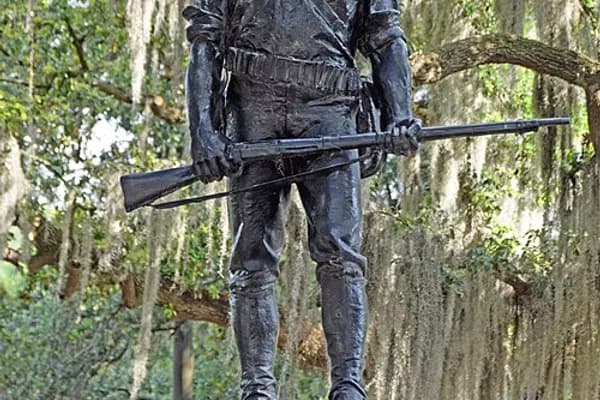
Standing at the south end of Forsyth Park, The Hiker is a statue created by Theo Alice Ruggles Kitson. It commemorates the American soldiers who fought in the Spanish–American War, the Boxer Rebellion and the Philippine-American War. The first version of it was made for the University of Minnesota in 1906, The Hiker depicts a hero stripped of his parade uniform and shown as a soldier reacting to the challenges of the battlefield. Officially called "The Georgia Volunteer," it was erected in Savannah because that city contributed more Spanish–American War soldiers per capita than any other city in Georgia. A drunk driver damaged the statue on January 18, 2025. The statue was restored and returned to the park on July 17, 2025.
Bonaventure Cemetery just outside of Savannah on a bluff of the Wilmington River has a section dedicated to the Spanish-American War Veterans from Worth Bagley Camp. It is the nation's second-largest area dedicated to those killed in the Spanish-American War.
Fountain
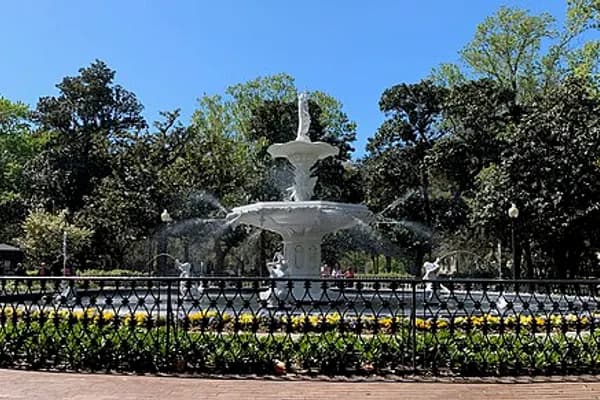
As one of the most photographed fountains in Savannah, the Forsyth Park Fountain sits on a direct line of continuation along the Bull Street corridor. The fountain was manufactured by Janes, Beebe & Company in Bronx County, New York – an iron foundry owned by Adrian Janes, which also created iron work for the Capitol dome of the U.S. Capitol Building and railings for the Brooklyn Bridge.
The fountain was installed in 1858. Its design by John Howard is derived from the work of the French sculptor, Michel Lienard, and is reminiscent of the fountains at Place de la Concorde in Paris. Other examples of this fountain can be found in Poughkeepsie, New York; Madison, Indiana; and Cuzco, Peru.
At the time of installation, Parisian urban planning was centered on the development of residential neighborhoods radiating out from a central green space. The Parisian model of developing large city parks was emulated by cities in the United States, including Savannah.
Every St. Patrick's Day, the fountain is ceremoniously turned green in celebration of Savannah's deep Irish heritage.
The fountain appears in many films, including The Longest Yard, Cape Fear, Forrest Gump and Midnight in the Garden of Good and Evil.
A restoration of the fountain was begun in June 2025, and completed six months later.
Panoramic view of Forsyth Park from Whitaker Street, on the park's western side Surrounding buildings
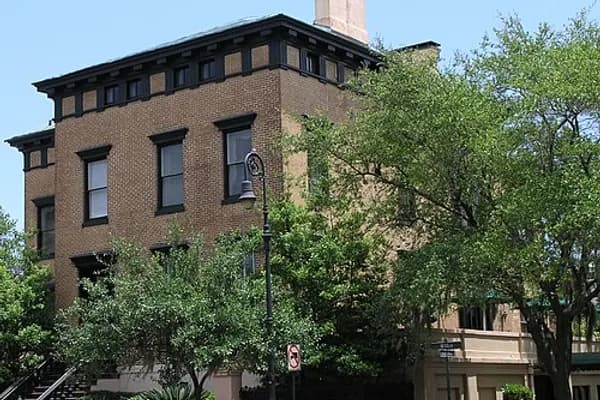
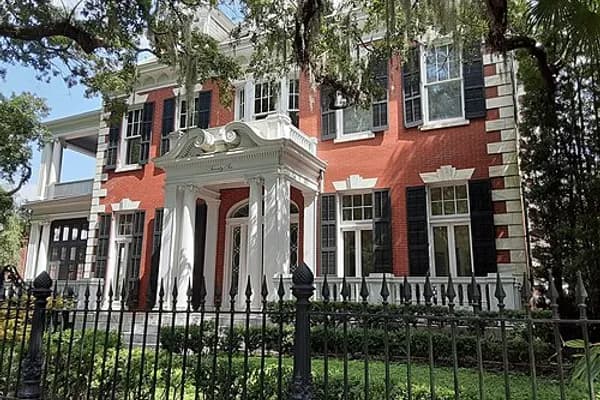
The below buildings each occupy one of the ten blocks on the three sides of the northern half park and are noted as historic structures by the Historic Preservation Department of the Chatham County-Savannah Metropolitan Planning Commission. These blocks fall in one of four wards. Clockwise from the north, these are Monterey Ward, Calhoun Ward, Forsyth Ward and Chatham Ward. Other wards abutting Forsyth Park are Lloyd Ward, Gallie Ward, and Cuthbert Ward. The properties are listed, again clockwise from the north, from the first East Gaston Street block.
John Berendt, author of 1994's Midnight in the Garden of Good and Evil, lived in Forsyth Park Apartments in the southwestern corner of the park while writing the book.
References
External links
Forsyth Park historical marker
32°04′03″N 81°05′47″W / 32.0676°N 81.0963°W / 32.0676; -81.0963
Encyclopedic content adapted from the Wikipedia article on Forsyth Park, used under CC BY-SA 4.0.
What makes Forsyth Park special
Forsyth Park stands out among Savannah’s neighborhoods for its distinctive character: savannah's iconic green space. Ranked #5 in Savannah, it offers the kind of experience that defines a great city trip — a place where the streets themselves tell a story and every block rewards curiosity.
Best for
Our take on Forsyth Park
Forsyth Park occupies a distinctive place in Savannah's neighborhood landscape. It is the kind of district that rewards travelers who venture beyond the obvious choices — quieter than the tourist-facing areas, richer in local character, and full of the small details that make a city trip memorable.
What makes Forsyth Park worth the visit is the texture of daily life here. It is a neighborhood that functions for the people who live in it — not just for the visitors who pass through. The shops serve local needs, the restaurants feed local appetites, and the streets have a rhythm that reflects genuine community rather than tourism infrastructure. That is the quality our editors prize most, and Forsyth Park has it in abundance.
Our editors recommend budgeting at least half a day here — enough time to walk the main streets, sit down for coffee, and discover the side streets where Forsyth Park's real character lives.
Living in Forsyth Park
Forsyth Park is connected to the rest of Savannah by public transit, and most visitors find it straightforward to reach from the city center or airport. Once you arrive, the neighborhood is best explored on foot — the scale is human and the streets reward wandering.
Day-to-day life in Forsyth Park has the rhythm of a genuine residential neighborhood. You will find grocery stores, pharmacies, cafés with morning regulars, and the kind of small independent shops that only survive where locals support them. For visitors, this means the infrastructure you need — good coffee, a decent meal, a quiet place to sit — is always within a short walk.
Accommodation in Forsyth Park ranges from boutique hotels to short-term rentals. We generally recommend staying within the neighborhood itself rather than commuting from a hotel elsewhere in Savannah — the experience of waking up inside a great neighborhood is fundamentally different from visiting one as a day trip.
What locals say about Forsyth Park
Long-term residents of Forsyth Park tend to describe their neighborhood with a mix of pride and protectiveness. Like any district with genuine character, Forsyth Park inspires loyalty — the kind of place people move to and never quite leave, or leave and spend years trying to get back to.
What locals appreciate most about Forsyth Park is its consistency — the feeling that the neighborhood works the same way on a Tuesday morning as it does on a Saturday night. It is not a place that performs for visitors and then goes quiet. The rhythm is genuine, the community is real, and the daily experience of living here is what draws people and keeps them.
Compared to the more famous districts in Savannah, Forsyth Park has maintained a lower profile, which many residents consider an advantage. The neighborhood evolves gradually rather than being reshaped by sudden attention, and the result is a community that still feels organic rather than curated.
Visitor tips
- Forsyth Park is located in Savannah, United States. The neighborhood is accessible by public transport, taxi, or rideshare from most parts of the city.
- Morning is often the best time to explore — the streets are quieter, the light is better for photography, and cafes are at their most welcoming.
- Wear comfortable walking shoes — the best way to experience Forsyth Park is on foot, wandering the side streets and discovering what lies around each corner.
- Save the neighborhood's location on your phone before you arrive. Offline maps are especially useful for navigating the smaller side streets.