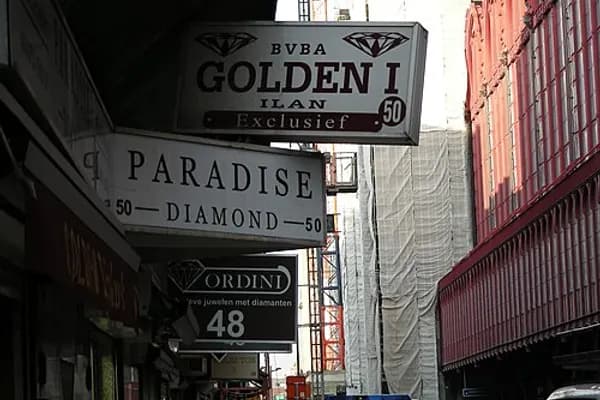
About the neighborhood
Area within the city of Antwerp, Belgium
51°12′52″N 4°25′06″E / 51.214509°N 4.4182508°E / 51.214509; 4.4182508
Antwerp's diamond district, also known as the Diamond Quarter (Diamantkwartier), and dubbed the Square Mile, is an area within the city of Antwerp, Belgium. It consists of several square blocks covering an area of about one square mile. While as of 2012, much of the gem cutting and polishing work historically done in the neighborhood had moved to low wage centers elsewhere, about 84% of the world's rough diamonds passed through the district, making it the largest diamond district. In 2011, it had a turnover of $56 billion dollars. Each year, approximately 50% of the rough diamonds return to Antwerp for cutting and polishing such as The Black Falcon, the world's largest cut diamond.
Over $16 billion in polished diamonds pass through the district's exchanges each year. There are 380 workshops that serve 1,500 companies. There are also 3,500 brokers, merchants and diamond cutters. In 2017, roughly 234 million carats were traded in the district, an area with a workforce of 30,000 people. Over 80% of rough diamonds were purchased in Antwerp.
Within the area is the Antwerp World Diamond Centre, and four trading exchanges including the Diamond Club of Antwerp and the Beurs voor Diamanthandel, both of which were founded by Hasidic diamantaires, the Antwerpsche Diamantkring and the Vrije Diamanthandel.
The neighborhood is dominated by Jewish, Jain Indians, Lebanese Maronite Christian, and Armenian dealers, known as diamantaires. More than 80% of Antwerp's Jewish population works in the diamond trade; Yiddish was, historically, a main language of the diamond exchange. No business is conducted on Saturdays.
Location
The diamond district is located adjacent to the Central Station (Antwerp Centraal) and a few minutes' walk to Meir, Antwerp's main shopping street. The Antwerp Zoo is also nearby. There are numerous and various restaurants, bars and cafes around the district.
History
Antwerp has been a focus of the diamond trade since the 15th century. The industry was transformed when Lodewyk van Berken invented a new form of diamond polishing tool, the scaif, which enabled the creation of the stereotypical sparkling, multifaceted diamond. This attracted orders from European nobility - and attracted other craftsmen to Antwerp. Charles the Bold commissioned him to cut and polish the Florentine Diamond. In the 1890s a diamond industry was established in Antwerp by families of diamonds traders and manufacturers who came from Amsterdam, Netherlands.
After the Second World War, the city's mayor encouraged Jews to return to Antwerp and many did so, including some who were working in the diamond trade. That helped to boost the industry. There was a subsequent decline however, starting in the 1960s, when some of the polishing business moved to India because of lower labour costs. Subsequently, some of the cutting business also moved to that country. A 2019 research study stated that India continued to dominate the cutting and polishing industry.
In February 2003, thieves stole loose diamonds, gold, silver and other types of jewelry valued at more than $100 million in the Antwerp diamond heist, also known as the "heist of the century."
The industry has avoided the 2022 European sanctions against Russia although the imports from Alrosa have diminished. If banned, the Antwerp World Diamond Centre claims 10,000 jobs would be at risk.
See also
Antwerp Diamond Bank
Antwerp Diamond Heist
Diamond District
Diamond Exchange District - Israel
Jewelers' Row, Philadelphia
Hatton Garden, London
Kimberley Process Certification Scheme
The Black Falcon
References
External links
Map of district
Encyclopedic content adapted from the Wikipedia article on Historic Centre, used under CC BY-SA 4.0.
What makes Historic Centre special
Historic Centre stands out among Antwerp’s neighborhoods for its distinctive character: diamond city's medieval core. Ranked #2 in Antwerp, it offers the kind of experience that defines a great city trip — a place where the streets themselves tell a story and every block rewards curiosity.
Best for
Our take on Historic Centre
Historic Centre is one of the strongest neighborhoods in Antwerp, and it consistently appears in our editors' personal favorites lists. It may not always get the same attention as the city's most famous district, but among travelers who know Antwerp well, Historic Centre is often the first recommendation.
Walking through Historic Centre is like reading a history book with your feet. The architecture tells the story of decades — sometimes centuries — of evolution, and the neighborhood has managed to preserve its historical character without becoming a museum piece. People still live here, still run businesses here, still argue about parking here. That living quality is what separates a great historic neighborhood from a pretty but lifeless one.
Our editors recommend budgeting at least half a day here — enough time to walk the main streets, sit down for coffee, and discover the side streets where Historic Centre's real character lives.
Living in Historic Centre
Historic Centre is connected to the rest of Antwerp by public transit, and most visitors find it straightforward to reach from the city center or airport. Once you arrive, the neighborhood is best explored on foot — the scale is human and the streets reward wandering.
Day-to-day life in Historic Centre has the rhythm of a genuine residential neighborhood. You will find grocery stores, pharmacies, cafés with morning regulars, and the kind of small independent shops that only survive where locals support them. For visitors, this means the infrastructure you need — good coffee, a decent meal, a quiet place to sit — is always within a short walk.
Accommodation in Historic Centre ranges from boutique hotels to short-term rentals. We generally recommend staying within the neighborhood itself rather than commuting from a hotel elsewhere in Antwerp — the experience of waking up inside a great neighborhood is fundamentally different from visiting one as a day trip.
What locals say about Historic Centre
Long-term residents of Historic Centre tend to describe their neighborhood with a mix of pride and protectiveness. Like any district with genuine character, Historic Centre inspires loyalty — the kind of place people move to and never quite leave, or leave and spend years trying to get back to.
What locals appreciate most about Historic Centre is its consistency — the feeling that the neighborhood works the same way on a Tuesday morning as it does on a Saturday night. It is not a place that performs for visitors and then goes quiet. The rhythm is genuine, the community is real, and the daily experience of living here is what draws people and keeps them.
Like any neighborhood that has earned attention, Historic Centre is navigating the tension between popularity and preservation. Rents have risen, new businesses have arrived, and long-time residents occasionally grumble that the neighborhood is not what it was. But the fundamentals — the walkability, the food, the community — remain strong, and most locals we speak to believe the neighborhood is still gaining more than it is losing.
Visitor tips
- Historic Centre is located in Antwerp, Belgium. The neighborhood is accessible by public transport, taxi, or rideshare from most parts of the city.
- Morning is often the best time to explore — the streets are quieter, the light is better for photography, and cafes are at their most welcoming.
- Wear comfortable walking shoes — the best way to experience Historic Centre is on foot, wandering the side streets and discovering what lies around each corner.
- Save the neighborhood's location on your phone before you arrive. Offline maps are especially useful for navigating the smaller side streets.