About the neighborhood
District of Busan, South Korea
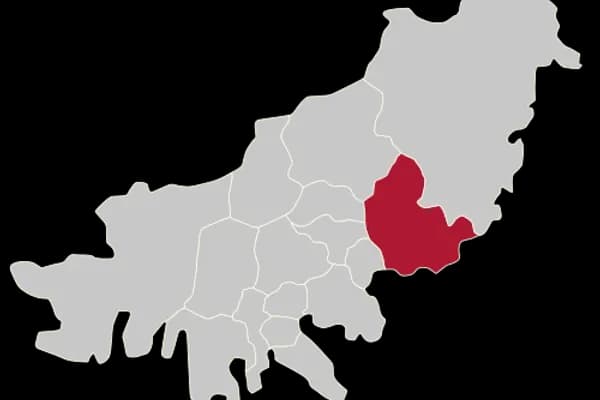
Haeundae District (Korean해운대구 RRHaeundae-gu) is a district (gu) of Busan, South Korea.
Haeundae has a population of about 423,000, the most populous district of Busan with 11.6% of the city population, and covers an area of 51.44km (19.86 sq mi) in eastern Busan. Haeundae became a division of Busan Metropolitan City in 1976 and attained the status of district in 1980.
Haeundae is linked to Busan Subway Line 2 and train stations on the Donghae Nambu railway line.
History
Haeundae takes its name from the ninth century Silla scholar and poet Ch'oe Ch'i-wŏn (literary name Haeun, or "Sea and Clouds"), who, according to a historical account, admired the view from the beach and built a pavilion nearby. A piece of Ch'oe's calligraphy, which he engraved on a rock at Haeundae, still exists. On Haeundae Dongbaek Island, there is a statue of Ch'oe Ch'i-wŏn, a Confucian scholar of the Unified Silla Period, and a monument. During the reign of Queen Jinseong during the Unified Silla Period, Ch'oe Ch'i-wŏn lamented that there was no place to write his studies.
Haeundae used to be isolated from the large communities in Busan and Busanjin. It remained undeveloped until the late 1970s and early 1980s. A small number of luxury hotels were constructed after the 1988 Seoul Olympics. More hotels and other tourist facilities have been constructed on the beach-front area since the mid-1990s, and shopping malls and movie theatre complexes have been built in the 'centre' of Haeundae: an area between Haeundae Station and the beach. The area has continued to grow, apart from during the 1997 Asian financial crisis.
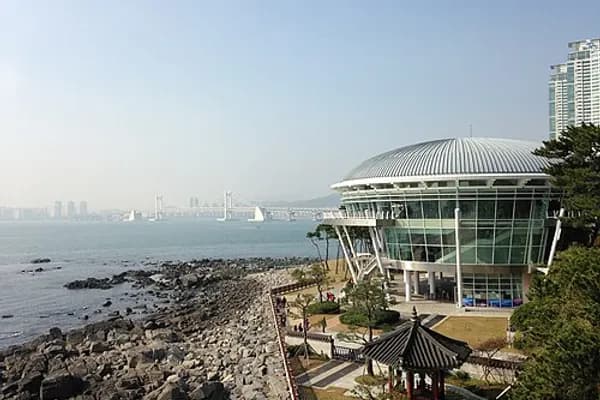
Haeundae has been a regular host of the annual Busan International Film Festival (BIFF). Haeundae's Dongbaek Island was the location for the 2005 APEC Conference.
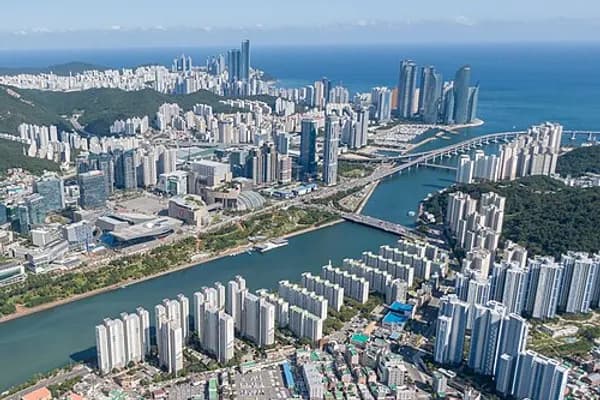
Haeundae New Town (해운대 신시가지, 海雲臺 新市街地, Haeundae Sinsigaji), a major commercial and residential redevelopment project begun in 1990, is located in the Jwa-dong area. This area lies in the southern shadow of the mountain Jangsan to the north, and is bounded in the south by Haeundae Station on the Dalmaji Gogae line of the Korean National Railroad. Another development project, Centum City, has been ongoing since early 2000 and is now a major feature of Busan. Marine City, located nearby, is constructed on land reclaimed from the sea, and has several huge, high-rise apartment blocks. Additional apartment blocks are under construction, with water resorts and related facilities, for use by the public, also planned for Marine City.
Tourist attractions
The district contains Haeundae Traditional Market, a large marketplace founded in 1910. It also contains Cheongsapo Daritdol Observatory, an elevated walkway over the sea, where people can look down into the reefs, see the coast, and look to the sunset over the ocean. The oldest active restaurant in Haeundae District is the Chinese restaurant Sinheunggwan.
Haeundae Dalmaji Hill
Haeundae's Dalmaji Hill is touted as one of the eight attractions of Busan, and is noted for its scenic view of the moon. Ch'oe Ch'i-wŏn (857-10th century), an official and poet from the late Unified Silla Dynasty (668-935), was so struck by its beauty that he decided to extend his stay there. Some even say that Dalmaji Hill is Busan's answer to Montmartre.
Haeundae Beach
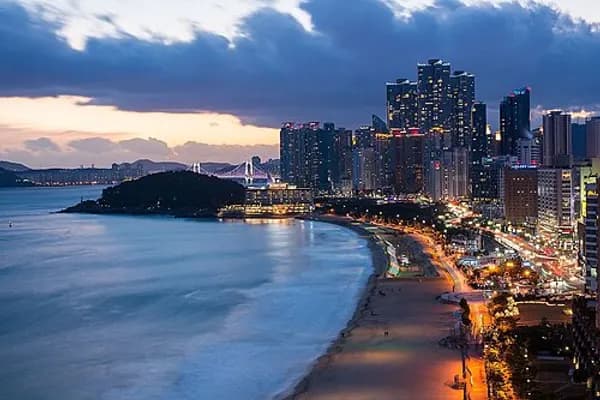
Haeundae Beach is regarded as one of the most famous beaches in South Korea. Along with Gwangandaegyo Bridge, it is one of Busan's most iconic landmarks, particularly famous among visitors from outside the city. Known as the largest beach in South Korea in terms of size and area, its unique location near the city center and affluent residential skyline makes it one of the most desirable places to live.
Haeridan-gil Street
Previously an old residential neighbourhood, Haeridan-gil (해리단길) has transformed in the last decade into a trendy area where many young locals spend their weekends. The neighbourhood is full of aesthetic cafes, highly rated restaurants and boutiques. Haeridan-gil is located at the top on gunam-ro, behind the old Haeundae Station, across the old Donghae-Nambu line (1905 to 2005).
Songjeong Beach
This beach is in Songjeong-dong, the westernmost division of Haeundae district. 1.2km long, it is popular with families and surfers, with a wide beach of white sand and shallow waters. There is a park to the north, featuring a pavilion and viewpoint, beyond which lies an active fishing port with scenic lighthouses.
Film and television
Haeundae is popular in South Korean media as a setting or filming location. The district was the setting of the movie Haeundae, a South Korean disaster movie scenario of an immense tsunami hitting the city of Busan. Haeundae has been featured in numerous K-Dramas, with the beach and Dongbaekseom being used as a filming location for Seoul Broadcasting System's 2008 drama Star's Lover. The island was the location for the scene where Lee Ma-ri, played by Choi Ji-woo confesses her love for Kim Chul Soo, played by Yoo Ji-tae; and the couple takes a walk on the beach. In 2012, KBS2 broadcast a drama, Haeundae Lovers, using Busan and the district as a backdrop. Much of the story takes place in Cheongsapo, a coastal community in the district east of Haeundae Beach.
Hauendae is home to the Busan Cinema Center, the location of the annual Busan International Film Festival, which features 5 inside theaters and 1 outside theater.
Education
Haeundae Tourism High School is a private vocational school in the district that specializes in tourism. Founded in 1972, it has a golf course, as well as facilities for the teaching of cooking, baking, bartending, and casino work.
Administrative divisions
Haeundae District is divided into 7 legal dong, which altogether comprise 18 administrative dong, as follows:
U-dong (2 administrative dong)
Jung-dong (2 administrative dong)
Jwa-dong (4 administrative dong)
Songjeong-dong
Banyeo-dong (4 administrative dong)
Bansong-dong (3 administrative dong)
Jaesong-dong (2 administrative dong)
Notable people
Jeung Eun-ji (Singer, Apink)
An Jae Mo (Actor)
Kang Seung-yoon (Singer, WINNER)
Park Ji-won (Singer, fromis 9)
Gallery
See also
Busan
Busan International Film Festival
Geography of South Korea
References
External links
Haeundae District website Archived 2017-04-08 at the Wayback Machine (in English)
Haeundae tour website (in English)
Wikivoyage has a travel guide for Haeundae.
Wikimedia Commons has media related to Haeundae-gu, Busan.
35°09′43″N 129°09′50″E / 35.16194°N 129.16389°E / 35.16194; 129.16389
Encyclopedic content adapted from the Wikipedia article on Haeundae, used under CC BY-SA 4.0.
What makes Haeundae special
Haeundae stands out among Busan’s neighborhoods for its distinctive character: busan's famous beach quarter. It tops our ranking of the best neighborhoods in Busan, it offers the kind of experience that defines a great city trip — a place where the streets themselves tell a story and every block rewards curiosity.
Best for
Our take on Haeundae
Haeundae is the neighborhood we send friends to first when they visit Busan. It earns the top spot in our ranking not because it is the most famous district in the city, but because it delivers the most complete neighborhood experience — the kind of place where every block rewards curiosity and every return visit reveals something new.
What makes Haeundae exceptional is the density of its cultural life. Art galleries, independent bookshops, small theaters, and creative studios are woven into the fabric of the neighborhood rather than clustered in a single zone. You encounter culture here by accident, which is how the best cultural experiences always happen.
Our editors recommend budgeting at least half a day here — enough time to walk the main streets, sit down for coffee, and discover the side streets where Haeundae's real character lives.
Living in Haeundae
Haeundae is connected to the rest of Busan by public transit, and most visitors find it straightforward to reach from the city center or airport. Once you arrive, the neighborhood is best explored on foot — the scale is human and the streets reward wandering.
Day-to-day life in Haeundae has the rhythm of a genuine residential neighborhood. You will find grocery stores, pharmacies, cafés with morning regulars, and the kind of small independent shops that only survive where locals support them. For visitors, this means the infrastructure you need — good coffee, a decent meal, a quiet place to sit — is always within a short walk.
Accommodation in Haeundae ranges from boutique hotels to short-term rentals. We generally recommend staying within the neighborhood itself rather than commuting from a hotel elsewhere in Busan — the experience of waking up inside a great neighborhood is fundamentally different from visiting one as a day trip.
What locals say about Haeundae
Long-term residents of Haeundae tend to describe their neighborhood with a mix of pride and protectiveness. Like any district with genuine character, Haeundae inspires loyalty — the kind of place people move to and never quite leave, or leave and spend years trying to get back to.
The creative community in Haeundae is genuine, not aspirational. Residents include working artists, writers, musicians, and designers who chose the neighborhood because it supported their work — affordable studio space, a community that values craft, and enough foot traffic to sustain independent galleries and shops.
Like any neighborhood that has earned attention, Haeundae is navigating the tension between popularity and preservation. Rents have risen, new businesses have arrived, and long-time residents occasionally grumble that the neighborhood is not what it was. But the fundamentals — the walkability, the food, the community — remain strong, and most locals we speak to believe the neighborhood is still gaining more than it is losing.
Visitor tips
- Haeundae is located in Busan, South Korea. The neighborhood is accessible by public transport, taxi, or rideshare from most parts of the city.
- Morning is often the best time to explore — the streets are quieter, the light is better for photography, and cafes are at their most welcoming.
- Wear comfortable walking shoes — the best way to experience Haeundae is on foot, wandering the side streets and discovering what lies around each corner.
- Save the neighborhood's location on your phone before you arrive. Offline maps are especially useful for navigating the smaller side streets.