About the neighborhood
Town within Busan, South Korea
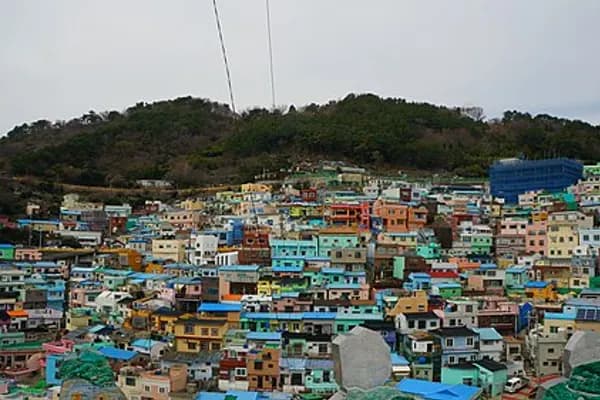
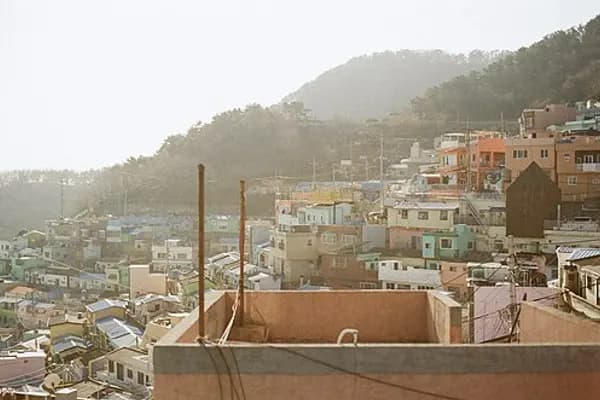
Gamcheon Culture Village (Korean감천문화마을) is a town within Gamcheon-dong, Saha District, Busan, South Korea. The area is known for its layered streets, twisted labyrinth-like alleys, and brightly painted houses, which have been restored and enhanced in recent years to attract tourism. Built on a steep mountain-side slope, the village has been nicknamed "Korea's Santorini" and the "Machu Picchu of Busan".
History
Gamcheon Village was built during the 1920s and 1930s when the Busan city administration decided to relocate the working-class population into an area secluded from the port, yet close enough to provide labor. In the midst of a post-war recovery in 1955, around 800 families moved to the village, contributing to the growth of an ascetic religious community known as Taegeukdo, a branch of Jeungsanism. A long-time resident noted the village's development throughout the decades: "Gamcheon was only one district in 1950, now it’s nine. In the ’70s there were only houses made of wood. In the late ’80s and early ’90s, families started to get bigger so they built two-level houses." Nonetheless, the village faced persisting poverty and poor living conditions.
In 2009, the Ministry of Culture, Sports and Tourism carried out a public art-themed renovation effort to convert the village to a cultural hub. It called for art students, professional artists, and residents to maintain, repair, and "decorate" the village with art. The renovation efforts reached their peak with the success of the "Empty House Residency Preservation Project." With improvements to infrastructure, fresh paint, and other home improvements, the establishment of spaces for retail and museums, and the addition of several dozens of art installations, the village has been reborn as Busan's most colorful and artistic spot. Some examples of the colorful art installations include bird sculptures, Murakami-like playful installations, scenes from the Little Prince, and painted schools of fish that guide bearings through the alleyways.
Tourism
The village has turned into one of the most featured tourist attractions in Busan. Since the public art renovation project in 2009, tourism in Gamcheon has increased considerably—the village saw approximately 1.4 million visitors in 2015. Village residents have met this influx of traffic with mixed attitudes. While some residents have participated in the renovation and tourism efforts, others have opted to move away despite difficulties with selling their homes. It is estimated that 300 local houses were empty as of 2015. Part of the development efforts in the Village include converting these abandoned houses into art galleries, museums, and shops.
References
See also
Urban regeneration in South Korea
Tourist trap
Overtourism
Encyclopedic content adapted from the Wikipedia article on Gamcheon, used under CC BY-SA 4.0.
What makes Gamcheon special
Gamcheon stands out among Busan’s neighborhoods for its distinctive character: busan's colorful hillside village. Ranked #3 in Busan, it offers the kind of experience that defines a great city trip — a place where the streets themselves tell a story and every block rewards curiosity.
Best for
Our take on Gamcheon
Gamcheon is one of the strongest neighborhoods in Busan, and it consistently appears in our editors' personal favorites lists. It may not always get the same attention as the city's most famous district, but among travelers who know Busan well, Gamcheon is often the first recommendation.
What makes Gamcheon worth the visit is the texture of daily life here. It is a neighborhood that functions for the people who live in it — not just for the visitors who pass through. The shops serve local needs, the restaurants feed local appetites, and the streets have a rhythm that reflects genuine community rather than tourism infrastructure. That is the quality our editors prize most, and Gamcheon has it in abundance.
Our editors recommend budgeting at least half a day here — enough time to walk the main streets, sit down for coffee, and discover the side streets where Gamcheon's real character lives.
Living in Gamcheon
Gamcheon is connected to the rest of Busan by public transit, and most visitors find it straightforward to reach from the city center or airport. Once you arrive, the neighborhood is best explored on foot — the scale is human and the streets reward wandering.
Day-to-day life in Gamcheon has the rhythm of a genuine residential neighborhood. You will find grocery stores, pharmacies, cafés with morning regulars, and the kind of small independent shops that only survive where locals support them. For visitors, this means the infrastructure you need — good coffee, a decent meal, a quiet place to sit — is always within a short walk.
Accommodation in Gamcheon ranges from boutique hotels to short-term rentals. We generally recommend staying within the neighborhood itself rather than commuting from a hotel elsewhere in Busan — the experience of waking up inside a great neighborhood is fundamentally different from visiting one as a day trip.
What locals say about Gamcheon
Long-term residents of Gamcheon tend to describe their neighborhood with a mix of pride and protectiveness. Like any district with genuine character, Gamcheon inspires loyalty — the kind of place people move to and never quite leave, or leave and spend years trying to get back to.
What locals appreciate most about Gamcheon is its consistency — the feeling that the neighborhood works the same way on a Tuesday morning as it does on a Saturday night. It is not a place that performs for visitors and then goes quiet. The rhythm is genuine, the community is real, and the daily experience of living here is what draws people and keeps them.
Compared to the more famous districts in Busan, Gamcheon has maintained a lower profile, which many residents consider an advantage. The neighborhood evolves gradually rather than being reshaped by sudden attention, and the result is a community that still feels organic rather than curated.
Visitor tips
- Gamcheon is located in Busan, South Korea. The neighborhood is accessible by public transport, taxi, or rideshare from most parts of the city.
- Morning is often the best time to explore — the streets are quieter, the light is better for photography, and cafes are at their most welcoming.
- Wear comfortable walking shoes — the best way to experience Gamcheon is on foot, wandering the side streets and discovering what lies around each corner.
- Save the neighborhood's location on your phone before you arrive. Offline maps are especially useful for navigating the smaller side streets.