About the neighborhood
One of the six sestieri of Venice, historical neighbourhood
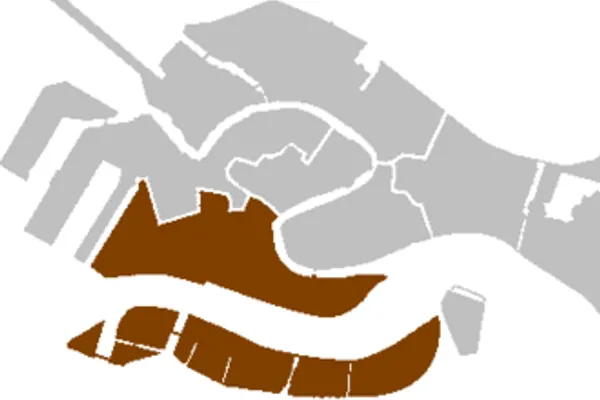
Dorsoduro is one of the six historic sestieri (districts) of Venice, Italy, located in the southern part of the city and known for its relatively firm terrain that earned it the name meaning "hard back" or "hard ridge" in Italian, distinguishing it from the more marshy areas of the lagoon. It stretches from the Grand Canal in the north to the Giudecca Canal in the south, encompassing waterfront promenades like the Zattere, the Punta della Dogana viewpoint, and occasionally including the nearby Giudecca island.
History
The original heart of the area was the Giudecca Canal, along which buildings were constructed from the sixth century. By the eleventh century, settlement had spread across to the Grand Canal, while later religious buildings including the Basilica of Santa Maria della Salute and the Zattere quay are now its main landmarks.
In the nineteenth century the Accademia was set up in Dorsoduro and the Ponte dell'Accademia linked it to San Marco, making it an expensive area, popular with foreign residents. The western quarter end and the Giudecca, became industrialised around this time.
Main sights
Landmarks and visitor attractions in Dorsoduro include:
Ca' Foscari
Ca' Rezzonico
Campo San Barnaba
Campo San Gregorio
Campo Santa Margherita
Gallerie dell'Accademia
Peggy Guggenheim Collection
Il Redentore (church)
Le Zitelle
Ospedale Giustinian
Palazzo Ariani
Palazzo Brandolin Rota
Palazzo Dario
Palazzo Giustinian Recanati
Palazzo Mocenigo Gambara
Palazzo Orio Semitecolo Benzon
Palazzo Zenobio
Punta della Dogana Dogana da Mar
Santa Maria della Salute (church)
San Pantalon (church)
San Trovaso (church)
Santa Maria del Carmelo (church)
San Sebastiano (church)
Scuola Grande dei Carmini
Church of Ognissanti
References
External links
Media related to Dorsoduro (Venice) at Wikimedia Commons
45°25′51.60″N 12°19′33.60″E / 45.4310000°N 12.3260000°E / 45.4310000; 12.3260000
Encyclopedic content adapted from the Wikipedia article on Dorsoduro, used under CC BY-SA 4.0.
What makes Dorsoduro special
Dorsoduro stands out among Venice’s neighborhoods for its distinctive character: venice's art district. It tops our ranking of the best neighborhoods in Venice, it offers the kind of experience that defines a great city trip — a place where the streets themselves tell a story and every block rewards curiosity.
Best for
Our take on Dorsoduro
Dorsoduro is the neighborhood we send friends to first when they visit Venice. It earns the top spot in our ranking not because it is the most famous district in the city, but because it delivers the most complete neighborhood experience — the kind of place where every block rewards curiosity and every return visit reveals something new.
What makes Dorsoduro exceptional is the density of its cultural life. Art galleries, independent bookshops, small theaters, and creative studios are woven into the fabric of the neighborhood rather than clustered in a single zone. You encounter culture here by accident, which is how the best cultural experiences always happen.
Our editors recommend budgeting at least half a day here — enough time to walk the main streets, sit down for coffee, and discover the side streets where Dorsoduro's real character lives.
Living in Dorsoduro
Dorsoduro is connected to the rest of Venice by public transit, and most visitors find it straightforward to reach from the city center or airport. Once you arrive, the neighborhood is best explored on foot — the scale is human and the streets reward wandering.
Day-to-day life in Dorsoduro has the rhythm of a genuine residential neighborhood. You will find grocery stores, pharmacies, cafés with morning regulars, and the kind of small independent shops that only survive where locals support them. For visitors, this means the infrastructure you need — good coffee, a decent meal, a quiet place to sit — is always within a short walk.
Accommodation in Dorsoduro ranges from boutique hotels to short-term rentals. We generally recommend staying within the neighborhood itself rather than commuting from a hotel elsewhere in Venice — the experience of waking up inside a great neighborhood is fundamentally different from visiting one as a day trip.
What locals say about Dorsoduro
Long-term residents of Dorsoduro tend to describe their neighborhood with a mix of pride and protectiveness. Like any district with genuine character, Dorsoduro inspires loyalty — the kind of place people move to and never quite leave, or leave and spend years trying to get back to.
The creative community in Dorsoduro is genuine, not aspirational. Residents include working artists, writers, musicians, and designers who chose the neighborhood because it supported their work — affordable studio space, a community that values craft, and enough foot traffic to sustain independent galleries and shops.
Like any neighborhood that has earned attention, Dorsoduro is navigating the tension between popularity and preservation. Rents have risen, new businesses have arrived, and long-time residents occasionally grumble that the neighborhood is not what it was. But the fundamentals — the walkability, the food, the community — remain strong, and most locals we speak to believe the neighborhood is still gaining more than it is losing.
Visitor tips
- Dorsoduro is located in Venice, Italy. The neighborhood is accessible by public transport, taxi, or rideshare from most parts of the city.
- Morning is often the best time to explore — the streets are quieter, the light is better for photography, and cafes are at their most welcoming.
- Wear comfortable walking shoes — the best way to experience Dorsoduro is on foot, wandering the side streets and discovering what lies around each corner.
- Save the neighborhood's location on your phone before you arrive. Offline maps are especially useful for navigating the smaller side streets.