About the neighborhood
Kingdom in the north of early Anglo-Saxon Britain
Deira (/ˈdaɪrə, ˈdɛərə/ DY-rə, DAIR-ə; Old Welsh/Cumbric: Deywr or Deifr; Old English: Dere or Dera rice) was an area of Post-Roman Britain, and a later Anglian kingdom.
Etymology
The name of the kingdom is of Brythonic origin, and is derived from the Proto-Celtic daru, meaning 'oak' (derw in modern Welsh), in which case it would mean 'the people of the Derwent', a derivation also found in the Latin name for Malton, Derventio. It is cognate with the modern Irish word doire; the names of the Irish cities of Derry and Kildare stem from this word.
History
Brythonic Deira
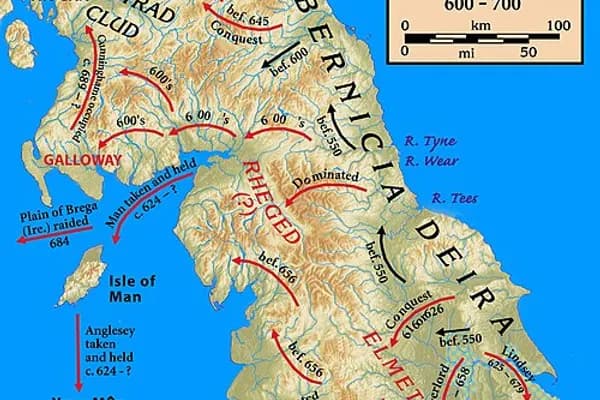
Following the Roman withdrawal from Britain a number of successor kingdoms rose in northern England, reflecting pre-Roman tribal territories. The area between the Humber and River Tees known as Deywr or Deifr corresponds to the tribal lands of the Parisi, bordered to the west and north by the Brythonic kingdoms of Elmet (Elfed) and Bernicia (Bryneich) respectively, and to the east by the North Sea.
Early Deira may have centred on Petuaria (modern Brough) and archaeological evidence shows that the town was refortified. Petuaria was a great tribal centre for the Parisi, but declined in importance from the mid-fourth century (possibly as the harbour silted up). After this period, Derventio (modern Malton) may have functioned as the region's capital.
It is not known if Deira was ever an independent Brythonic kingdom, and no British king has been identified with the area from the surviving genealogies, poems or chronicles. However the area was subject to the same fractious inheritance traditions and changing power dynamic (following the Roman withdrawal) that allowed Elmet and Bernicia to become independent hereditary kingdoms in the early fifth century. In Welsh literature, Deira is part of the Hen Ogledd (The Old North) region, which was divided into many related kingdoms after the death of Coel Hen (Coel the Old).
Anglian Deira
The kingdom, which was previously ruled by a British dynasty, was probably created in the third quarter of the fifth century when Anglian warriors invaded the Derwent Valley. Anglian Deira's territory also extended from the Humber to the Tees, and from the sea to the western edge of the Vale of York. It later merged with the kingdom of Bernicia, its northern neighbour, to form the kingdom of Northumbria.
According to Simeon of Durham (writing early in the 12th century), Deira extended from the Humber to the Tyne, but the land was waste north of the Tees. The Brythonic kingdom centred on Eboracum ("boar-place"), which may have also been called Ebrauc. After the city was taken by King Edwin of the Angles, it became Eoforwic, the capital of the new Anglian kingdom.
Archaeology suggests that the Anglian royal house was in place by the middle of the fifth century, but the first certainly recorded king is Ælla in the late sixth century. After his death, Deira was subject to king Æthelfrith of Bernicia, who united the two kingdoms into Northumbria. Æthelfrith ruled until the accession of Ælla's son Edwin, in 616 or 617, who also ruled both kingdoms until 633.
Osric, the nephew of Edwin, ruled Deira after Edwin, but his son Oswine was put to death by Oswiu in 651. For a few years subsequently, Deira was governed by Æthelwald son of Oswald of Bernicia.
Bede wrote of Deira in his Historia Ecclesiastica (completed in 731).
Anglian kings of Deira
Notes
References
Bede (1910). Lionel C. Jane (ed.). Ecclesiastical History of the English Nation. Translated by John Stevens via Wikisource.
Higham, N.J. (1993). The Kingdom of Northumbria AD 350–1100. Stroud: Sutton. ISBN0-86299-730-5
Mackenzie, E.; Ross, M. (1834). An Historical, Topographical, and Descriptive View of the County Palatine of Durham. Vol.I. Newcastle upon Tyne: Mackenzie and Dent. p.xi.
Malam, John (2011). Yorkshire, A Very Peculiar History. Book House. ISBN978-1907184574.
Mills, Anthony David (2003). A Dictionary of British Place-Names. Oxford University Press. ISBN978-0-19-852758-9.
Morris, John (1973). The Age of Arthur. Weidenfeld & Nicolson.
Koch, John T. (2006). Celtic Culture: A Historical Encyclopedia. ABC-CLIO. ISBN1-85109-440-7.
Further reading
Geake, Helen & Kenny, Jonathan (eds.) (2000). Early Deira: Archaeological studies of the East Riding in the fourth to ninth centuries AD. Oxford: Oxbow. ISBN1-900188-90-2
Encyclopedic content adapted from the Wikipedia article on Deira, used under CC BY-SA 4.0.
What makes Deira special
Deira stands out among Dubai’s neighborhoods for its distinctive character: traditional souks and abras. Ranked #5 in Dubai, it offers the kind of experience that defines a great city trip — a place where the streets themselves tell a story and every block rewards curiosity.
Best for
Our take on Deira
Deira occupies a distinctive place in Dubai's neighborhood landscape. It is the kind of district that rewards travelers who venture beyond the obvious choices — quieter than the tourist-facing areas, richer in local character, and full of the small details that make a city trip memorable.
What makes Deira worth the visit is the texture of daily life here. It is a neighborhood that functions for the people who live in it — not just for the visitors who pass through. The shops serve local needs, the restaurants feed local appetites, and the streets have a rhythm that reflects genuine community rather than tourism infrastructure. That is the quality our editors prize most, and Deira has it in abundance.
Our editors recommend budgeting at least half a day here — enough time to walk the main streets, sit down for coffee, and discover the side streets where Deira's real character lives.
Living in Deira
Deira is connected to the rest of Dubai by public transit, and most visitors find it straightforward to reach from the city center or airport. Once you arrive, the neighborhood is best explored on foot — the scale is human and the streets reward wandering.
Day-to-day life in Deira has the rhythm of a genuine residential neighborhood. You will find grocery stores, pharmacies, cafés with morning regulars, and the kind of small independent shops that only survive where locals support them. For visitors, this means the infrastructure you need — good coffee, a decent meal, a quiet place to sit — is always within a short walk.
Accommodation in Deira ranges from boutique hotels to short-term rentals. We generally recommend staying within the neighborhood itself rather than commuting from a hotel elsewhere in Dubai — the experience of waking up inside a great neighborhood is fundamentally different from visiting one as a day trip.
What locals say about Deira
Long-term residents of Deira tend to describe their neighborhood with a mix of pride and protectiveness. Like any district with genuine character, Deira inspires loyalty — the kind of place people move to and never quite leave, or leave and spend years trying to get back to.
What locals appreciate most about Deira is its consistency — the feeling that the neighborhood works the same way on a Tuesday morning as it does on a Saturday night. It is not a place that performs for visitors and then goes quiet. The rhythm is genuine, the community is real, and the daily experience of living here is what draws people and keeps them.
Compared to the more famous districts in Dubai, Deira has maintained a lower profile, which many residents consider an advantage. The neighborhood evolves gradually rather than being reshaped by sudden attention, and the result is a community that still feels organic rather than curated.
Visitor tips
- Deira is located in Dubai, United Arab Emirates. The neighborhood is accessible by public transport, taxi, or rideshare from most parts of the city.
- Morning is often the best time to explore — the streets are quieter, the light is better for photography, and cafes are at their most welcoming.
- Wear comfortable walking shoes — the best way to experience Deira is on foot, wandering the side streets and discovering what lies around each corner.