About the neighborhood
Shinto shrine in Fukuoka Prefecture, Japan
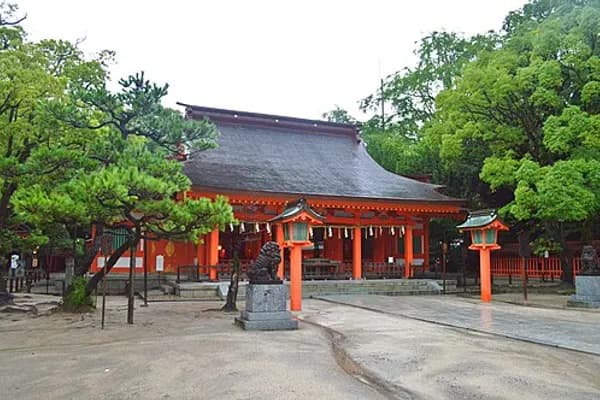
Sumiyoshi Shrine (住吉神社) is a Shinto shrine in the Sumiyoshi neighborhood of Hakata-ku, Fukuoka in Fukuoka Prefecture, Japan. It is the ichinomiya of former Chikuzen Province. The main festival of the shrine is held annually on October 13. Along with the more famous Sumiyoshi-taisha in Osaka and the Sumiyoshi Jinja in Shimonoseki, Yamaguchi, it is one of the "Three Great Sumiyoshi" shrines.
Enshrined kami
The kami enshrined at Sumiyoshi Jinja are:
Sumiyoshi sanjin (住吉三神)
Empress Jingū (神功皇后)
Amaterasu (天照皇大神)
Origins
Per the shrine's legend (Chikuzen Sumiyoshi Daimyojin Goengi), the shrine is the birthplace of the Sumiyoshi cult and the origin for all Sumiyoshi shrines in the country. Unlike Hakata, which is located on sand dunes, the area surrounding the shrine grounds is located on the alluvial land of the Naka River, and topographically located on the cape of Reizeitsu, which juts out into the mouths of the Hie River and the Naka River. This was thought to be a suitable location for a place of worship for the guardian deity of navigation. Bronze spear and a bronze sword from the Yayoi Period have been excavated from the shrine grounds, and it is theorized that this area was originally a sacred place for Nakoku or the Amabe maritime tribe.
History
The foundation of the Sumitomo Shrine in Hakozaki is unknown. It first appears in historical documentation in an entry in the Shoku Nihongi dated April 737, when it is recorded that offerings were made to "Chikushi Sumiyoshi" and to Ise Grand Shrine in response to disrespectful actions by the kingdom of Silla in the Korean Peninsula. Per a survey dated 806, 36 shrines were dedicated to Sumiyoshi in Chikuzen Province, and in 847 the monk Ennin and in 852 the monk Enchin recited Buddhist sutras at the shrine on their return from Tang China. In 878, it was placed under the direct protection of the Imperial Court after an oracle at [[ Kashii-gū]] warned of a possible attack by Silla. In the Engishiki, the shrine is listed as a Myojin Taisha and in 1019, the shrine was entrusted to Emperor Go-Ichijō as a "once-in-a-generation" offering. It has been regarded as the ichinomiya of Chikuzen Province since the late Heian period. Takezaki Suenaga's Mōko Shūrai Ekotoba depicts the vermilion torii gate of Sumiyoshi Shrine. In 1480, the renga master Sōgi visited the shrine, and wrote about the devastation of Sumiyoshi Shrine due to war in the "Tsukushi Doki". During the Sengoku period, the shrine records and old documents were taken by Ōuchi Yoshitaka to Yamaguchi and were destroyed in the Tainei-ji incident of 1551. The current shrine was restored by Kuroda Nagamasa, the first daimyō of Fukuoka Domain in 1623. Subsequent rulers of the domain continued to support the shrine to the Meiji restoration. Under the Meiji government's State Shinto's system of ranked Shinto shrines, Sumiyoshi Shrine was ranked as a Prefectural Shrine in 1872, and promoted to an Imperial shrine, 3rd rank (官幣小社, Kanpei-shōsha) in 1925.
In 2004, archaeological excavations began around the precincts. In a total of three excavations up to 2014, the remains of a mansion from the medieval to early modern period were discovered along with artifacts related to rituals.
Cultural Properties
Honden (本殿) - The main hall of the shrine was built by Kuroda Nagamasa in 1623 during the early Edo period. It is in the Sumiyoshi-zukuri style, which is considered to be an older form of shrine architecture. It is a gabled structure and the roof is thatched with cypress bark. The pillars are painted vermilion and the wooden walls are painted white. It was designated as a National Important Cultural Property in 1922.
Gallery
See also
Ichinomiya
References
External links
Wikimedia Commons has media related to Sumiyoshi-jinja (Fukuoka).
Official home page(in Japanese)
Cultural Properties of Fukuoka City(in Japanese)
Fukuoka Tourism Web(in Japanese)
Encyclopedic content adapted from the Wikipedia article on Daimyō, used under CC BY-SA 4.0.
What makes Daimyō special
Daimyō stands out among Fukuoka’s neighborhoods for its distinctive character: fukuoka's hippest fashion district. Ranked #3 in Fukuoka, it offers the kind of experience that defines a great city trip — a place where the streets themselves tell a story and every block rewards curiosity.
Best for
Our take on Daimyō
Daimyō is one of the strongest neighborhoods in Fukuoka, and it consistently appears in our editors' personal favorites lists. It may not always get the same attention as the city's most famous district, but among travelers who know Fukuoka well, Daimyō is often the first recommendation.
What makes Daimyō worth the visit is the texture of daily life here. It is a neighborhood that functions for the people who live in it — not just for the visitors who pass through. The shops serve local needs, the restaurants feed local appetites, and the streets have a rhythm that reflects genuine community rather than tourism infrastructure. That is the quality our editors prize most, and Daimyō has it in abundance.
Our editors recommend budgeting at least half a day here — enough time to walk the main streets, sit down for coffee, and discover the side streets where Daimyō's real character lives.
Living in Daimyō
Daimyō is connected to the rest of Fukuoka by public transit, and most visitors find it straightforward to reach from the city center or airport. Once you arrive, the neighborhood is best explored on foot — the scale is human and the streets reward wandering.
Day-to-day life in Daimyō has the rhythm of a genuine residential neighborhood. You will find grocery stores, pharmacies, cafés with morning regulars, and the kind of small independent shops that only survive where locals support them. For visitors, this means the infrastructure you need — good coffee, a decent meal, a quiet place to sit — is always within a short walk.
Accommodation in Daimyō ranges from boutique hotels to short-term rentals. We generally recommend staying within the neighborhood itself rather than commuting from a hotel elsewhere in Fukuoka — the experience of waking up inside a great neighborhood is fundamentally different from visiting one as a day trip.
What locals say about Daimyō
Long-term residents of Daimyō tend to describe their neighborhood with a mix of pride and protectiveness. Like any district with genuine character, Daimyō inspires loyalty — the kind of place people move to and never quite leave, or leave and spend years trying to get back to.
What locals appreciate most about Daimyō is its consistency — the feeling that the neighborhood works the same way on a Tuesday morning as it does on a Saturday night. It is not a place that performs for visitors and then goes quiet. The rhythm is genuine, the community is real, and the daily experience of living here is what draws people and keeps them.
Compared to the more famous districts in Fukuoka, Daimyō has maintained a lower profile, which many residents consider an advantage. The neighborhood evolves gradually rather than being reshaped by sudden attention, and the result is a community that still feels organic rather than curated.
Visitor tips
- Daimyō is located in Fukuoka, Japan. The neighborhood is accessible by public transport, taxi, or rideshare from most parts of the city.
- Morning is often the best time to explore — the streets are quieter, the light is better for photography, and cafes are at their most welcoming.
- Wear comfortable walking shoes — the best way to experience Daimyō is on foot, wandering the side streets and discovering what lies around each corner.
- Save the neighborhood's location on your phone before you arrive. Offline maps are especially useful for navigating the smaller side streets.