About the neighborhood
Unincorporated town in the State of Nevada, United States
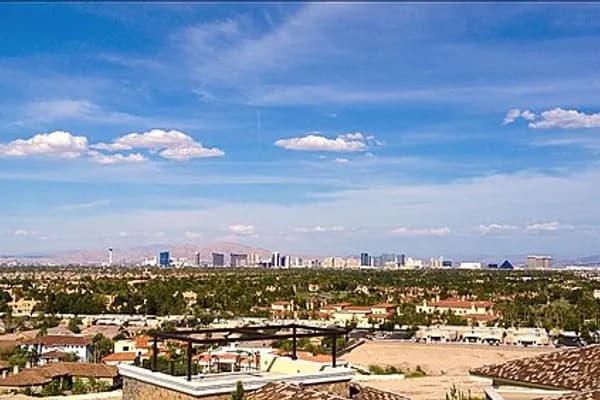
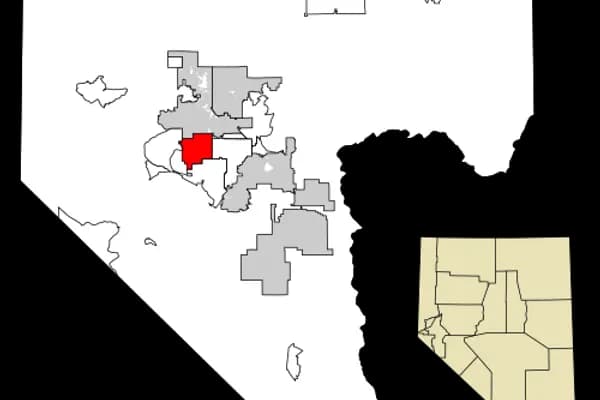
Spring Valley is an unincorporated town and census-designated place in Clark County, Nevada, United States, located 2 miles (3km) west of the Las Vegas Strip. The population was 215,597 at the 2020 census. Spring Valley was formed in May 1981.
History
In 1965, the Stardust International Raceway was built by the Stardust Resort and Casino. In 1969, the Stardust was sold to the Parvin-Dohrmann Corporation, which had little interest in the raceway and then leased it until 1970, when Pardee Homes purchased the land. They began developing a master-planned housing community called Spring Valley. The community was named by Doug Pardee and sales manager Jack Whiteman, in reference to its views of the Spring Mountains and its location in the Las Vegas Valley. In 1981, residents grouped together to solicit the Clark County Commission to create an unincorporated town, which it did that May. The residents wanted to create the town due to hypothetical annexations into other communities in the Las Vegas Valley, and because they claimed they did not pay their taxes fairly for county services. The town originally encompassed 1 square mile (3km), but now occupies much of the southwest quarter of the Las Vegas Valley, totaling 33.4 square miles (90km).
Geography
According to the United States Census Bureau, the census-designated place (CDP) of Spring Valley (which may not exactly coincide with the town boundaries) has a total area of 33.4sqmi (87km), all of it land.
The predominant boundaries of Spring Valley are Sahara Avenue on the north, Decatur Boulevard on the east, Warm Springs Road on the south, and Hualapai Way on the west.
The area mostly consists of housing subdivisions, with strip malls lining the large boulevards that connect suburban Las Vegas to the Strip. The northern part of Spring Valley includes areas of rural-estate zoning, with large parcels of land on blocks of 164 square mile (40,000m). The southern part of Spring Valley is quickly developing – fifteen years ago, very little south of W Hacienda Ave was developed within Spring Valley.
A large park, Desert Breeze Park, is located in the north-central part of the town. Next to the park is Roger M. Bryan Elementary School.
Demographics
At the census of 2010, there were 178,395 people living in the CDP. The racial makeup was 57.9% White, 9.8% African American, 0.6% Native American, 17.4% Asian, 0.8% Pacific Islander, and 5.0% from two or more races. Hispanic or Latino of any race were 20.6% of the population and 48.1% of the population was non-Hispanic White.
As of the census of 2000, there were 117,390 people, 47,964 households, and 29,929 families living in the CDP. The population density was 3,519.4/sqmi (1,358.8/km). There were 52,870 housing units at an average density of 1,585/sqmi (612/km). The racial makeup of the CDP was 72.60% White, 5.29% African American, 0.60% Native American, 11.21% Asian, 0.48% Pacific Islander, 5.14% from other races, and 4.67% from two or more races. Hispanic or Latino of any race were 13.77% of the population.
There were 47,964 households, out of which 27.0% had children under the age of 18 living with them, 46.7% were married couples living together, 10.5% had a female householder with no husband present, and 37.6% were non-families. 25.9% of all households were made up of individuals, and 5.9% had someone living alone who was 65 years of age or older. The average household size was 2.44 and the average family size was 2.98.
In the CDP, the population was spread out, with 21.2% under the age of 18, 9.4% from 18 to 24, 33.7% from 25 to 44, 25.0% from 45 to 64, and 10.7% who were 65 years of age or older. The median age was 36 years. For every 100 females, there were 99.6 males. For every 100 females age 18 and over, there were 98.4 males.
The median income for a household in the CDP was $48,563, and the median income for a family was $55,021. Males had a median income of $37,068 versus $28,288 for females. The per capita income for the CDP was $26,321. About 4.8% of families and 6.7% of the population were below the poverty line, including 6.9% of those under age 18 and 7.7% of those age 65 or over.
Culture
Chinatown
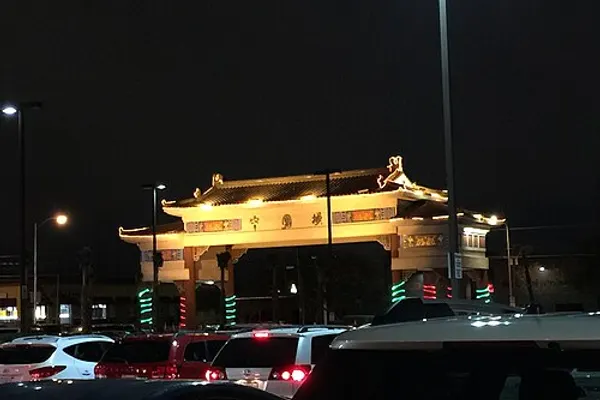
The strip malls along Spring Mountain Road and surrounding streets, from Valley View to Jones Boulevard in Spring Valley into Paradise, house many ethnic Chinese and other pan-Asian businesses, with the original called Chinatown Plaza. The district is primarily a retail destination, rather than a residential enclave, catering to Asian Americans.
The Chinatown Plaza strip mall was conceived by Taiwanese American James Chih-Cheng Chen and opened in February 1995 at the corner of Spring Mountain and Wynn; it has 85,000ft (26,000m) of space and was designed by Simon Lee in a style inspired by Tang dynasty buildings. Chen called it "America's first master-planned Chinatown". The plaza was funded by JHK Investment Group, Inc., which Chen had formed with two high school classmates: Henry Chen-Jen Hwang and K.C. Chen (no relation). James Chen, an emigrant from Taiwan who arrived in Los Angeles in 1971 with $30, saw a demand for Asian food and restaurants: "I see so many Asian tourists here [in Las Vegas], but I see no Asian business people. They're happy with everything in Las Vegas except the food." Sharon Hwang, Henry's daughter, recalled her father was similarly inspired by stories he would hear from tourists returning from Las Vegas to Los Angeles: "... We figured all the Southern California Chinese, they love to come to Vegas, gambling; that was the thing. So they would come average, I would say, once or twice a year at least. But everybody's thing was, there's no Chinese food; there's no good Chinese food in Las Vegas, nothing authentic, just nothing really. It was kind of a joke almost in California." By 1996, the plaza was visited by approximately 3,000 to 5,000 daily, and Chen was planning to open the Far East Trade Center later that year for manufacturers to exhibit their goods.
Clark County designated Chinatown Plaza as the Asian Pacific American Cultural Center on May 7, 1996, the first official recognition of the new district. Nevada Governor Kenny Guinn officially designated the 3mi long (4.8km) district along Spring Mountain from Las Vegas Boulevard to Rainbow Boulevard as Chinatown in October 1999 and it continues to grow as the Asian population in Las Vegas expands rapidly. The Chinatown area has gained much popularity, receiving national attention in a 2004 article by The Wall Street Journal. Huffington Post classifies the Chinatowns in Las Vegas, Atlanta-Chamblee, Dallas-Richardson, and North Miami Beach as "modern" styled Chinatown, in contrast with the historic core Chinatowns in New York and San Francisco. The Las Vegas Chinatown is pan-Asian in nature instead of being completely Chinese according to the previous source. The official website for the Chinatown Plaza indicates that Spring Mountain Road is the general corridor for the neighborhood.
The history of Chinese population in the Las Vegas Valley shows that the Chinese population remained small throughout most of its history. As a result, a Chinatown could only be created with initiative from entrepreneurs that would in essence fabricate a scenario that came naturally in other large cities that have historically important Chinatowns. According to Bonnie Tsui, Las Vegas's Chinese population boomed starting from the 1960s and by the 1990s, the Chinese population grew to 15,000 with the majority working in the casino industry. Even as the population grew, the "Chinatown experiment" could not rely on the local Chinese population to create it, but relied on a label on the plaza itself before people knew it was "Chinatown". In addition, Senator Harry Reid "... ordered a sign to be put up for Chinatown [along Interstate 15]..." but was taken down by the order of the governor of Nevada Bob Miller.
Education
All public schools within Spring Valley are part of the Clark County School District.
Elementary schools
Roger M. Bryan Elementary School
Patricia A. Bendorf Elementary School
C.H. Decker Elementary School
Harvey Dondero Elementary School
Marion Earl Elementary School
Wayne Tanaka Elementary School
Pat Diskin Elementary School
Helen Jydstrup Elementary School
Middle schools
Wilbur & Theresa Faiss Middle School
Victoria Fertitta Middle School
Kenny Guinn Middle School
Clifford J. Lawrence Middle School
Grant Sawyer Middle School
Lawrence & Heidi Canarelli Middle School
High schools
Durango High School
Spring Valley High School
Bonanza High School
Ed W. Clark High School
Sierra Vista High School
Spring Valley has a public library, a branch of the Las Vegas-Clark County Library District.
See also
Nevada portal
List of census-designated places in Nevada
References
External links
Wikimedia Commons has media related to Spring Valley, Nevada.
Official website
The Spring Valley land-use plan, which includes information on its boundaries
Spring Valley Town Advisory Board
36°6′45″N 115°15′1″W / 36.11250°N 115.25028°W / 36.11250; -115.25028
Sports Allegiant Stadium
Bettye Wilson Soccer Complex
Cashman Field
City National Arena
Darling Tennis Center
Las Vegas Motor Speedway
Las Vegas Ballpark
Mandalay Bay Events Center
MGM Grand Garden Arena
New Las Vegas Stadium
Sam Boyd Stadium
Sphere
T-Mobile Arena
Thomas & Mack Center
Government Las Vegas City Hall
Clark County Government Center
Lloyd D. George Federal Courthouse
Las Vegas Metropolitan Police Department
Clark County Coroner's Office
CommunitiesResearch and education University of Nevada, Las Vegas
Nevada State University
National University
Touro University Nevada
College of Southern Nevada
Roseman University of Health Sciences
Parks and public spaces Acacia Demonstration Gardens
Clark County Shooting Complex
Clark County Wetlands Park
Floyd Lamb Park at Tule Springs
Lake Mead National Recreation Area
Springs Preserve
Mount Charleston
Red Rock Canyon National Conservation Area
Spring Mountains National Recreation Area
Sunset Park
Tule Springs Fossil Beds National Monument
Valley of Fire State Park
Area shopping 63 CityCenter
Blvd
Bonanza Gift Shop
The Boulevard Mall
The Shops at Crystals
Downtown Container Park
Downtown Summerlin
Galleria at Sunset
Grand Canal Shoppes
Fashion Show Mall
The Forum Shops at Caesars
Las Vegas Premium Outlets North
Meadows Mall
Miracle Mile Shops
Stratosphere Tower Shops
The Shoppes at the Palazzo
Tivoli Village
Town Square
Water Street District
Other Architecture
History
Timeline
Landmarks
Skyscrapers
Las Vegas Strip
Restaurants
Michelin-starred restaurants
Condominiums
1999 flood
Category
WikiProject
Encyclopedic content adapted from the Wikipedia article on Chinatown, used under CC BY-SA 4.0.
What makes Chinatown special
Chinatown stands out among Las Vegas’s neighborhoods for its distinctive character: vegas' best-kept food secret. Ranked #3 in Las Vegas, it offers the kind of experience that defines a great city trip — a place where the streets themselves tell a story and every block rewards curiosity.
Best for
Our take on Chinatown
Chinatown is one of the strongest neighborhoods in Las Vegas, and it consistently appears in our editors' personal favorites lists. It may not always get the same attention as the city's most famous district, but among travelers who know Las Vegas well, Chinatown is often the first recommendation.
What strikes us most about Chinatown is the depth of its food culture. This is not a neighborhood with a few good restaurants — it is a neighborhood where eating well is woven into daily life, where the corner places are as good as the destination spots, and where you could eat every meal for a week without repeating yourself or being disappointed.
Our editors recommend budgeting at least half a day here — enough time to walk the main streets, sit down for coffee, and discover the side streets where Chinatown's real character lives.
Living in Chinatown
Chinatown is connected to the rest of Las Vegas by public transit, and most visitors find it straightforward to reach from the city center or airport. Once you arrive, the neighborhood is best explored on foot — the scale is human and the streets reward wandering.
Dining options range from quick, affordable local spots to more deliberate sit-down restaurants. The neighborhood supports a genuine food ecosystem — bakeries, grocery shops, specialty stores — which means you can eat well at every price point. Weekend mornings tend to be the most atmospheric time for a food-focused walk.
Accommodation in Chinatown ranges from boutique hotels to short-term rentals. We generally recommend staying within the neighborhood itself rather than commuting from a hotel elsewhere in Las Vegas — the experience of waking up inside a great neighborhood is fundamentally different from visiting one as a day trip.
What locals say about Chinatown
Long-term residents of Chinatown tend to describe their neighborhood with a mix of pride and protectiveness. Like any district with genuine character, Chinatown inspires loyalty — the kind of place people move to and never quite leave, or leave and spend years trying to get back to.
Ask a local what they love most, and the answer almost always starts with the food. Residents have strong opinions about which bakery is best, which café makes the best morning coffee, which restaurant they bring visiting friends to as proof that Chinatown is the best neighborhood in Las Vegas. The food culture here is not performative — it is the backbone of community life.
Compared to the more famous districts in Las Vegas, Chinatown has maintained a lower profile, which many residents consider an advantage. The neighborhood evolves gradually rather than being reshaped by sudden attention, and the result is a community that still feels organic rather than curated.
Visitor tips
- Chinatown is located in Las Vegas, United States. The neighborhood is accessible by public transport, taxi, or rideshare from most parts of the city.
- For the best food experience, visit during lunchtime on weekdays when locals fill the restaurants, or explore weekend markets if available.
- Wear comfortable walking shoes — the best way to experience Chinatown is on foot, wandering the side streets and discovering what lies around each corner.
- Save the neighborhood's location on your phone before you arrive. Offline maps are especially useful for navigating the smaller side streets.