About the neighborhood
City in Nevada, United States
Henderson is a city in Clark County, Nevada, United States, about 16 miles (26km) southeast of Las Vegas. It is the 2nd most populous city in Nevada, after Las Vegas, with 317,610 residents as of the 2020 census. The city is part of the Las Vegas Valley.
Henderson is notable for its extensive system of outdoor recreation facilities, including over 220 miles (350km) of trails and 72 parks.
Incorporated in 1953, Henderson was originally known for its role in magnesium production during World War II. Since then, it has grown rapidly through the development of master planned communities starting with the large Green Valley neighborhood, redevelopment and reinvestment after the PEPCON disaster, and the city government's historically proactive planning and management.
History
1913 to the Hoover Dam
In the fall of 1917, manganese ore along with other metals were found at the site of the Three Kids Mine, a now-defunct mine adjacent to the Lake Las Vegas area 8 miles (13km) northwest of Boulder City and 15 miles (24km) southeast of Las Vegas. Mining would continue intermittently until the mine was officially closed in 1961.
Instead, there were clusters of Hoovervilles scattered throughout the area with a variety of names. Pittman, the most prominent settlement of what would become Henderson, still exists today —though not incorporated nor a city—was the most prominent of the settlements and is currently known, many of which remain neighborhood names today.
World War II growth
In an effort to supply the Allies in World War II, the federal government needed vast quantities of magnesium for the war. Mined from Gabbs, Nevada, the ore needed to be processed in order to produce a variety of critical war materials, such as airplane engines, fuselages, and incendiary munitions casing.
The area was chosen to build a two-mile long industrial complex to house the company chosen to run the operation, Basic Magnesium Incorporated (BMI), which would go on to have a massive impact on the development of Henderson.
The War Department identified the area as being ideal for military industrial manufacturing. The area was at least 250 miles from the coast in between the McCullough Hills and River Mountains, protecting the area from low-altitude aircraft attacks. The area is also roughly halfway between the railroad line connecting Las Vegas to Los Angeles and Salt Lake and the Hoover Dam's water and electricity.
In September 1941, around 2,700 workers began construction of the BMI complex in order to complete it in just 11 months. When the plant opened in February 1942, around 15,000 people would come from around the country to come work at the plant. At its peak, it would produce 25% of the nation's magnesium. In between the preexisting communities of Pittman and Midway, what is now downtown Henderson was referred to as the Basic Townsite.
During this time, the first high school in Henderson and second in Clark County, Basic High School, was established in 1942. The school has moved twice, once in the 1950s and again in 1972 to its current location. The school has a large, white letter "B" made of painted boulders on the side of the River Mountain range.
Incorporation
By the end of World War II, Henderson suffered a sharp decline when the BMI plant ceassed production, with most of its 14,000 employees leaving with their families. With the sharp population decline, Henderson's future was uncertain and the state government was looking to public and private sectors to repurpose infrastructure. In 1946, the Nevada Legislature authorized the Colorado River Commission of Nevada to purchase the industrial plants, preventing the town's dissolution.
This intervention paved the way for the city of Henderson to exist. Henderson was officially incorporated as a city on April 16, 1953, with a population of 7,500 and Dr. Jim French serving as its first mayor.
Post-war growth to 1980s
Despite its proximity to Las Vegas, Henderson maintained a distinct identity throughout the 1960s and 1970s, with slower rates of development and a priority placed on developing single-family homes, retail, and manufacturing industries. Land continued to be developed independently across Henderson, in particular expanding around the former towns of Pittman and Midway City, as well as near the Water Street District and the area east of Boulder Highway and south of Lake Mead Boulevard.
In 1971, a land sale involving KLAS-TV founder and Las Vegas Sun publisher, Hank Greenspun, caused controversy but resulted in the development of the first neighborhoods outside the original downtown, Green Valley. Greenspun acquired 4,720 acres of government-released land directly in between Las Vegas and downtown Henderson at approximately $280 per acre, a low price which drew criticism.
Throughout the 1960s into the 1980s, the Green Valley development encouraged growth with other master-planned communities following suit including other early-built developments including MacDonald Highlands in the 1970s, the Fountains in 1988, Seven Hills in 1996, and Anthem in 1988.
PEPCON disaster and aftermath
On May 4, 1988, the Pacific Engineering and Production Company of Nevada (PEPCON) chemical plant experienced a catastrophic fire and series of explosions. The facility was one of only two in the United States producing ammonium perchlorate, a key component in solid rocket fuel.
The disaster resulted in two fatalities, injured over 300 individuals, and caused extensive damage throughout the Las Vegas Valley. The explosions were so powerful that they registered seismic activity equivalent to a 3.5 magnitude earthquake and were felt up to 10 miles away.
The incident led to significant changes in industrial safety regulations and emergency response protocols in the region. In the aftermath, PEPCON ceased operations in Henderson, and the site was eventually redeveloped for commercial use.
Geography
Henderson is about 16 miles (26km) southeast of Las Vegas.
According to the United States Census Bureau, the city has a total area of 107.7 square miles (279.0km), all land.
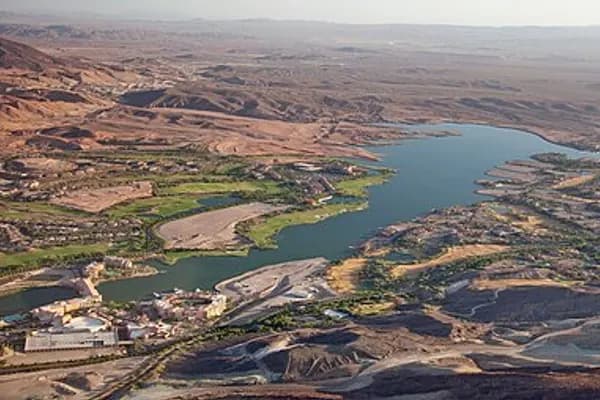
The city is in the Mojave Desert with wildlife and vegetation typical of the Mojave, situated in the Las Vegas Valley drainage basin at the northern end of the McCullough Range in the southeast quadrant of the Las Vegas Valley.
Residential neighborhoods in Henderson include Anthem, Anthem Country Club, Ascaya, Black Mountain Vistas, Cadence, Calico Ridge, Champion Village, The Fountains, Grand Legacy, Green Valley, Green Valley Estates, Green Valley Ranch, Hillsboro Heights, Inspirada, Lake Las Vegas, MacDonald Highlands, MacDonald Ranch, Madeira Canyon, Club at Madeira Canyon, Roma Hills, Seven Hills, Sun City Anthem, Sun City MacDonald Ranch, Tuscany Village, and Whitney Ranch.
Climate
Henderson is classified as having a hot desert climate (BWh) in the Köppen climate classification. It has mild winters and hot summers. Snow can occasionally fall in the winter. The monsoon can bring storms in the summer, which can cause flash flooding and thunderstorms. The hottest month is July and the coldest month is December. On average there are 292 clear days per year.
Demographics
2020 census
According to the 2020 census, Henderson had a population of 317,610 residents, a just-over 23% increase from the 2010 census. The city's racial makeup was 66.4% White alone, 6.0% Black or African American alone, 0.8% American Indian and Alaska Native alone, 9.3% Asian alone, 0.7% Native Hawaiian and Pacific Islander alone, and 10.9% identifying as two or more races. Hispanic or Latino people of any race were 19.1% of the population, while 59.3% were non-Hispanic White.
There were 124,626 households, with an average household size of 2.54 individuals. Owner-occupied housing units accounted for 65.2% of all households, with a median value of $427,900. The median gross rent was $1,641.
The age distribution in 2020 was as follows: 4.9% under 5 years old, 21.4% under 18, and 20.0% aged 65 or older. The median age was 42.2 years. For every 100 females, there were 98.81 males.
Economically, the median household income was $85,311, with a per capita income of $46,882. Approximately 8.1% of the population lived below the poverty line.
Residents with at least a high school diploma accounted for 93.6% of the population, while residents with bachelor's degrees or higher accounted for 35.3%.
2010 census
At the census of 2010, 257,729 people resided in Henderson. The racial makeup was 76.9% White, 5.1% African American, 0.7% Native American, 7.2% Asian, 0.6% Pacific Islander, and 4.8% from two or more races. Hispanic or Latino people of any race were 14.9% of the population and 68.7% of the population was non-Hispanic White.
According to the 2000 census, there were 175,381 people, 66,331 households, and 47,095 families residing in the city. The population density was 2,200.8 inhabitants per square mile (849.7/km). There were 71,149 housing units at an average density of 892.8 per square mile (344.7/km). The city's racial makeup was 80.49% White, 3.76% African American, 0.70% Native American, 3.98% Asian, 0.42% Pacific Islander, 3.16% from other races, and 3.49% from two or more races. Hispanic or Latino people of any race were 13.71% of the population.
There were 66,331 households, out of which 33.0% had children under the age of 18 living with them, 56.4% were married couples living together, 10.0% had a female householder with no husband present, and 29.0% were non-families. 20.3% of all households were made up of individuals, and 5.0% had someone living alone who was 65 years of age or older. The average household size was 2.63 and the average family size was 3.05.
In the city, the population was spread out, with 25.1% under the age of 18, 7.9% from 18 to 24, 32.5% from 25 to 44, 24.4% from 45 to 64, and 10.1% who were 65 years of age or older. The median age for the city was 36 years. For every 100 females, there were 98.4 males. For every 100 females age 18 and over, there were 96.4 males.
The city's median household income was $63,830, and the median family income was $74,120. The per capita income for the city was $33,238. About 3.9% of families and 5.6% of the population were below the poverty line, including 6.4% of those under age 18 and 4.7% of those age 65 or over.
Economy
The largest single employer in Henderson is the city government itself, with 3,524 full-time equivalent employees. Other large employers include Barclays, Green Valley Ranch, Sunset Station, Amazon, the Las Vegas Raiders, and Dignity Health, which operates two hospital campuses in Henderson.
In 2023, the city released a report to identify areas for public policy improvement to support the city economy's primary industries, including: logistics, electric equipment and components manufacturing, financial and credit services, media and sports production, and back-office management and support services. Overall, the city attracts more advanced industries than its Southern Nevada counterparts such as Las Vegas, North Las Vegas, and Boulder City since Henderson has more bachelor's and master's degree-holding residents per capita.
Manufacturing
TIMET, one of the largest manufacturers of titanium in the world, operates a facility in Henderson that produces titanium sponge and titanium tetrachloride, employing approximately 600 people.
Levi Strauss operates a 620,000-square-foot (58,000m) manufacturing and distribution facility in Henderson, where it utilizes advanced laser technology to create custom-designed denim products. This facility allows for the production of personalized designs at a rapid pace.
Haas Automation, a leading manufacturer of computerized numerical control machines, began constructing a major production facility in Henderson in 2024. The new facility will cover 2,400,000 square feet (220,000m) and is expected to employ up to 1,400 people over five years.
ProCaps Laboratories, a vitamin manufacturing company, operates a 90,000-square-foot (8,400m) facility in Henderson. The facility includes a unique 1,400-square-foot (130m) glass-enclosed broadcast studio that enables live broadcasting while production continues uninterrupted. This arrangement is a first-of-its-kind setup in the U.S. for a vitamin production facility.
IT networking infrastructure
Google's $600 million data center in Henderson operates on a 64-acre (260,000m) campus. This facility supports Google's network infrastructure Google Cloud, AI, Maps, Search in North America. In addition to the initial investment, Google announced plans to invest an additional $400 million in 2024 to upgrade its Nevada data centers, including the one in Henderson.
Logistics
Amazon operates multiple facilities in Henderson. Among them is a 600,000-square-foot (56,000m) cross-dock facility that enables efficient redistribution of large inventory shipments. The facility employs over 1,000 workers and is one of three Amazon fulfillment centers in Nevada.
The Las Vegas Raiders maintain their corporate headquarters and a healthcare performance center in Henderson. The facility features a 336,000-square-foot (31,200m) complex with training fields and administrative offices.
Kroger operates a major distribution center in Henderson, which supports grocery operations throughout the region. The 428,000-square-foot (39,800m) facility employs around 270 people and serves as a vital logistics hub for the company's network of stores.
Ethel M Chocolates, established by Forrest Mars Sr., has been a part of Henderson's economic fabric since 1981. The facility produces gourmet chocolates and offers a popular tourist attraction with its cactus garden and interactive experiences.
Top employers
Although ranges are given in order to protect employee privacy, according to the City of Henderson Comprehensive Annual Financial Report, fiscal year ending June 30, 2024, identifies the city's largest employers as:
Arts and culture
An increasing number of major shopping malls, movie theater complexes, concert venues, restaurants and casino resorts offer residents a variety of choices for leisure time in Henderson. The city also sits a few miles southeast of Las Vegas and is not too far from the world-famous Las Vegas Strip. "Shakespeare in the Park" celebrated its tenth anniversary in 1996, a testament to Henderson's long-standing support for the arts and cultural programs. The city also boasts the largest recreational facility – the Henderson Multigenerational Facility – in Nevada as well as Nevada's only scenic Bird Preserve. The city supports a variety of other cultural events, many of which are held at the outdoor amphitheater, the largest one of its kind in Nevada.
Points of interest
Acacia Demonstration Gardens
Anthem Country Club
Ascaya
Black Mountain Recreation Center
Clark County Heritage Museum
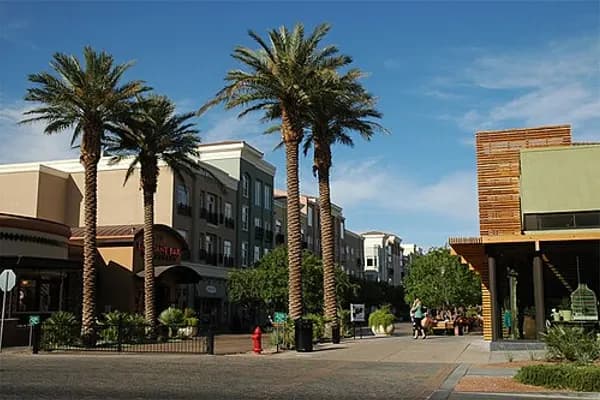
The District at Green Valley Ranch
Ethel M Botanical Cactus Garden
Ethel M Chocolate Factory
Encyclopedic content adapted from the Wikipedia article on Henderson, used under CC BY-SA 4.0.