About the neighborhood
Borough of Amsterdam in North Holland, Netherlands
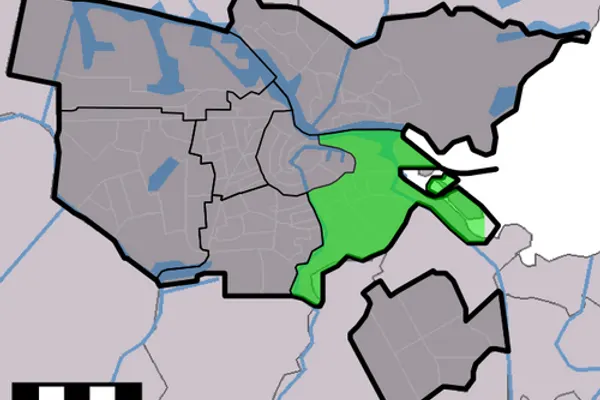
Amsterdam-Oost (Dutch pronunciation: ˌɑmstərdɑmˈoːst) is a borough of Amsterdam, Netherlands, established in May 2010 after a merger of the former boroughs of Zeeburg and Oost-Watergraafsmeer. In 2013, the borough had almost 123,000 inhabitants.
History
Amsterdam-Oost is the borough of Amsterdam on the eastern side of the Singelgracht canal. The borough is bordered by the Amstel river in the west, the Weespertrekvaart canal in the south, and the IJ lake in the east and north.
The eastern city expansion beyond the 17th-century Amsterdam canal belt began in the last quarter of the 19th century with the development of the Oosterparkbuurt and Dapperbuurt. These neighborhoods, including the Weesperzijde area along the Amstel river, are called Oud-Oost ('Old East').
In the early 20th century, additional urban expansions were planned toward the east. Between 1920 and 1940, the Indische Buurt and Transvaalbuurt neighborhoods were constructed, partly on the territory of the former municipality of Nieuwer-Amstel. To improve the accessibility of these new neighborhoods, a railway project known as Spoorwegwerken Oost ('Eastern Railway Works') was carried out between 1932 and 1942 in which the old ground-level railroads were elevated on embankments and viaducts. In addition, the former Weesperpoortstation (1843) was closed on October 15, 1939, to be replaced by the Amsterdam Amstel railway station. The railway works also allowed for the extension of several tram routes.
From 1939 to 1942, further urban expansion projects were carried out in the former municipality of Watergraafsmeer, which was annexed by the city of Amsterdam in 1921.
In the 1990s, the new neighborhoods were added in the Oostelijk Havengebied ('Eastern Docklands') area. Since 2002, the new neighborhood of IJburg, initially also called Nieuw-Oost ('New East') is under construction. The Zeeburgereiland is also to be developed for residential purposes.
In March 2007, the Transvaalbuurt and parts of the Indische Buurt were marked aandachtswijk (disadvantaged neighborhood) by minister for housing Ella Vogelaar which made national urban renewal funds and programmes available to the area.
In 2007, construction of the Oostpoort shopping centre and residential area on the site of the former Oostergasfabriek began, which has also become home of the Stadsdeelkantoor(borough or 'district' office) and several educational institutions.
Borough government
Until 2014, the Amsterdam boroughs, called stadsdelen or 'districts', were governed by a directly elected district council (deelraad) as well as a separate district executive board, the members of which were appointed and controlled by the council. Since the 2014 municipal elections, the district councils have been abolished and replaced by smaller, but still directly elected district committees (bestuurscommissies). The district committees are elected every four years, on the same day as the city's central municipal council. Each district committee elects three of its members to form an executive committee (dagelijks bestuur). The district committees' jurisdiction is determined by the central municipal council. Responsibilities delegated to the 2014-2018 district committees include parks and recreation, streets and squares, refuse collection, permits and events, preparation of zoning plans, passports and drivers licenses, and welfare work.
The district committee of Amsterdam-Oost consists of 15 members. The committee was elected on March 19, 2014. Five national political parties and one local party are represented on the committee. In April 2014, the committee elected its executive committee. Executive committee chair is Ivar Manuel (D66), the other members are Thijs Reuten (PvdA) and Nevin Özütok (GL).
The borough office (stadsdeelkantoor or 'district office') of Amsterdam-Oost is located at Oranje-Vrijstaatplein 2 in the new Oostpoort neighborhood.
Neighborhoods
The borough consists of the following neighborhoods:
IJburg
Indische Buurt
Eastern Docklands (In Dutch, "Oostelijk Havengebied")
Oud-Oost
Watergraafsmeer
References
External links
Wikimedia Commons has media related to Amsterdam-Oost.
Amsterdam-Oost travel guide from Wikivoyage
Borough of Amsterdam-Oost Archived 2014-08-12 at the Wayback Machine
52°21′10″N 4°55′50″E / 52.35278°N 4.93056°E / 52.35278; 4.93056
Encyclopedic content adapted from the Wikipedia article on Amsterdam-Oost, used under CC BY-SA 4.0.
What makes Amsterdam-Oost special
Amsterdam-Oost stands out among Amsterdam’s neighborhoods for its distinctive character: where amsterdam actually hangs out. Ranked #3 in Amsterdam, it offers the kind of experience that defines a great city trip — a place where the streets themselves tell a story and every block rewards curiosity.
Best for
Our take on Amsterdam-Oost
Amsterdam-Oost is one of the strongest neighborhoods in Amsterdam, and it consistently appears in our editors' personal favorites lists. It may not always get the same attention as the city's most famous district, but among travelers who know Amsterdam well, Amsterdam-Oost is often the first recommendation.
What makes Amsterdam-Oost worth the visit is the texture of daily life here. It is a neighborhood that functions for the people who live in it — not just for the visitors who pass through. The shops serve local needs, the restaurants feed local appetites, and the streets have a rhythm that reflects genuine community rather than tourism infrastructure. That is the quality our editors prize most, and Amsterdam-Oost has it in abundance.
Our editors recommend budgeting at least half a day here — enough time to walk the main streets, sit down for coffee, and discover the side streets where Amsterdam-Oost's real character lives.
Living in Amsterdam-Oost
Amsterdam-Oost is connected to the rest of Amsterdam by public transit, and most visitors find it straightforward to reach from the city center or airport. Once you arrive, the neighborhood is best explored on foot — the scale is human and the streets reward wandering.
Day-to-day life in Amsterdam-Oost has the rhythm of a genuine residential neighborhood. You will find grocery stores, pharmacies, cafés with morning regulars, and the kind of small independent shops that only survive where locals support them. For visitors, this means the infrastructure you need — good coffee, a decent meal, a quiet place to sit — is always within a short walk.
Accommodation in Amsterdam-Oost ranges from boutique hotels to short-term rentals. We generally recommend staying within the neighborhood itself rather than commuting from a hotel elsewhere in Amsterdam — the experience of waking up inside a great neighborhood is fundamentally different from visiting one as a day trip.
What locals say about Amsterdam-Oost
Long-term residents of Amsterdam-Oost tend to describe their neighborhood with a mix of pride and protectiveness. Like any district with genuine character, Amsterdam-Oost inspires loyalty — the kind of place people move to and never quite leave, or leave and spend years trying to get back to.
What locals appreciate most about Amsterdam-Oost is its consistency — the feeling that the neighborhood works the same way on a Tuesday morning as it does on a Saturday night. It is not a place that performs for visitors and then goes quiet. The rhythm is genuine, the community is real, and the daily experience of living here is what draws people and keeps them.
Compared to the more famous districts in Amsterdam, Amsterdam-Oost has maintained a lower profile, which many residents consider an advantage. The neighborhood evolves gradually rather than being reshaped by sudden attention, and the result is a community that still feels organic rather than curated.
Visitor tips
- Amsterdam-Oost is located in Amsterdam, Netherlands. The neighborhood is accessible by public transport, taxi, or rideshare from most parts of the city.
- Morning is often the best time to explore — the streets are quieter, the light is better for photography, and cafes are at their most welcoming.
- Wear comfortable walking shoes — the best way to experience Amsterdam-Oost is on foot, wandering the side streets and discovering what lies around each corner.
- Save the neighborhood's location on your phone before you arrive. Offline maps are especially useful for navigating the smaller side streets.