About the neighborhood
Area within the City of Bath, Somerset, England
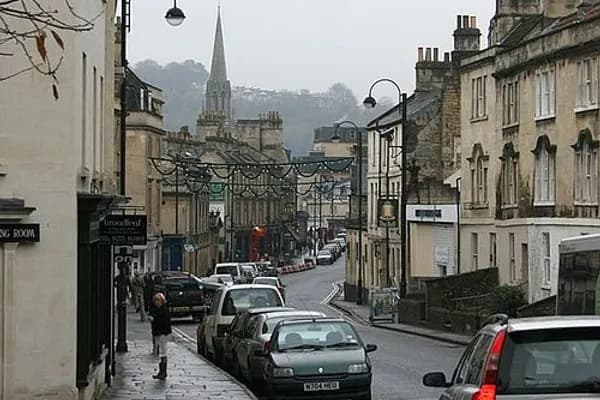
Walcot is a suburb of the city of Bath, in the Bath and North East Somerset district, in the ceremonial county of Somerset, England. It lies to the north-north-east of the city centre, and is an electoral ward of the city.
The Paragon and, continuing out of the city, London Road are part of the A4 road. The other main thoroughfare is Walcot Street, which adjoins the city centre and is well known for its artisan shops.
Walcot Street and London Road are believed to be a Roman road, leading north from the Roman town of Aquae Sulis and linking with the Fosse Way. Walcot originally grew as a residential area (a vicus) in the 1st to 3rd centuries, located between the walled town, the Fosse Way and the possible Roman fort sited across the river in the Bathwick area.
The parish church of St Swithin, on The Paragon was built in 1779-90 by John Palmer. The 18th-century poet Christopher Anstey is buried at the church. Walcot was the birthplace of Richard Debaufre Guyon, who would become, in succession, an Austrian officer, a Hungarian rebel and an Ottoman Pasha.
Governance
The electoral ward returns two councillors to Bath and North East Somerset Council. The wards surrounding Walcot ward are: Lansdown to the north-west, Lambridge to the north-east, Bathwick to the south-east, and Kingsmead to the south-west. The River Avon forms the boundary with Bathwick and is crossed here by the Cleveland Bridge. The Grosvenor area of the city falls within the ward.
In 1891 the civil parish had a population of 24,899. On 26 March 1900 the parish was abolished to form Bath.
Notable residents
Richard Guyon (1813–1856), British-born Hungarian soldier, general in the Hungarian Revolutionary Army.
Sir William Herschel (1738–1822), astronomer, musician.
Benjamin Plim Bellamy (1782–1847), actor and proprietor of the Bath Assembly Rooms.
Arnold Ridley (1896-1984), actor and playwright.
Margaret Graham (balloonist) (1804-1864) first British woman to make a solo balloon flight, which she accomplished in 1826.
References
External links
St Swithin's Church
Walcot Street Artworks Trail leaflet
Explore Walcot Street
History of Walcot Street
Encyclopedic content adapted from the Wikipedia article on Walcot, used under CC BY-SA 4.0.
What makes Walcot special
Walcot stands out among Bath’s neighborhoods for its distinctive character: bath's bohemian creative street. Ranked #4 in Bath, it offers the kind of experience that defines a great city trip — a place where the streets themselves tell a story and every block rewards curiosity.
Best for
Our take on Walcot
Walcot occupies a distinctive place in Bath's neighborhood landscape. It is the kind of district that rewards travelers who venture beyond the obvious choices — quieter than the tourist-facing areas, richer in local character, and full of the small details that make a city trip memorable.
What strikes us most about Walcot is the depth of its food culture. This is not a neighborhood with a few good restaurants — it is a neighborhood where eating well is woven into daily life, where the corner places are as good as the destination spots, and where you could eat every meal for a week without repeating yourself or being disappointed.
Our editors recommend budgeting at least half a day here — enough time to walk the main streets, sit down for coffee, and discover the side streets where Walcot's real character lives.
Living in Walcot
Walcot is connected to the rest of Bath by public transit, and most visitors find it straightforward to reach from the city center or airport. Once you arrive, the neighborhood is best explored on foot — the scale is human and the streets reward wandering.
Day-to-day life in Walcot has the rhythm of a genuine residential neighborhood. You will find grocery stores, pharmacies, cafés with morning regulars, and the kind of small independent shops that only survive where locals support them. For visitors, this means the infrastructure you need — good coffee, a decent meal, a quiet place to sit — is always within a short walk.
Accommodation in Walcot ranges from boutique hotels to short-term rentals. We generally recommend staying within the neighborhood itself rather than commuting from a hotel elsewhere in Bath — the experience of waking up inside a great neighborhood is fundamentally different from visiting one as a day trip.
What locals say about Walcot
Long-term residents of Walcot tend to describe their neighborhood with a mix of pride and protectiveness. Like any district with genuine character, Walcot inspires loyalty — the kind of place people move to and never quite leave, or leave and spend years trying to get back to.
The creative community in Walcot is genuine, not aspirational. Residents include working artists, writers, musicians, and designers who chose the neighborhood because it supported their work — affordable studio space, a community that values craft, and enough foot traffic to sustain independent galleries and shops.
Compared to the more famous districts in Bath, Walcot has maintained a lower profile, which many residents consider an advantage. The neighborhood evolves gradually rather than being reshaped by sudden attention, and the result is a community that still feels organic rather than curated.
Visitor tips
- Walcot is located in Bath, United Kingdom. The neighborhood is accessible by public transport, taxi, or rideshare from most parts of the city.
- Morning is often the best time to explore — the streets are quieter, the light is better for photography, and cafes are at their most welcoming.
- Wear comfortable walking shoes — the best way to experience Walcot is on foot, wandering the side streets and discovering what lies around each corner.
- Save the neighborhood's location on your phone before you arrive. Offline maps are especially useful for navigating the smaller side streets.