About the neighborhood
Capital and the largest city of Georgia (country)
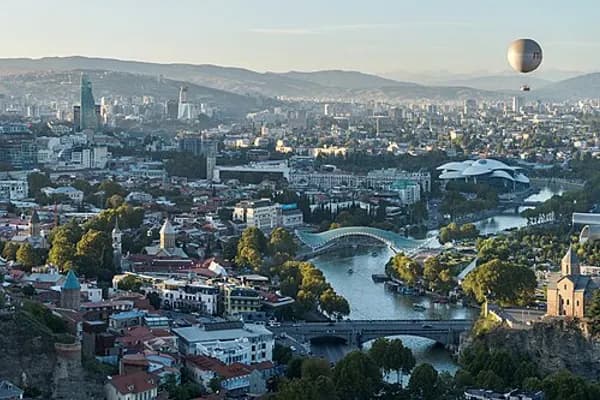
Tbilisi (/təbɪˈliːsi, təˈbɪlɪsi/ tə-bil-EE-see, tə-BIL-iss-ee; Georgian თბილისი, pronounced ˈtʰbilisi or ტფილისი, t'pilisi, tʼpʰilisi) is the capital and largest city of Georgia, located on the banks of the Kura River. With more than 1.3 million inhabitants, it contains almost one third of the country's population. Tbilisi was founded in the fifth century AD by Vakhtang I of Iberia and has since served as the capital of various Georgian kingdoms and republics. Between 1801 and 1917, then part of the Russian Empire, it was the seat of the Caucasus Viceroyalty, governing both the northern and southern sides of the Caucasus.
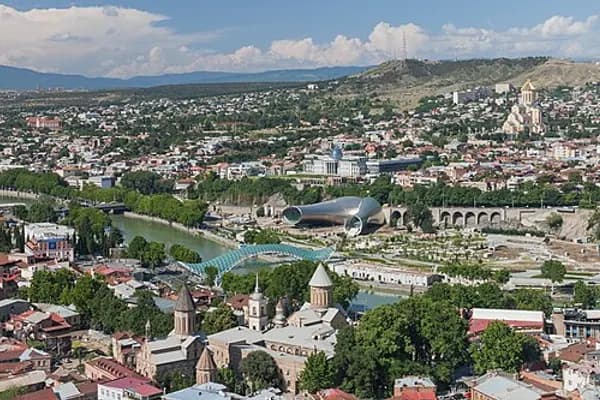
Because of its location at the crossroads between Europe and Asia, and its proximity to the lucrative Silk Road, throughout history, Tbilisi has been a point of contention among various global powers. To this day, the city's location ensures its position as an important transit route for energy and trade projects. Tbilisi's history is reflected in its architecture, which is a mix of medieval, neoclassical, Beaux Arts, Art Nouveau, Stalinist, and Modern structures.
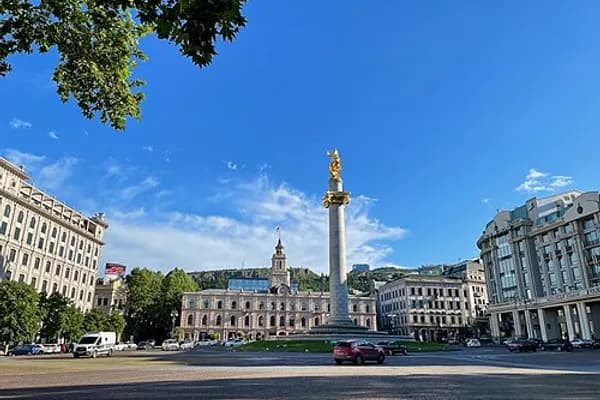
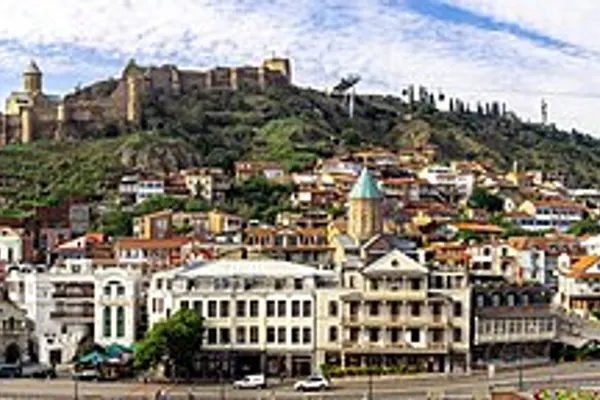
Historically, Tbilisi has been home to people of diverse cultural, ethnic, and religious backgrounds, though its population is overwhelmingly Eastern Orthodox Christian. Notable tourist destinations include the Sameba and Sioni cathedrals, Freedom Square, Rustaveli Avenue and Aghmashenebeli Avenue, medieval Narikala Fortress, the pseudo-Moorish Opera Theater, and the Georgian National Museum. The climate in Tbilisi mostly ranges from 20 to 32°C (68 to 90°F) in summer and −1 to 7°C (30 to 45°F) in winter.
Names and etymology
The name "Tbilisi" derives from Old Georgian Tbilisi (Asomtavruli: ႧႡႨႪႨႱႨ, Mkhedruli: თბილისი), and further from tpili (Modern Georgian: თბილი, warm, itself from Old Georgian: ႲႴႨႪႨ ṭpili). The name Tbilisi (the place of warmth) was therefore given to the city because of the area's numerous sulfuric hot springs.
Until 1936, the name of the city in English and most other languages followed the Persian pronunciation Tiflis, while the Georgian name was ტფილისი (Ṭpilisi). In some languages it is still known by its pre-1936 name Tiflis (/ˈtɪflɪs/ TIF-liss)
On 17 August 1936, by order of the Soviet leadership, the official Russian names of various cities were changed to more closely match the local language. In addition, the Georgian-language form Ṭpilisi was modernized on the basis of a proposal by Georgian linguists; the ancient Georgian component ტფილი (ṭpili, 'warm') was replaced by the newer თბილი (tbili). That form was the basis for the new official Russian name (Тбилиси Tbilisi). Most other languages have subsequently adopted the new name form, but some languages, such as Turkish, Persian, Greek, Spanish, and German, have retained a variation of Tiflis.
Some of the traditional names of Tbilisi in other languages of the region have different roots. The Ossetian name Калак (Kalak) derives from the Georgian word ქალაქი (kalaki) meaning simply city. Chechen and Ingush names for the city use a form similar to or the same as their names for the country of Georgia (Гуьржех Gürƶex) as does the historical Kabardian name (Курджы Kwrdžə), while Abkhaz Қарҭ (Ķarţ) is from the Mingrelian ქართი (Karti).
History
Early history
Archaeologists discovered evidence of continuous habitation of the Tbilisi suburb of Dighomi since the early Bronze Age, and stone artifacts dating to the Paleolithic age.
During the late Bronze Age to early Iron Age, it was the largest settlement in the Caucasus. According to legend, the present-day territory of Tbilisi was covered by forests as late as 458. One widely accepted variant of the Tbilisi foundation myth states that King Vakhtang I of Iberia (r.c. 447/49–502/22) went hunting in the heavily wooded region with a falcon (sometimes the falcon is replaced with either a hawk or other small birds of prey in the legend). The king's falcon allegedly caught or injured a pheasant during the hunt, after which both birds fell into a nearby hot spring and died from burns. King Vakhtang became so impressed with the hot springs that he decided to clear the forest and build a city on the location.
King Dachi of Iberia (r.522–534), the successor of Vakhtang I, moved the capital of Iberia from Mtskheta to Tbilisi and began construction of the fortress wall that lined the city's new boundaries. From the sixth century, Tbilisi grew at a steady pace due to the region's strategic location along with important trade and travel routes between Europe and Asia.
Foreign domination
Tbilisi's favorable trade location, however, did not necessarily bode well for its survival. Located strategically in the heart of the Caucasus between Europe and Asia, Tbilisi became an object of rivalry among the region's various powers such as the Roman Empire, Parthia, Sassanid Persia, Muslim Arabs, the Byzantine Empire, and the Seljuk Turks. The cultural development of the city was somewhat dependent on who ruled the city at various times, although Tbilisi was fairly cosmopolitan.
From 570 to 580, the Persians ruled the city until 627, when Tbilisi was sacked by the Byzantine/Khazar armies and later, in 736–738, Arab armies entered the town under Marwan II. After this point, the Arabs established an emirate centered in Tbilisi. Arabic dirhams were brought to Georgia following the Arab conquest in the seventh century, and a mint was founded in Tbilisi that produced coins with inscriptions in both Arabic and Georgian. In 764, Tbilisi – still under Arab control – was once again sacked by the Khazars. In 852, the armies of Arab leader Bugha Al-Turki invaded Tbilisi in order to enforce its return to Abbasid allegiance. The Arab domination of Tbilisi continued until about 1050. In 1065, the Seljuk Sultan Alp Arslan campaigned against the Kingdom of Georgia, subjugated Tbilisi, and built a mosque in the city.
Capital of Georgia
In 1121, after the Battle of Didgori against the Seljuks, the troops of King David IV of Georgia besieged Tbilisi, taking it in 1122. David moved his residence from Kutaisi to Tbilisi, making it the capital of a unified Georgian State, thus inaugurating the Georgian Golden Age. From the 12–13th centuries, Tbilisi became a regional power with a thriving economy and astonishing cultural output. By the end of the 12th century, the population of Tbilisi had reached 100,000. The city also became an important literary and cultural center, not only for Georgia, but also for the Eastern Orthodox world of the time. During Queen Tamar's reign, Shota Rustaveli worked in Tbilisi while writing his legendary epic poem The Knight in the Panther's Skin. This period is often referred to as "Georgia's Golden Age" or the Georgian Renaissance.
Mongol domination and other instability
Tbilisi's "Golden Age" did not last for more than a century. In 1226, Tbilisi was captured by the Khwarezmian Empire under Shah Jalal al-Din, who massacred tens of thousands of Christians. The Khwarezmian occupation left Tbilisi's defenses severely devastated and prone to further attacks by Mongol armies. In 1236, after suffering crushing Mongol defeats, Georgia submitted to Mongol domination. The nation itself maintained a form of "semi-independence" and did not lose its statehood, but Tbilisi would be strongly influenced by the Mongols for the next century, both politically and culturally. In the 1320s, the Mongols retreated from Georgia, and Tbilisi became the capital of an independent Georgian state, once again. However, an outbreak of the Black Death struck the city in 1366.
Between the late 14th century and the late 18th century, Tbilisi would again be under the rule of various foreign powers. On several occasions, the city would even be completely burned and razed to the ground. On 22 November 1386, Tbilisi was sacked by the armies of Timur. Timur invaded the Kingdom of Georgia seven more times. In 1440, the city was invaded and looted by Jahan Shah of the Qara Qoyunlu. From 1477 to 1478, the city was held by the Aq Qoyunlu tribesmen of Uzun Hassan.
Iranian and Ottoman control
As early as the 1510s, Tbilisi (and the kingdoms of Kartli and Kakheti) were made vassal territories of Safavid Iran. In 1522, Tbilisi was garrisoned for the first time by a large Safavid force. Following the death of king (shah) Ismail I (r. 1501–1524), king David X of Kartli expelled the Iranians. During this period, many parts of Tbilisi were reconstructed and rebuilt. The four campaigns of the king Tahmasp I (r. 1524–1576) resulted in the reoccupation of Kartli and Kakheti, and a Safavid force was permanently stationed in Tbilisi from 1551 onwards, reinforced with the 1555 Treaty of Amasya.
Tbilisi was captured by the Ottomans in 21-24 August 1578, under Osman Pasha and Mustafa Pasha, following the departure of David XI ("Daud Khan") from the city, during the Ottoman–Safavid War (1578–1590). It would remain under Ottoman control for the next 40 years.
From 1614 to 1747, with brief intermissions, Tbilisi was an important city under Iranian rule, and it functioned as a seat of the Iranian vassal kings of Kartli whom the shah conferred with the title of vali. In 1718, the Venetian senate implored the Safavid emperor Soltan Hoseyn to protect the Catholic Armenians and Capuchin missionaries in Tbilisi from the Gregorian Armenians. Under the later rules of Teimuraz II and Heraclius II, Tbilisi became a vibrant political and cultural center free of foreign rule—but, fearful of the constant threat of invasion, Georgia's rulers sought Russian protection in the 1783 Treaty of Georgievsk. Despite this agreement, the city was captured and devastated in 1795 by the Iranian Qajar ruler Agha Mohammad Khan.
Russian control
In 1801, the Russian Empire annexed the Georgian Kingdom of Kartli-Kakheti, of which Tbilisi was one of the most significant urban centers. Within Tsarist Russia, Tbilisi (known then as Tiflis) was included within the Tiflis Uyezd county in 1801, part of what was initially the Georgia Governorate. Following the establishment of the Tiflis Governorate (Gubernia) in 1846, Tbilisi became its capital. Russian Imperial administrators implemented a new Western-style city plan and commissioned new buildings and infrastructure, including roads and railroads connecting Tbilisi to other important cities in the Russian Empire, such as Batumi and Poti. By the 1850s, Tbilisi once again emerged as a major trade and cultural center, with many foreign, including Western European, entrepreneurs operating.
The likes of Ilia Chavchavadze, Akaki Tsereteli, Mirza Fatali Akhundzade, Iakob Gogebashvili, Alexander Griboyedov and many other statesmen, poets and artists all found their home in Tbilisi. The city was visited on numerous occasions by and was the object of affection of Alexander Pushkin, Leo Tolstoy, Mikhail Lermontov, the Romanov family and others. The main new artery built under Russian administration was Golovin Avenue (present-day Rustaveli Avenue), on which the Viceroys of the Caucasus established their residence. For much of the early 19th century, Tbilisi's largest ethnic group was Armenian, at some point forming 74.3% of the population.
Brief independence
After the Russian Revolution of 1917, the city served as a location of the Transcaucasus interim government which established, in the spring of 1918, the short-lived independent Transcaucasian Federation with the capital in Tbilisi. At this time, Tbilisi had roughly the same number of Armenians as Georgians, with Russians being the third largest ethnic group. It was in the former Viceroy of the Caucasus's palace where the independence of three Transcaucasus nations – Georgia, Armenia and Azerbaijan – was declared by their respective national councils on 26 to 28 May 1918. After this, Tbilisi functioned as the capital of the Democratic Republic of Georgia until 25 February 1921. From 1918 to 1919, the city also consecutively served as the headquarters of the country's German garrison and later the British 27th Division; Tbilisi was also the main office of the British Chief Commissioner in Transcaucasia, Oliver Wardrop and the High Commissioner to Armenia, Colonel William N. Haskell.
Under the national government, Tbilisi turned into the first Caucasian University City after the Tbilisi State University was founded in 1918. On 25 February 1921, the Bolshevist Russian 11th Red Army invaded Tbilisi and after bitter fighting at the outskirts of the city, declared Soviet rule.
Soviet rule
In 1921, the Democratic Republic of Georgia was occupied by the Soviet Bolshevik forces from Russia, and until 1936, Tbilisi functioned first as the capital city of the Transcaucasian SFSR (which included Armenia, Azerbaijan, and Georgia), and afterward until 1991 as the capital of the Georgian Soviet Socialist Republic. During Soviet rule, Tbilisi's population grew significantly, the city became more industrialized, and it also came to be an important political, social, and cultural centre of the Soviet Union. In 1980, the city hosted the first state-sanctioned rock festival in the USSR. As a major tourist destination for both Soviet citizens and foreign visitors, Tbilisi's "Old Town" (the neighborhoods within the original city walls) was reconstructed in the 1970s and 1980s.
Tbilisi witnessed mass anti-Russian demonstrations during 1956 in the 9 March Massacre, in protest against the anti-Stalin policies of Nikita Khrushchev. Peaceful protests occurred in 1978, and in 1989 the April 9 tragedy was a peaceful protest that turned violent.
Post-independence
Since the break-up of the Soviet Union, Tbilisi has experienced periods of significant instability and turmoil. After a brief civil war, which the city endured for two weeks from December 1991 to January 1992 (when pro-Gamsakhurdia and Opposition forces clashed), Tbilisi became the scene of frequent armed confrontations among various mafia clans and illegal business operators. During the Shevardnadze Era (1992–2003), crime and corruption were rampant. Many segments of society became impoverished because of unemployment caused by the crumbling economy. Average citizens of Tbilisi started to become increasingly disillusioned with the existing quality of life in the city (and in the nation in general). Mass protests took place in November 2003 after falsified parliamentary elections forced more than 100,000 people into the streets and concluded with the Rose Revolution. Since 2003, Tbilisi has experienced considerably more stability with decreasing crime rates, an improved economy, and a real estate boom. During the 2008 South Ossetia war, the Tbilisi area was hit by multiple Russian air attacks.
Encyclopedic content adapted from the Wikipedia article on Vera, used under CC BY-SA 4.0.