About the neighborhood
Town in Bali, Indonesia
Ubud (Balinese: ᬉᬩᬸᬤ᭄) is a town in the Gianyar Regency of Bali, Indonesia. Ubud has no status; that is part of the eponymous Ubud District of Gianyar. Promoted as an arts and culture centre, Ubud has developed a large tourism industry. It forms a northern part of the Greater Denpasar metropolitan area (known as Sarbagita).
Ubud is an administrative district (kecamatan) with a population of 74,800 (as of the 2020 Census) in an area of 42.38km. The central area of Ubud desa (village) has a population of 11,971 and an area of 6.76km, and receives more than three million foreign tourists each year. The area surrounding the town is made up of farms, rice paddies, agroforestry plantations, and tourist accommodations. As of 2018, more tourists visited Ubud than Denpasar to the south.
History
Eighth-century legend tells of a Javanese priest, Rsi Markandya, who meditated at the confluence of two rivers (an auspicious site for Hindus) at the Ubud locality of Campuhan. Here, he founded the Gunung Lebah Temple on the valley floor, which remains a pilgrimage destination.
The town was originally important as a source of medicinal herbs and plants; Ubud gets its name from the Balinese word ubad (medicine).
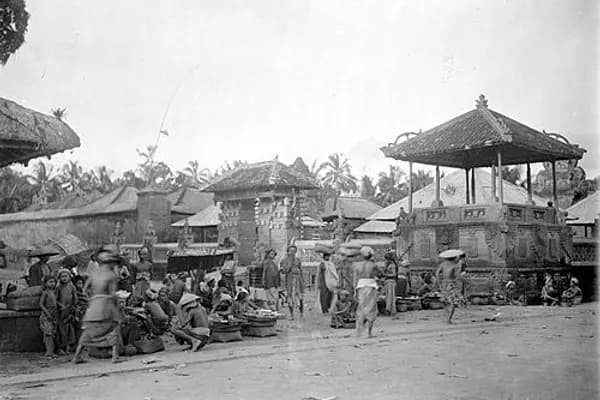
In the late 19th century, Ubud became the seat of feudal lords who owed their allegiance to the king of Gianyar, at one time the most powerful of Bali's southern states. The lords were members of the Balinese Kshatriya caste of Suk and were significant supporters of the village's increasingly renowned arts scene.
Antonio Blanco, a Spanish-American artist, lived in Ubud from 1952 until he died in 1999. A new burst of creative energy came in the 1960s after the arrival of Dutch painter Arie Smit and the development of the Young Artists Movement. The Bali tourist boom since the late 1960s has led to significant development in the town.
In 2002, terrorist bombings caused a decline in tourism throughout Bali, including Ubud. In response to this, the Ubud Writers and Readers Festival was created to help revive tourism, the island's main economic lifeline.
Streets
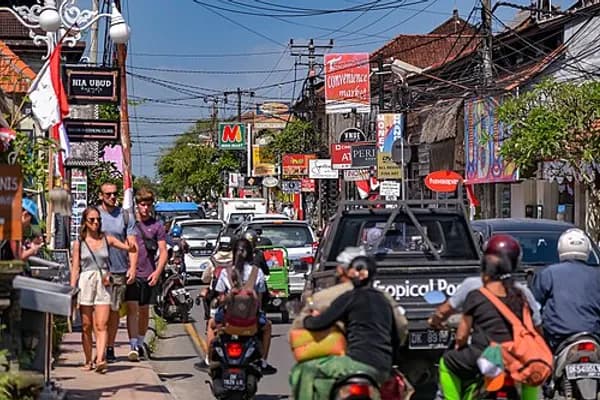
The main street is Jalan Raya Ubud (Jalan Raya means main road), which runs east–west through the center of town. Two long roads, Jalan Monkey Forest and Jalan Hanoman, extend south from Jalan Raya Ubud.
Buildings
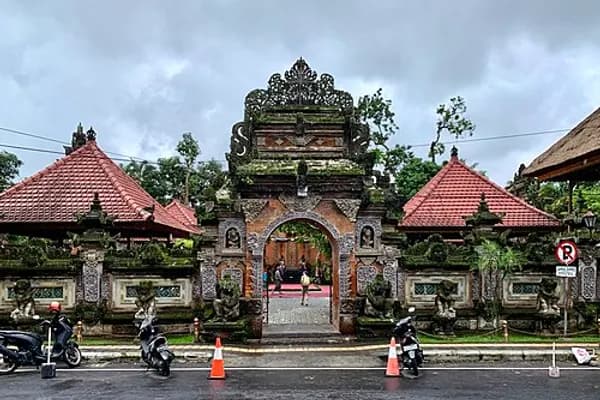
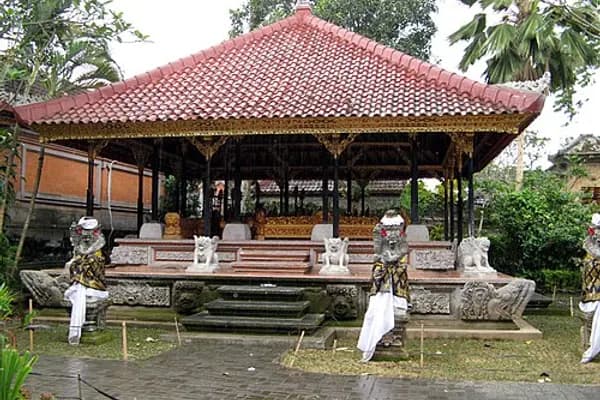
Puri Saren Agung is a large palace located at the intersection of Monkey Forest and Raya Ubud roads. The residence of Tjokorda Gede Agung Sukawati (1910–1978), the last ruling monarch of Ubud, is still owned by the royal family. Dance performances and ceremonies are held in its courtyard. The palace was also one of Ubud's first hotels, opening its doors back in the 1930s.
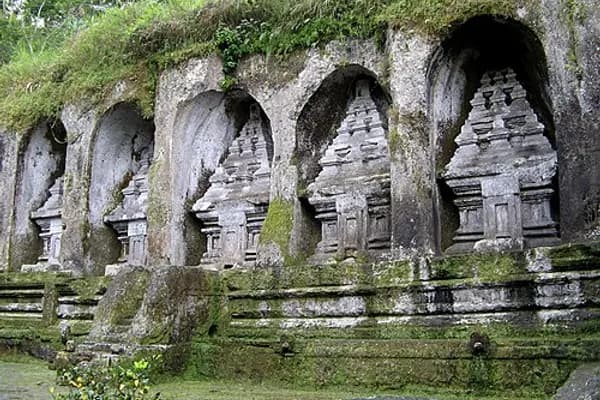
Some Hindu temples exist, such as Pura Desa Ubud, which is the main temple, Pura Taman Saraswati, and Pura Dalem Agung Padangtegal, the temple of death. The Gunung Kawi temple is the site of the royal tombs. Goa Gajah, also known as the Elephant Cave, is located in a steep valley just outside Ubud near the town of Bedulu.
The Moon of Pejeng, in nearby Pejeng, is the largest single-cast bronze kettle drum in the world, dating from circa 300BC. It is a popular destination for tourists interested in local culture.
Transportation
Like other towns popular with tourists in Bali, it is not permitted to order a metered taxi or ride-sharing service for pickup within Ubud. Instead, a taxi and price must be negotiated with a member of the local taxi cooperative. This protectionist system ensures the driver is local and also keeps fares inflated to up to 10 times those available elsewhere.
Economy
The economy of Ubud is highly reliant on tourism, with a focus on shopping, resorts, museums, yoga, and zoos. There is a strong focus on sustainable economy regarding the retail industry in Ubud, with many Bali-grown brands favoring materials and ingredients that would not cause much waste to the environment. From home and living amenities to tropical clothing brands, Ubud offers a unique array of retail options that have proven attractive to tourists from around the world.
One of the initiatives that have boosted Ubud as another popular tourist destination in recent years is the Ubud Food Festival (UFF). Happening in less than a week every April, this festival brings fellow restaurateurs and restaurants in Ubud together to create either special menus or particular promotions that may not be available in other months.
In contrast to the tourist area in southern Bali, the Ubud area is less densely populated by locals. However, tourists far outnumber locals, with the Gianyar regency seeing 3,842,663 tourist arrivals in 2017 - 1.3 million alone visiting Ubud Monkey Forest.
Culture
The town and area have several art museums, including the Blanco Renaissance Museum, the Puri Lukisan Museum, the Neka Art Museum, and the Agung Rai Museum of Art. The Museum Rudana in Peliatan is nearby. Galleries promoting local and overseas crafts abound in Ubud, too. Some often hold exhibitions focused on stimulating dialogue between local and international artists, rather than on selling artworks. One of the primary examples is BIASA ArtSpace, founded by art enthusiast and fashion designer Susanna Perini.
The 'Tek Tok' is a traditional Balinese dance that is accompanied by the musical sound of mouth 'Tek Tok', along with various combinations of body movement and other sounds. The story Draupadi Parwa told in the Tek Tok Dance conveys a moral message: when a woman who embodies the values of patience, sacrifice, compassion, devotion, and holy sincerity is disrespected, disasters and calamities will befall a kingdom or state. This story also conveys the message that God will always protect truth, virtue, devotion, and genuine compassion. The Tek Tok dance performance is held regularly at the Bali Culture Center (BCC) in Ubud four times a week. Ubud Writers and Readers Festival (UWRF) is held annually and attracts writers and readers from around the world.
Many Balinese dances are performed around Ubud, including the Legong by the Peliatan Dance Group, the first troupe to travel abroad.
Climate
Ubud has a tropical rainforest climate (Af).
Administration
Ubud kecamatan/district is made up of the following desa (villages): Kedewatan, Sayan, Singakerta, Peliatan, Mas, Lodtunduh, Petulu, Padang tegal, and Ubud itself.
Nature
The Mandala Suci Wenara Wana is known to Westerners as the Ubud Monkey Forest. The grounds contain an active temple and are located near the southern end of Monkey Forest Street. This protected area houses the Pura Dalem Agung Padangtegal, and as of June 2017, approximately 750 crab-eating macaques (Macaca fascicularis) monkeys live there.
The Campuhan Ridge Walk is a hill in nearby Campuhan, from where one can see two rivers, Tukad Yeh Wos Kiwa and Tukad Yeh Wos Tengen, merge. A one-meter-wide paved-block track runs about 2 kilometers to the top of the hill, a popular spot to watch the sunset.
Goa Gajah, also known as the Elephant Cave, features intricate carvings and a tranquil meditation cave.
Tegunungan Waterfall is one of the highest waterfalls in the Ubud area of Bali. At more than 40 meters high, this waterfall is surrounded by green scenery.
Notes
References
Picard, Kunang Helmi (1995) Artifacts and Early Foreign Influences. From Oey, Eric, ed. (1995). Bali. Singapore: Periplus Editions. pp.130–133. ISBN962-593-028-0.
Wikimedia Commons has media related to Ubud.
External links
Ubud website
Weather station in Ubud
Wikivoyage has a travel guide for Ubud.
Encyclopedic content adapted from the Wikipedia article on Ubud Centre, used under CC BY-SA 4.0.
What makes Ubud Centre special
Ubud Centre stands out among Bali (Ubud)’s neighborhoods for its distinctive character: bali's cultural heart among the rice fields. It tops our ranking of the best neighborhoods in Bali (Ubud), it offers the kind of experience that defines a great city trip — a place where the streets themselves tell a story and every block rewards curiosity.
Best for
Our take on Ubud Centre
Ubud Centre is the neighborhood we send friends to first when they visit Bali (Ubud). It earns the top spot in our ranking not because it is the most famous district in the city, but because it delivers the most complete neighborhood experience — the kind of place where every block rewards curiosity and every return visit reveals something new.
What makes Ubud Centre exceptional is the density of its cultural life. Art galleries, independent bookshops, small theaters, and creative studios are woven into the fabric of the neighborhood rather than clustered in a single zone. You encounter culture here by accident, which is how the best cultural experiences always happen.
Our editors recommend budgeting at least half a day here — enough time to walk the main streets, sit down for coffee, and discover the side streets where Ubud Centre's real character lives.
Living in Ubud Centre
Ubud Centre is connected to the rest of Bali (Ubud) by public transit, and most visitors find it straightforward to reach from the city center or airport. Once you arrive, the neighborhood is best explored on foot — the scale is human and the streets reward wandering.
Day-to-day life in Ubud Centre has the rhythm of a genuine residential neighborhood. You will find grocery stores, pharmacies, cafés with morning regulars, and the kind of small independent shops that only survive where locals support them. For visitors, this means the infrastructure you need — good coffee, a decent meal, a quiet place to sit — is always within a short walk.
Accommodation in Ubud Centre ranges from boutique hotels to short-term rentals. We generally recommend staying within the neighborhood itself rather than commuting from a hotel elsewhere in Bali (Ubud) — the experience of waking up inside a great neighborhood is fundamentally different from visiting one as a day trip.
What locals say about Ubud Centre
Long-term residents of Ubud Centre tend to describe their neighborhood with a mix of pride and protectiveness. Like any district with genuine character, Ubud Centre inspires loyalty — the kind of place people move to and never quite leave, or leave and spend years trying to get back to.
The creative community in Ubud Centre is genuine, not aspirational. Residents include working artists, writers, musicians, and designers who chose the neighborhood because it supported their work — affordable studio space, a community that values craft, and enough foot traffic to sustain independent galleries and shops.
Like any neighborhood that has earned attention, Ubud Centre is navigating the tension between popularity and preservation. Rents have risen, new businesses have arrived, and long-time residents occasionally grumble that the neighborhood is not what it was. But the fundamentals — the walkability, the food, the community — remain strong, and most locals we speak to believe the neighborhood is still gaining more than it is losing.
Visitor tips
- Ubud Centre is located in Bali (Ubud), Indonesia. The neighborhood is accessible by public transport, taxi, or rideshare from most parts of the city.
- Morning is often the best time to explore — the streets are quieter, the light is better for photography, and cafes are at their most welcoming.
- Wear comfortable walking shoes — the best way to experience Ubud Centre is on foot, wandering the side streets and discovering what lies around each corner.