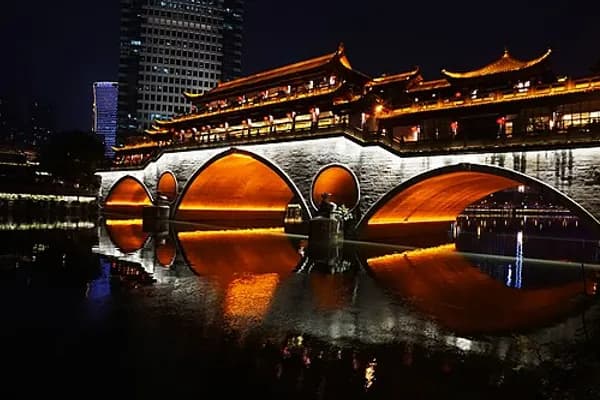
About the neighborhood
Capital of Sichuan, China
City of HibiscusChinese蓉城Literal meaningHibiscus City
Chengdu is the capital city of the Chinese province of Sichuan. With a population of 20,937,757 at the 2020 census, it is the fourth most populous city in China, and it is the only city with a population of over 20 million apart from provincial-level municipalities. It is traditionally the hub of Western China.
Chengdu is in central Sichuan. The surrounding Chengdu Plain is known as the "Country of Heaven" and the "Land of Abundance". Its prehistoric settlers included the Sanxingdui culture. The site of Dujiangyan, an ancient irrigation system, is designated as a World Heritage Site. The Jin River flows through the city. Chengdu's culture reflects that of its province, Sichuan; in 2011, it was recognized by UNESCO as a city of gastronomy. It is associated with the giant panda, a Chinese national symbol that inhabits the area of Sichuan; the city is home to the Chengdu Research Base of Giant Panda Breeding.
Founded by the Kingdom of Shu in the 4th century BC, Chengdu is unique as the only Chinese settlement that has maintained its name unchanged throughout the imperial, republican, and communist eras for more than two thousand years. It was the capital of Liu Bei's Shu Han Empire during the Three Kingdoms Era, as well as several other local kingdoms during the Middle Ages. During World War II, refugees from eastern China fleeing from the Japanese settled in Chengdu. After the war, Chengdu was briefly the capital of the Nationalist republican government until it withdrew to Taipei on the island of Taiwan. Under the PRC, Chengdu's importance as a link between Eastern China and Western China expanded, with railways built to Chongqing in 1952, and Kunming and Tibet afterward. In the 1960s, Chengdu became an important defense industry hub.
Chengdu is one of the most important economic, financial, commercial, cultural, transportation, research, and communication centers in China. Its economy is diverse, characterized by the machinery, automobile, medical, food, and information technology industries. Chengdu is a leading financial hub, ranking 35th globally on the 2021 Global Financial Centres Index. Chengdu also hosts many international companies; more than 315 Fortune 500 companies have established branches in the city. Chengdu is the third Chinese city with two international airports after Beijing and Shanghai. Chengdu Shuangliu International Airport, and the newly built Tianfu International Airport, a hub of Air China and Sichuan Airlines, is one of the 30 busiest airports in the world, and the Chengdu railway station is one of the six biggest in China. Chengdu is considered a "Beta + (global second-tier)" city classification (along with Barcelona and Washington, D.C.) according to the GaWC. As of 2023, the city also hosts 23 foreign consulates, the fourth most in China behind Beijing, Shanghai, and Guangzhou. Chengdu is the seat of the Western Theater Command region of the People's Liberation Army. In 2023, Chengdu became the third Chinese city to host the Summer World University Games, after Beijing and Shenzhen. In 2025, the city also hosted the World Games. It is considered one of the best cities in China to live in, and also a national central city of China.
Chengdu is a major city for scientific outputs, ranking at #21 globally and 2nd in Western China after Xi'an. The city is home to the greatest number of universities and research institutes in Western China. Notably, these include: Sichuan University, University of Electronic Science and Technology of China, Southwestern University of Finance and Economics, Southwest Jiaotong University, Chengdu University of Technology, Sichuan Normal University, and Xihua University.
Name
The name Chengdu is attested in sources dating back to the Warring States period. It has been called the only major city in China to have remained at an unchanged location with an unchanged name throughout the imperial, republican, and communist eras. However, it also had other names; for example, it was briefly known as "Xijing" (Western Capital) in the 17th century. The etymology of the name is unclear. The earliest and most widely known explanation, although not generally accepted by modern scholars, is provided in the 10th-century geographical work Universal Geography of the Taiping Era, which states that the ninth king of Shu's Kaiming dynasty named his new capital Chengdu after a statement by King Tai of Zhou that a settlement needed "one year to become a town, two to become a city, and three to become a metropolis." (The character for cheng Chinese 成 may mean "turned into" while du Chinese 都 can mean either a metropolis or a capital).
The present spelling is based on pinyin romanization; its Postal Map romanization was "Chengtu". Its former status as the seat of the Chengdu Prefecture prompted Marco Polo's spellings "Sindafu", "Sin-din-fu", and the Protestant missionaries' romanization "Ching-too Foo".
Although the city's official name has remained (almost) constant, the surrounding area has sometimes been known by other names, including "Yizhou". Chinese nicknames for the city include the "Turtle City", variously derived from the old city walls' shape on a map or a legend that Zhang Yi had planned their course by following a turtle's tracks; the "Brocade City" (see Sichuan brocade), a contraction of the earlier "City of the Brocade Official", after an imperial office established under the Western Han; the "Hibiscus City" (Rongcheng, 蓉城), from the hibiscus which King Meng Chang of the Later Shu ordered planted upon the city wall during the 10th century.
According to Étienne de la Vaissière, "Baghshūr" (lit.'pond of salt water') may be the Sogdian name for the region of Chengdu. This toponym is attested near Merv, but not far from Chengdu are found the large saltwater wells of the Yangtze basin.
Logo
The city logo adopted in 2011 is inspired by the Golden Sun Bird, an ancient relic unearthed in 2001 from the Jinsha Site.
History
Early history
Archaeological discoveries at the Sanxingdui and Jinsha Site have established that the area surrounding Chengdu was inhabited over four thousand years ago, in the 18th–10th centuryBC. At the time of China's Xia, Shang, and Zhou dynasties, it represented a separate ancient bronze-wielding culture that, following its partial sinification, became known to the Chinese as Shu. Shu was conquered by Qin in 316BC, and the settlement was re-founded by Qin general Zhang Yi.
Pre-Qin to Qin and Han dynasties
In the early stage of the Xia dynasty or even earlier, the ancient Shu Kingdom, located on the Chengdu Plain, had developed a relatively advanced bronze civilization, becoming an important source of Chinese civilization and one of the birthplaces of the Chinese nation. According to records, there were five dynasties in the ancient Shu Kingdom, and their capitals were Qushang (now Wenjiang District, Chengdu), Piyi (now Pidu District), Xindu, and Guangdu. At the end of the Spring and Autumn period (around the 4th century BC), the fifth King Kaiming moved the capital to Chengdu. According to "Taiping Huanyu Ji", the name of the city is borrowed from the history of the establishment of the capital in the Western Zhou dynasty. The allusion in Zhou Wang Qianqi's "one year, he lived in a cluster, two years became a city, and three years Chengdu" is to the name Chengdu; it has been used to this day. Therefore, Chengdu has become a rare city in China and the world that has not changed its name since its establishment. Some people think that Chengdu is a transliteration of ancient Shu place names. There is a saying that "Guangdu, Xindu, and Chengdu" are collectively referred to as the "Three Capitals of Ancient Shu". Nowadays, many cultural relics of the ancient Shu Kingdom are located on the Chengdu Plain, including Sanxingdui Ruins, Jinsha Ruins, Yufu Ancient City Ruins, and Wangcong Temple. Jinsha Ruins, located in Chengdu's urban area, is a pinnacle of ancient Shu culture.
The Golden Mask of the Shang and Zhou dynasties at the Jinsha Site.
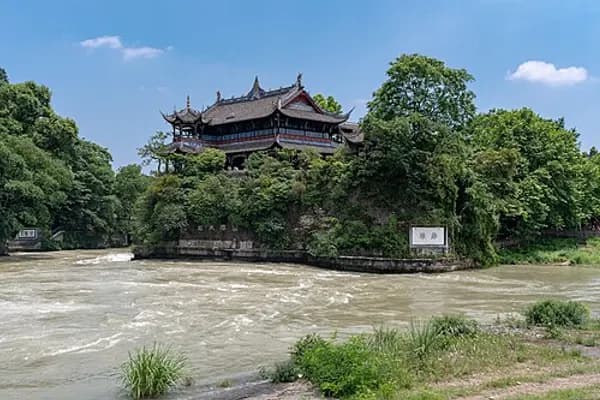
The ancient state of Shu was the first target to be conquered by the Qin state in the process of unifying the world. King Huiwen of Qin had prepared for this for many years and opened the Shiniu Road (i.e., the Jinniu Road) from Qin to Shu. In 316 BC, King Huiwen of Qin took advantage of the mutual attack between Ba and Shu and sent Sima Cuo to lead his army into Shu along the Shiniu Road, capturing the land in a few months. After that, the king of Qin abolished the three Shu Hou and finally established Shu County, with the county seat in Chengdu, the former capital of Shu. In 311 BC, Zhang Yi of the Qin dynasty built the Chengdu city wall according to the system of the capital Xianyang, building a large city and a small city. In 256 BC, King Zhao of Qin appointed Li Bing as the governor of Shu County. During his tenure, he presided over the construction of the world-famous Dujiangyan Water Conservancy Project. The Chengdu Plain has been fertile and wild for thousands of miles since then. After decades of operation, Chengdu replaced Guanzhong Plain in the late Qin dynasty and was called the "Land of Abundance"; this reputation has endured to this day.
During the Han dynasty, the Chengdu economy, especially its brocade industry, prospered, becoming an important source of tribute to the court. The imperial court invested in Chengdu and specifically set up the Jinguan management and built "Jinguan City" in the southwest of Chengdu; "Jinguan City" and "Jincheng" became nicknames for Chengdu. In the second year of Emperor Ping of the Yuan dynasty, Chengdu's population reached 76,000 households, or about 354,000 people, making it one of the most populous cities at the time. Towards the six major cities. In the third year of the reign of Emperor Jing of the Han dynasty (141 BC), the Wen Dang, the prefect of Shu County, established the world's earliest local government-run school, "Wenweng Shishi", in Chengdu. In the Han dynasty, Chengdu's literature and art also reached a high level. All the most famous literary masters in the Han dynasty were from Chengdu, including Sima Xiangru, Yang Xiong, and Wang Bao.
In the former Han dynasty, the whole country was divided into 14 prefectural governors' departments, among which the Yizhou governor was established in Luoxian (now Guanghan City, Sichuan), and the governor later moved to Chengdu. In the first year of Emperor Guangwu's reign (25 years) in the Eastern Han dynasty, Gongsun Shu established himself as the emperor in Chengdu, and the country's name was "married family". In the twelfth year of Jianwu in the Later Han dynasty (36 years), the Great Sima Wuhan of the Eastern Han dynasty finally captured Chengdu after five years of war, and his family perished in the process. In the fifth year of Zhongping (188), Emperor Ling of Han, the court accepted Liu Yan's suggestion and changed the provincial governors to state shepherds with actual recruitment and command power. In the fifth year of Chuping (194), it moved to Chengdu. At that time, the Yizhou Provincial Governor's Department was the place where the Hu people in the Western Regions were operating.
Imperial era
Under the Han, the brocade produced in Chengdu became fashionable and was exported throughout China. A "Brocade Official" (錦官; jǐnguān) was established to oversee its production and transaction. After the fall of the Eastern Han, Liu Bei ruled Shu Han, the southwestern part of the Three Kingdoms, from Chengdu. His minister Zhuge Liang called the area the "Land of Abundance". Under the Tang, Chengdu was considered the second most prosperous city in China after Yangzhou. Both Li Bai and Du Fu lived in the city. Li Bai praised it as "lying above the empyrean." The city's present Caotang ("Grass Hall") was constructed in 1078 in honor of an earlier, more humble structure of that name erected by Du Fu in 760, the second year of his 4-year stay. The Taoist Qingyang Gong ("Green Goat Temple") was built in the 9th century.
Chengdu was the capital of Wang Jian's Former Shu from 907 to 925, when it was conquered by the Later Tang. The Later Shu was founded by Meng Zhixiang in 934, with its capital at Chengdu. Its second and last king, Meng Chang, beautified the city by ordering hibiscus to be planted upon the city walls.
The Song conquered the city in 965, introducing the first widely used paper money in the world. Su Shi praised it as "the southwestern metropolis". At the fall of the Song, a rebel leader set up a short-lived kingdom known as Great Shu (Chinese 大蜀, Dàshǔ). Allegedly, the Mongols called for the death of a million people in the city, but the city's population had fewer than 30,000 residents (not Chengdu prefecture). The aged males who had not fled were killed, while in typical fashion, the women, children, and artisans were enslaved and deported. During the Yuan dynasty, most of Sichuan's residents were deported to Hunan due to the insurgency by western ethnic tribes in western Sichuan. Marco Polo visited Chengdu and wrote about the Anshun Bridge or an earlier version of it.
At the fall of the Ming, the rebel Zhang Xianzhong established his Great Western Kingdom (Chinese 大西) with its capital at Chengdu; it lasted only from 1643 to 1646. Zhang was said to have massacred a large number of people in Chengdu and throughout Sichuan. In any case, Chengdu was said to have become a virtual ghost town frequented by tigers and the depopulation of Sichuan necessitated the resettlement of millions of people from other provinces during the Qing dynasty. Following the Columbian Exchange, the Chengdu Plain became one of China's principal sources of tobacco. Pi County was considered to have the highest quality in Sichuan, which was the center of the country's cigar and cigarette production, the rest of the country long continuing to consume snuff instead.
Modern era
In 1911, Chengdu's branch of the Railway Protection Movement helped trigger the Wuchang Uprising, which led to the Xinhai Revolution that overthrew the Qing dynasty.
During World War II, the capital city of China was forced to move inland from Nanjing to Wuhan in 1937 and from Wuhan to Chengdu, then from Chengdu to Chongqing in 1938, as the Kuomintang (KMT) government under Generalissimo Chiang Kai-shek ultimately retreated to Sichuan to escape from the invading Japanese forces. They brought with them to Sichuan businesspeople, workers, and academics who founded many of the industries and cultural institutions that continue to make Chengdu an important cultural and commercial production center.
Encyclopedic content adapted from the Wikipedia article on Tianfu Square, used under CC BY-SA 4.0.