About the neighborhood
Suburb of Wellington City, New Zealand
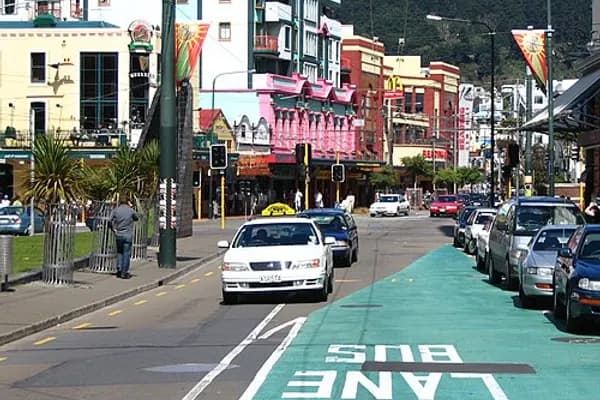
Te Aro (Māori pronunciation; formerly also known as Te Aro Flat) is an inner-city suburb of Wellington, New Zealand. It comprises the southern part of the central business district including the majority of the city's entertainment district and covers the mostly flat area of city between The Terrace and Cambridge Terrace at the base of Mount Victoria.
Geography and history
Waimapihi Stream is now mostly culverted, but formerly ran from the area around Zealandia and down Aro Valley then past what is now the western end of Te Aro Park and on to the sea. The name means "the stream (or bathing place) of Mapihi, a chieftainess of those iwi". Te Aro Pā was east of the stream near what is now lower Taranaki Street.
Waitangi stream flowed from Newtown, past the Basin Reserve and down to the shore at the eastern side of Te Aro, forming a large swamp or lagoon that was used by Māori for food (eels and shellfish) and flax gathering. The stream flooded in heavy rain. Periodically the shingle beach that created the lagoon would collapse, draining the lagoon. This happened in spectacular fashion in March 1853:
On Thursday evening it commenced raining heavily and continued to do so without intermission during the whole of Thursday night and the greater part of yesterday. About four o'clock yesterday afternoon the large additional body of water which had accumulated in the swamp at Te Aro, in consequence of the rain, caused to burst the narrow bank which separated it from the sea with a loud noise which was heard to a considerable distance, and a thick turbid stream of mud poured forth with great rapidity into the harbour. From the head of the swamp, winding through its whole length, a regular channel has been cut of the average width of ten or twelve yards, and during the afternoon masses of earth, and small islands of flax were hurried with amazing swiftness by the stream and force of the current into the harbour, the surface of which was covered to a considerable extent with masses of floating mud and flax. The opening which has been made to the sea by this sudden eruption of the swamp extends over several of the town acres with water frontage at the head of Lambton harbour.
The 1855 Wairarapa earthquake uplifted Te Aro and drained the swamp. The area around the former swampy foreshore was redeveloped and opened in 2006 as Waitangi Park.
The Te Aro Reclamation Act of 1879 made possible reclamation of 40 acres of land on the foreshore as far as what is now Cable Street. Early European settlement in Te Aro was centred on commerce and working-class people, as opposed to Thorndon which was the centre of official business. By the 1880s Te Aro was packed with working-class houses and businesses catering to the workers, and the area had gained a reputation for being poorly-drained, dirty and disease-ridden. Typhoid was prevalent in the city in the early 1890s and most deaths from the disease occurred in the slums of Te Aro. Almost half of Wellington's deaths in the 1918 influenza pandemic occurred in Te Aro. The situation gradually improved as new suburbs such as Newtown, Miramar and Karori opened up and city infrastructure was developed. In 1945 Wellington City Council held a conference to discuss the slums of Te Aro, which led to the widening of Taranaki Street.
Te Aro Pā
A war party of Te Āti Awa and others migrated from Taranaki to Wellington and established the pā in the 1820s. Members of the New Zealand Company arrived in Wellington in 1839 and laid out a town plan which paid no regard to the several pā in the area. In 1844 six rangatira (chiefs) from the settlement signed the 1844 deed, bringing Te Aro Pā into the New Zealand Company purchase of 1839. William Anson McCleverty was tasked with swapping Māori land around Wellington Harbour for land further away, which resulted in less-convenient food-growing areas.
Around 200 people lived at the pā in the 1840s, but numbers decreased after that. An 1850 survey stated that there were 186 people at Te Aro Pā who were mostly Christian. People lived in traditional "huts" (whare) and there were two "churches or chapels". The people had 26 acres cultivated in potatoes and also grew small amounts of kūmara, wheat and maize. They had seven canoes, 20 horses and two carts, some cattle and tame pigs and had half a ton of flax prepared for export. As a result of losing resources provided by the land they had sold, combined with loss of food- and flax-producing swamp land uplifted by the 1855 earthquake and the return of many people to Taranaki in 1860, the population of Te Aro Pā decreased and by the 1880s almost all had left. Some Māori at the pā had been given Crown Grants to the land which meant they could not sell it, so they leased parcels of land to European settlers. By the 1870s most of the pā's remaining land was sold to Wellington Council who wished to extend Taranaki Street to the waterfront through pā lands.
In 2005 archaeologists discovered the remains of three structures from the pā during redevelopment of a site at 39–43 Taranaki Street.
Chinatown
Haining Street and Frederick Street are short streets which run between Taranaki Street and Tory Street. This area became the centre of Wellington's Chinese community in the late nineteenth century, after miners migrated to the city from goldfields in the South Island. Haining Street became known by its Chinese residents as Ton Yung Gaai ("Chinese people's street"). Haining Street developed a bad reputation for its gambling houses, brothels and opium dens, and the street's notoriety increased in 1905 when white supremacist Lionel Terry shot dead an elderly Chinese man named Joe Kum Yung. Terry was anti-Asian and told authorities he killed Joe to bring public attention to his views. In 2006 a memorial plaque to Joe Kum Yung was installed on the footpath in Haining Street. Some other reminders of the area's time as Wellington's Chinatown are the Chinese Mission Hall at 40 – 46 Frederick Street, designed by Frederick de Jersey Clere and built in 1905, the Wellington Chinese Masonic Society building at 23 Frederick Street, built in 1925, and the Tung Jung Association building at 2 Frederick Street, built in 1926.
Red light district
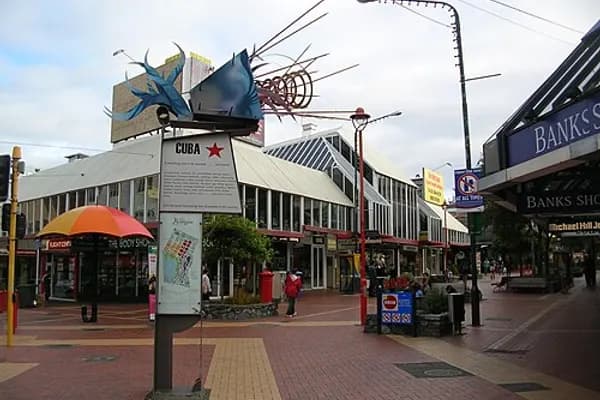
The area around Marion Street, Vivian Street and Cuba Street was the heart of Wellington's red light district for much of the 20th century. Carmen Rupe, a transgender woman prominent in Wellington in the 1970s, ran Carmen's International Coffee House at 86 Vivian Street where sexual services were available. Carmen is remembered with themed traffic lights in Cuba Street. In Marion Street is a trompe-l'oeil mural of a prostitute leaning on a wall. It was painted by Michael Benseman and Michael Ting in 1990, and references the area's history of prostitution. A television documentary produced in 1989 explored the red light district, interviewing prostitutes, strippers and business owners. In 2018 Wellington City Council installed a rainbow-coloured pedestrian crossing at Dixon Street where it bisects Cuba Mall, and in October 2022 two memorial benches were unveiled at the corner of Cuba Street and Vivian Street. The benches commemorate Carmen Rupe and Chrissy Witoko, another transgender businesswoman in the area, and resulted from a collaboration between PrideNZ, the Chrissy Witoko Memorial Trust and the Cultural Heritage team at Wellington City Council.
Demographics
The population of Te Aro roughly doubled between 1991 and 1996 and has increased rapidly since then. The rapid growth rate of population in the area become particularly evident at the beginning of the 21st century as apartment buildings were erected (or converted out of former office buildings) all over the suburb. Particularly characteristic are new rooftop apartments on existing buildings. These can be attributed to the relaxation of city by-laws governing commercial building-zones in the early 1990s. In October 2021 Wellington City Council released its draft District Plan which would allow new buildings in Te Aro to reach 42.5 metres or 12 storeys, to cater for projected population growth in the area. Public feedback following release of the draft plan showed many residents were worried about loss of sunlight and privacy.
Te Aro, comprising the statistical areas of Dixon Street West, Dixon Street East, Vivian West, Courtenay and Vivian East, covers 1.28km (0.49sqmi). It had an estimated population of 11,620 as of June 2025, with a population density of 9,078 people per km.
Te Aro had a population of 12,369 in the 2023 New Zealand census, an increase of 546 people (4.6%) since the 2018 census, and an increase of 2,145 people (21.0%) since the 2013 census. There were 5,913 males, 6,168 females, and 291 people of other genders in 6,039 dwellings. 18.0% of people identified as LGBTIQ+. The median age was 28.8 years (compared with 38.1 years nationally). There were 435 people (3.5%) aged under 15 years, 6,228 (50.4%) aged 15 to 29, 4,992 (40.4%) aged 30 to 64, and 714 (5.8%) aged 65 or older.
People could identify as more than one ethnicity. The results were 69.3% European (Pākehā); 10.1% Māori; 4.3% Pasifika; 24.4% Asian; 3.9% Middle Eastern, Latin American and African New Zealanders (MELAA); and 1.7% other, which includes people giving their ethnicity as "New Zealander". English was spoken by 97.9%, Māori by 2.8%, Samoan by 0.8%, and other languages by 27.6%. No language could be spoken by 0.7% (e.g. too young to talk). New Zealand Sign Language was known by 0.5%. The percentage of people born overseas was 41.7, compared with 28.8% nationally.
Religious affiliations were 18.1% Christian, 3.8% Hindu, 2.2% Islam, 0.6% Māori religious beliefs, 2.2% Buddhist, 0.7% New Age, 0.3% Jewish, and 3.0% other religions. People who answered that they had no religion were 64.6%, and 4.9% of people did not answer the census question.
Of those at least 15 years old, 5,991 (50.2%) people had a bachelor's or higher degree, 4,620 (38.7%) had a post-high school certificate or diploma, and 1,329 (11.1%) people exclusively held high school qualifications. The median income was $51,800, compared with $41,500 nationally. 2,322 people (19.5%) earned over $100,000 compared to 12.1% nationally. The employment status of those at least 15 was 7,329 (61.4%) full-time, 1,656 (13.9%) part-time, and 573 (4.8%) unemployed.
Entertainment and arts
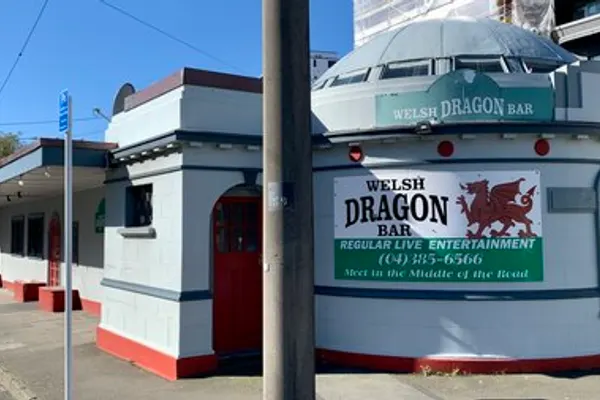
Te Aro is New Zealand's largest entertainment district and thrives at night when the business district to the north closes down. Much of the nightlife is in the north of the suburb around Courtenay Place, Dixon Street, and lower Cuba Street. Saturdays are the biggest nights when most bars and clubs stay open to at least 3am.
Movies were historically a popular pastime in Te Aro, but in recent years some cinemas have closed. The Paramount in Courtenay Place opened in 1917 and closed in 2017. The 10-screen Reading complex in Courtenay Place closed in November 2016 after suffering damage in the Kaikōura earthquake. It reopened in March 2017 but closed again in January 2019 after further assessment. The iconic Embassy Theatre, symbolic home of The Lord of the Rings film series, is still open.
Te Aro is home to several small theatres, including Circa, BATS, The Hannah Playhouse and Griffin. Larger venues include The Opera House on Manners Street and the St. James Theatre on Courtenay Place.
There are several galleries and museums in the area. The National Tattoo Museum Of New Zealand opened at 187 Vivian Street in 2011, after moving from other premises.
Points of interest
Te Aro Park
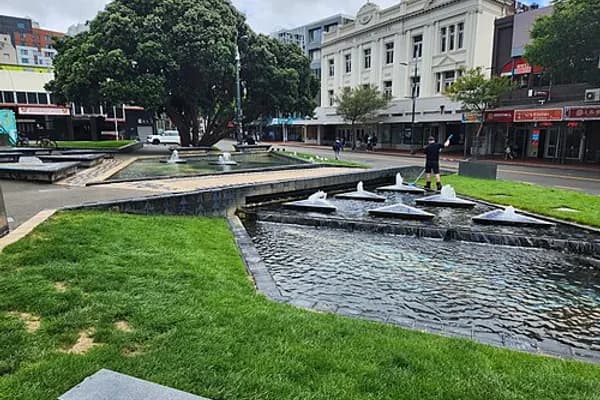
Te Aro Park (formerly commonly known as Pigeon Park) is a small public park situated on a triangular piece of land between Manners Street and Dixon Street. Te Aro Pā was close to this location but by the 1880s very few Māori remained at the site. The Council bought the land in the 1870s, and it became known as Market Reserve and then Manners Street Reserve. In 1910 buildings on the site were demolished and a park created, with public toilets at the western end. An electrically operated clock was installed at the eastern end of the park in 1927 by the Tramways Department, but has since been moved further along to a pedestrian area in Courtenay Place. In 1939 a memorial and drinking fountain were installed by Taranaki Street Wesleyan Church to commemorate the centenary of Wesleyan missionaries landing in Wellington and preaching to Māori at Te Aro Pā. The memorial was retained in the redeveloped park.
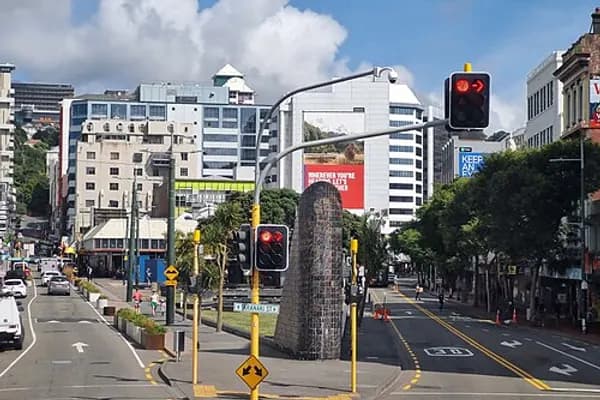
In 1988 Wellington City Council approved a design by Shona Rapira Davies for redevelopment of the park as a symbolic waka (canoe). The project, named Te Waimapihi, ended up costing over $800,000, more than three times the amount agreed with Davies, and was finished a year later than agreed. A documentary was made about Davies' work on the park and the controversy that surrounded the project. The redeveloped park was opened in May 1992. A tiled upright structure forms the prow of the canoe, and trees planted at intervals along the sides represent paddlers. Paving at the park is formed from 30,000 clay tiles handmade by Davies and imprinted with plants and names. Warning signs had to be installed when it was discovered that the tiles become extremely slippery when wet. Triangular shapes throughout the park evoke Māori weaving, and flowing water in the park's pools represents cleansing and renewal. A piece of pounamu (greenstone) was buried under the prow at the opening ceremony.
Encyclopedic content adapted from the Wikipedia article on Te Aro, used under CC BY-SA 4.0.