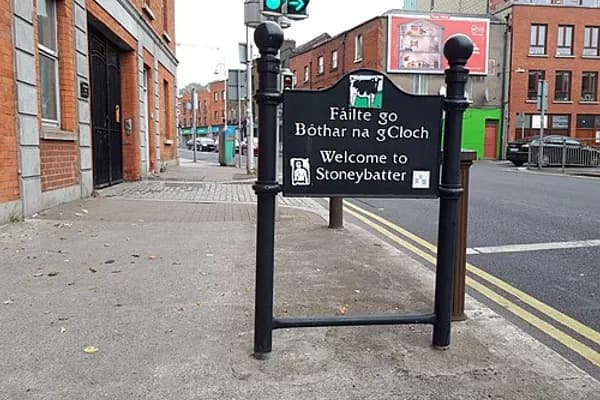
About the neighborhood
Neighbourhood in northern inner-city Dublin, Ireland
Stoneybatter (Irish: Bóthar na gCloch), is a neighbourhood of Dublin, Ireland, on the Northside of the city between the River Liffey, the North Circular Road, Smithfield Market, and Grangegorman. It is in the D7 postal district.
It is often referred to as Dublin's "hipster quarter", and was in Time Out's list of coolest neighbourhoods in the world in 2019.
History
James Collins' 1913 book Life in Old Dublin notes that "Centuries ago (Stoneybatter) was called Bothar-na-gCloch". In Joyce's Irish names of places we find the following interesting information as to the original name of the place: "Long before the city had extended so far, and while Stoneybatter was nothing more than a country road, it was -- as it continues to be -- the great thoroughfare to Dublin from the districts lying west and north-west of the city; and it was known by the name of Bothar-na-gCloch (Bohernaglogh), i.e. the road of the stones, which was changed to the English equivalent, Stoneybatter or stony road".
Stoneybatter is mentioned as the district from which the two sisters, the Misses Morkan, had moved to Usher's Island, in the exposition at the beginning of James Joyce's final story in Dubliners, "The Dead". Stoneybatter is also the main location for events in the Tana French novel "The Trespasser," and the area is mentioned in the Irish folk song "The Spanish Lady". In 1937 the Aughrim Street Scout Group was established, operating ever since and a prominent feature of the local community
In recent years the area has become known as an example of an area undergoing gentrification.
Local street names
Viking names
Apart from the striking artisan dwellings, the area is also known for its prominent Viking street names. For example, there is Viking Road, Olaf Road, Thor Place, Sitric Road, Norseman Place, Ard Ri Road, Malachi Road, Ostman Place, Ivar Street, Sigurd Road and Harold Road. At the time of the Norman invasion, the Vikings, Ostmen or Austmenn (men of the East) as they called themselves, were exiled to the north of the Liffey where they founded the hamlet of Ostmenstown, later to become Oxmantown.
Other street names
The northern end of Stoneybatter derives its name of Manor Street, bestowed in 1780, from the Manor of Grangegorman in which it was located. During the reign of Charles II (1660–1680), the Manor was held by Sir Thomas Stanley, a knight of Henry Cromwell and a staunch supporter of the Restoration. The short thoroughfare in Stoneybatter called Stanley Street is named after him.
Transport
Stoneybatter is served by Dublin Bus routes 11/b, 37, 39/a/x, and 70/n, as well as Go-Ahead Ireland route N2. These routes connect the neighbourhood with Dublin city centre, Phoenix Park, Cabra, Ashtown, Castleknock, Blanchardstown, Clonsilla, Ongar, Clonee, Dunboyne, Donnybrook, Clonskeagh, Kilmacud, Sandyford, Broombridge, Glasnevin, Griffith Avenue, Marino and Fairview. The Luas stops at Smithfield and Phibsborough are located nearby, but no Luas stop directly serves the neighbourhood of Stoneybatter. Heuston station is also close by, served by both InterCity and Commuter rail services.
Popular culture
The streets and surrounding areas of Stoneybatter have been used as a filming location for both TV and film. Notable productions, filmed in the area, include:
TV series
Dear Sarah (1989)
Who Do You Think You Are? (2014)
Who Do You Think You Are? (Ireland) (2018)
Modern Love (TV series) (2020)
Film
Robbery (1967)
Educating Rita (1983)
Michael Collins (1996)
The Informant (1997)
The Boxer (1997)
Angela's Ashes (1999)
When Brendan Met Trudy (2000)
Shadow Dancer (2012)
Love, Rosie (2014)
Nan: The Movie (2020)
The Miracle Club (2023)
Father Mother Sister Brother (2025)
Music
Spice Girls – "Stop" (1998)
See also
List of towns and villages in the Republic of Ireland
References
External links
Wikimedia Commons has media related to Stoneybatter.
The Guardian – "Discover Dublin’s Stoneybatter, a district on the rise" (2016)
Encyclopedic content adapted from the Wikipedia article on Stoneybatter, used under CC BY-SA 4.0.
What makes Stoneybatter special
Stoneybatter stands out among Dublin’s neighborhoods for its distinctive character: dublin's quirkiest village. Ranked #4 in Dublin, it offers the kind of experience that defines a great city trip — a place where the streets themselves tell a story and every block rewards curiosity.
Best for
Our take on Stoneybatter
Stoneybatter occupies a distinctive place in Dublin's neighborhood landscape. It is the kind of district that rewards travelers who venture beyond the obvious choices — quieter than the tourist-facing areas, richer in local character, and full of the small details that make a city trip memorable.
What makes Stoneybatter worth the visit is the texture of daily life here. It is a neighborhood that functions for the people who live in it — not just for the visitors who pass through. The shops serve local needs, the restaurants feed local appetites, and the streets have a rhythm that reflects genuine community rather than tourism infrastructure. That is the quality our editors prize most, and Stoneybatter has it in abundance.
Our editors recommend budgeting at least half a day here — enough time to walk the main streets, sit down for coffee, and discover the side streets where Stoneybatter's real character lives.
Living in Stoneybatter
Stoneybatter is connected to the rest of Dublin by public transit, and most visitors find it straightforward to reach from the city center or airport. Once you arrive, the neighborhood is best explored on foot — the scale is human and the streets reward wandering.
Day-to-day life in Stoneybatter has the rhythm of a genuine residential neighborhood. You will find grocery stores, pharmacies, cafés with morning regulars, and the kind of small independent shops that only survive where locals support them. For visitors, this means the infrastructure you need — good coffee, a decent meal, a quiet place to sit — is always within a short walk.
Accommodation in Stoneybatter ranges from boutique hotels to short-term rentals. We generally recommend staying within the neighborhood itself rather than commuting from a hotel elsewhere in Dublin — the experience of waking up inside a great neighborhood is fundamentally different from visiting one as a day trip.
What locals say about Stoneybatter
Long-term residents of Stoneybatter tend to describe their neighborhood with a mix of pride and protectiveness. Like any district with genuine character, Stoneybatter inspires loyalty — the kind of place people move to and never quite leave, or leave and spend years trying to get back to.
What locals appreciate most about Stoneybatter is its consistency — the feeling that the neighborhood works the same way on a Tuesday morning as it does on a Saturday night. It is not a place that performs for visitors and then goes quiet. The rhythm is genuine, the community is real, and the daily experience of living here is what draws people and keeps them.
Compared to the more famous districts in Dublin, Stoneybatter has maintained a lower profile, which many residents consider an advantage. The neighborhood evolves gradually rather than being reshaped by sudden attention, and the result is a community that still feels organic rather than curated.
Visitor tips
- Stoneybatter is located in Dublin, Ireland. The neighborhood is accessible by public transport, taxi, or rideshare from most parts of the city.
- Morning is often the best time to explore — the streets are quieter, the light is better for photography, and cafes are at their most welcoming.
- Wear comfortable walking shoes — the best way to experience Stoneybatter is on foot, wandering the side streets and discovering what lies around each corner.
- Save the neighborhood's location on your phone before you arrive. Offline maps are especially useful for navigating the smaller side streets.