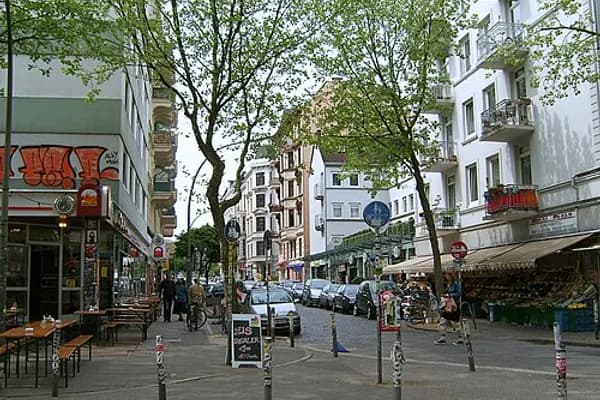
About the neighborhood
Quarter of Hamburg in Germany
Sternschanze (German pronunciation: ˈʃtɛʁnˌʃantsə , lit.'Star Sconce') is a quarter in the centre of Hamburg (Germany) within the Altona borough. In 2014, the population was 7,776 on an area of 0.6km with a density of 14,113 inhabitants per km. After Reeperbahn, it is Hamburg's best known entertainment and nightlife district. It is also known as Schanzenviertel (ˈʃantsn̩ˌfɪʁtl̩ ) and nicknamed Schanze (ˈʃantsə ).
History
The name of the quarter originates from a sconce (German: Schanze) shaped like a star that was built in 1682 in front of the Hamburg Wallring. From the 1930s to the 1970s the quarter was home to a large number of working-class people. In the 1970s, families and students started moving into the area. It nearly, but not fully, maps onto the entertainment district area of Schanzenviertel with its many bars and clubs, which is known as “die Schanze" by its inhabitants. In the local slang, residents here live "in the sconce" ("in der Schanze").
The former concert house/theatre building Rote Flora (built in 1888 as Flora concert hall) is also located here, at the street known as Schulterblatt. It was squatted by leftist groups in 1989, after plans in 1987/88 emerged to rebuild it as a new musical theatre. These plans were later realized near Holstenstraße station as Neue Flora. Since the beginning of the occupation, Rote Flora was used for cultural events by the squatting groups. In 2000, the building was acquired by real-estate agent Klausmartin Kretschmer, under a contract where the city of Hamburg prohibited him to make any alterations. Because he planned to make alterations anyway, conflicts arose with residents. In 2014, Hamburg city re-bought the building to avoid further conflicts; the building was renovated in 2015 by volunteers.
Since the beginning of the new millennium, Sternschanze has become en vogue and subject to gentrification. Nevertheless, political demonstrations, mostly by leftist groups, take place here and sometimes lead to clashes with the police, frequently on 1 May (German Labour Day). Graffiti paintings can be found on many walls throughout the quarter. In 2008, the area of Schanzenviertel, which formerly was cut into three parts by the boundaries of Hamburg-Mitte, Eimsbüttel, and Altona, was merged into the new quarter of Sternschanze, which since then has belonged only to the Altona borough.
Politics
These are the results of Sternschanze in the Hamburg state election:
Geography
Sternschanze is located between the quarters of St. Pauli, Altona-Altstadt, Eimsbüttel, and Rotherbaum.
Transportation
Sternschanze station is serviced by Hamburg S-Bahn (lines S11, S21, S31) and U-Bahn trains (U3 line), Feldstraße - which is officially located in neighbouring St. Pauli quarter - by the underground line U3 only. Schlump station is located on the north eastern boundaries of the Sternschanze quarter and served by underground lines U2 and U3.
References
External links
Sternschanze at Hamburg.de, in German
Wikimedia Commons has media related to Hamburg-Sternschanze.
Hamburg portal
Encyclopedic content adapted from the Wikipedia article on Sternschanze, used under CC BY-SA 4.0.
What makes Sternschanze special
Sternschanze stands out among Hamburg’s neighborhoods for its distinctive character: hamburg's alternative heart. Ranked #2 in Hamburg, it offers the kind of experience that defines a great city trip — a place where the streets themselves tell a story and every block rewards curiosity.
Best for
Our take on Sternschanze
Sternschanze is one of the strongest neighborhoods in Hamburg, and it consistently appears in our editors' personal favorites lists. It may not always get the same attention as the city's most famous district, but among travelers who know Hamburg well, Sternschanze is often the first recommendation.
What makes Sternschanze exceptional is the density of its cultural life. Art galleries, independent bookshops, small theaters, and creative studios are woven into the fabric of the neighborhood rather than clustered in a single zone. You encounter culture here by accident, which is how the best cultural experiences always happen.
Our editors recommend budgeting at least half a day here — enough time to walk the main streets, sit down for coffee, and discover the side streets where Sternschanze's real character lives.
Living in Sternschanze
Sternschanze is connected to the rest of Hamburg by public transit, and most visitors find it straightforward to reach from the city center or airport. Once you arrive, the neighborhood is best explored on foot — the scale is human and the streets reward wandering.
Day-to-day life in Sternschanze has the rhythm of a genuine residential neighborhood. You will find grocery stores, pharmacies, cafés with morning regulars, and the kind of small independent shops that only survive where locals support them. For visitors, this means the infrastructure you need — good coffee, a decent meal, a quiet place to sit — is always within a short walk.
Accommodation in Sternschanze ranges from boutique hotels to short-term rentals. We generally recommend staying within the neighborhood itself rather than commuting from a hotel elsewhere in Hamburg — the experience of waking up inside a great neighborhood is fundamentally different from visiting one as a day trip.
What locals say about Sternschanze
Long-term residents of Sternschanze tend to describe their neighborhood with a mix of pride and protectiveness. Like any district with genuine character, Sternschanze inspires loyalty — the kind of place people move to and never quite leave, or leave and spend years trying to get back to.
The creative community in Sternschanze is genuine, not aspirational. Residents include working artists, writers, musicians, and designers who chose the neighborhood because it supported their work — affordable studio space, a community that values craft, and enough foot traffic to sustain independent galleries and shops.
Like any neighborhood that has earned attention, Sternschanze is navigating the tension between popularity and preservation. Rents have risen, new businesses have arrived, and long-time residents occasionally grumble that the neighborhood is not what it was. But the fundamentals — the walkability, the food, the community — remain strong, and most locals we speak to believe the neighborhood is still gaining more than it is losing.
Visitor tips
- Sternschanze is located in Hamburg, Germany. The neighborhood is accessible by public transport, taxi, or rideshare from most parts of the city.
- Morning is often the best time to explore — the streets are quieter, the light is better for photography, and cafes are at their most welcoming.
- Wear comfortable walking shoes — the best way to experience Sternschanze is on foot, wandering the side streets and discovering what lies around each corner.
- Save the neighborhood's location on your phone before you arrive. Offline maps are especially useful for navigating the smaller side streets.