About the neighborhood
Suburb of Melbourne, Victoria, Australia
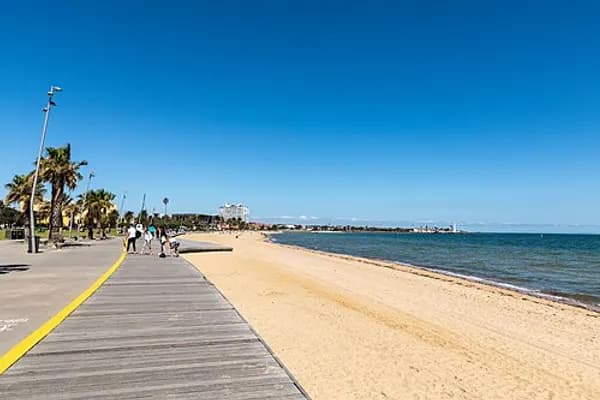
St Kilda is an inner seaside suburb in Melbourne, Victoria, Australia, six kilometres (3+12 miles) southeast of the Melbourne central business district, located within the City of Port Phillip local government area. St Kilda recorded a population of 19,490 at the 2021 census. The beachfront and hill portion of the locality (between Fitzroy Street, the beach and St Kilda Road), is well known for its cafes, bars, palm trees and old flats and mansions, particularly along the main streets such as Fitzroy Street, Grey Street and Acland Street. The locality also includes the lower density areas between Barkly Street and Hotham Street, and the area south of Carlisle Street down to Dickens Street, as well as a part of Albert Park.
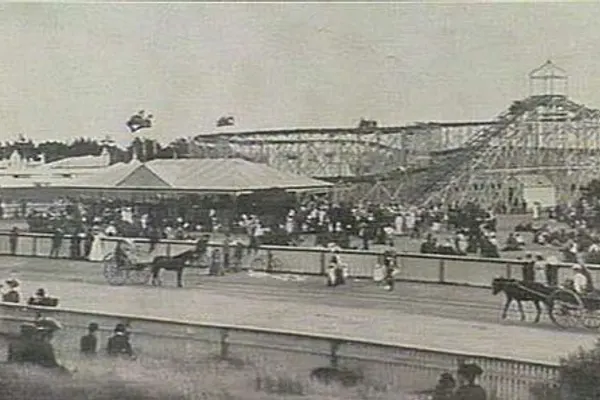
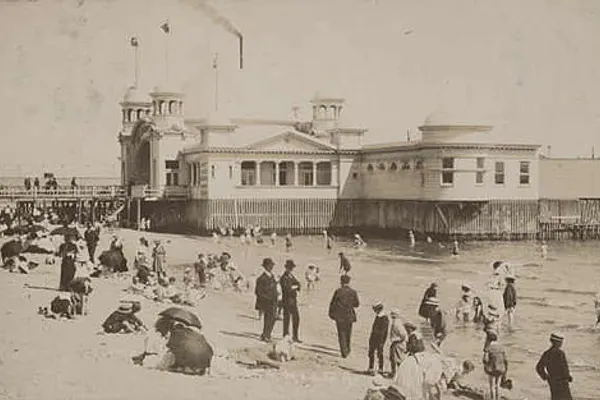
St Kilda was named by Charles La Trobe, then superintendent of the Port Phillip District, after a schooner, Lady of St Kilda, which moored at the main beach in early 1842. From the 1850s to the 1880s in the Victorian era, St Kilda became a favoured suburb of Melbourne's elite, and many palatial mansions and grand terraces were constructed along its hills, wide streets and waterfront. After the turn of the century, the St Kilda foreshore became Melbourne's favoured playground, with electric tram lines linking the suburbs to the seaside amusement rides, ballrooms, cinemas and cafes, and crowds flocked to St Kilda Beach. Many of the mansions and grand terraces became guest houses, and some demolished or their gardens were filled in with apartment buildings, making St Kilda the most densely populated suburb in Melbourne by the 1930s.
After World War II, St Kilda became Melbourne's red-light district, and the guest houses became low-cost rooming houses. By the late 1960s, St Kilda had developed a culture of bohemianism, attracting prominent artists and musicians, including those in the punk and LGBT subcultures. While some of these groups still maintain a presence in St Kilda, since the 2000s the district has experienced rapid gentrification, pushing many lower socio-economic groups out to other areas, with the suburb again being sought after by the wealthy. Since at least the 1950s, the suburb has been the centre of Melbourne's Jewish community.
St Kilda is home to many of Melbourne's visitor attractions including Luna Park, St Kilda Pier, the Palais Theatre and the Esplanade Hotel. It hosts many of Melbourne's big events and festivals.
Name
Before being officially named St Kilda in 1842 by Charles La Trobe, who was superintendent of the Port Phillip District of New South Wales, the area was known by several names, including 'Green Knoll', 'Punk Town' and 'The Village of Fareham'. It was eventually named after the schooner Lady of St Kilda, which was owned between 1834 and 1840 by Sir Thomas Acland. Acland sold the vessel in 1840 to Jonathan Cundy Pope of Plymouth. The vessel sailed for Port Phillip in February 1841. The ship was used in Port Phillip as a cargo vessel; in January 1842 it was docked in Hobson Bay and listed for sale by exchange of sheep. The vessel was moored at the main beach for the early part of 1842, which was soon known as "the St Kilda foreshore".
The schooner Lady of St Kilda was named in honour of Lady Grange, who was imprisoned by her husband between 1734 and 1740 on the island of Hirta, the largest island in the St Kilda archipelago, on the western edge of Scotland.
History
The Euroe Yroke area (now known as St Kilda) was inhabited an estimated 31,000 to 40,000 years ago. Evidence has been found of shellfish middens and huts along Albert Park and Lake and axes which were most likely sharpened on the sandstone cliffs behind the main beach. Corroborees were held at the historic tree which still stands at St Kilda Junction, at the corner of Fitzroy Street and Queens Road. Much of the area north of present-day Fitzroy Street was swampland, part of the Yarra River delta, which comprised vast areas of wetlands and sparse vegetation.
The first European settler in St Kilda was Benjamin Baxter in around 1839. He was a settler from Melbourne on a grazing lease. In 1840, St Kilda was the home to Melbourne's first quarantine station for Scottish immigrants.
The area was officially named St Kilda in 1842. The first sale of Crown lands for the village of St Kilda took place on 7 December 1842. The first block was bought by James Ross Lawrence, who had been master of the Lady of St Kilda until 1842. Lawrence had now settled in Melbourne. His block was bounded by three unmade roads. One of these roads he named Acland Street, after Thomas Acland, who had been his employer until 1840 but who had never been to Port Phillip District. The remaining two became Fitzroy Street and The Esplanade. (A plaque at the junction of Acland and Fitzroy Streets marks the site of the block.) By 1845, Lawrence had subdivided and sold the land on which he had built a cottage. The land on the sea side of The Esplanade has continued to be Crown land.
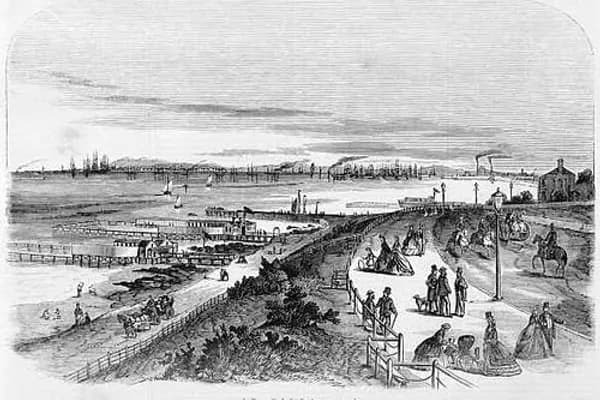
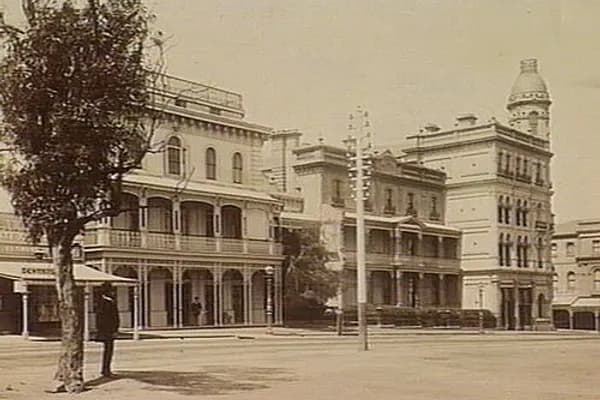
Sparsely settled at first, nevertheless the indigenous peoples were soon driven out. The high ground above the beach offered a cool fresh breeze during Melbourne's hot summer months, and the suburb offered such attractions that after the gold rush of the 1850s, St Kilda became the most fashionable area for the wealthy. By the 1880s, St Kilda hosted many mansions and grand terraces. The area east of St Kilda Road, sometimes known as St Kilda Hill, featured large villas and mansions in extensive grounds.
St Kilda became a separate municipality on 24 April 1857, and in the same year, the railway line connected St Kilda to Melbourne city, and a loop line to Windsor. These railway lines made the area even more attractive as a place to settle, and attracted visitors to St Kilda Beach, with attractions such as the St Kilda Pier, various privately run sea baths, and events like the St Kilda Cup. Cricket and bowling clubs were formed in 1855 and 1865 respectively. By the mid-1860s St Kilda had about fifteen hotels, including the George Hotel on Fitzroy Street (which began as the Terminus in 1857).
The wealthy elite included numerous Jewish families, and St Kilda's first synagogue was built in 1872 in Charnwood Grove.
What is now called St Kilda Road, south of the junction, was originally called High Street, and before it was widened was lined with shops.
Land boom
St Kilda's population more than doubled between 1870 and 1890, to about 19,000 persons. By the time of the Land Boom of the 1880s St Kilda the mansions and grand terraces were joined by palatial hotels - The Esplanade Hotel was built in 1878 overlooking St Kilda Beach, and the George Hotel opposite the station was greatly expanded in 1889. The smaller streets with smaller blocks between the big estates were developed with modest cottages and terraces, housing the working class population of the area.
Much of the area which is now St Kilda West was swampland, but was reclaimed and subdivided in the 1880s, though only the blocks closest to Fitzroy Street were built on at first.
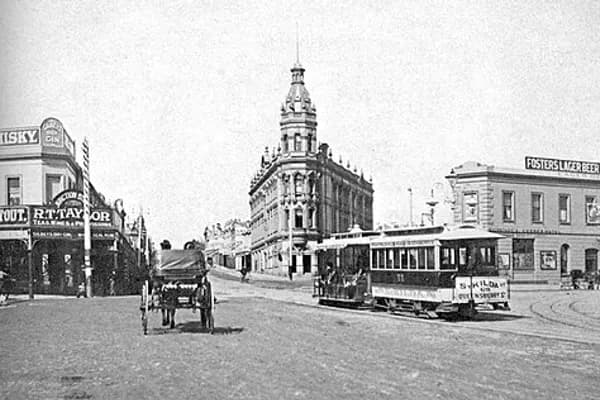
Cable tram lines across Melbourne were built in the late 1880s, with a line from Swanston Street in central Melbourne along St Kilda Road to St Kilda Junction completed in 1888, and a line from Windsor station at Chapel Street along Wellington Street and Fitzroy Streets, then around the Esplanade, opened in 1891, making the suburb and the beachfront easily accessible.
Seaside playground
The boom of the 1880s ended with the bank crashes of the early 1890s and subsequent depression, affecting all levels of society, but ruining many of the newly wealthy. Many of St Kilda's mansions and spacious terrace houses became guest houses, and the wealthy elite retreated to other exclusive suburbs such as Brighton and Toorak.
From 1906, the Victorian Railways operated a tram line, described as an 'Electric Street Railway', from St Kilda Station to Brighton, via Grey Street, Barkly Street and Mitford Street in Elwood. The developing electric tram lines in the east and southeastern suburbs soon arrived as well, with two lines terminating in front of Luna Park by 1913, joined by the electric line that replaced the cable car in 1925, bringing cords of day-trippers to the beach front.
Carlo Catani, a native of Italy, a local resident, and Chief Engineer of the Public Works Department, was a founding member of the St Kilda Foreshore Committee established in 1906, tasked with the beautification of the St Kilda foreshore, for which he did the design. His plan saw the creation of park and lawn areas, paths and promenades, rockeries and gardens and avenues of trees and palms right along the foreshore. The committee also oversaw the leases for the various amusement operators wishing to cater to the growing visitation to the area, which included the Dreamland amusement park (1906 - 1909), a new St Kilda Sea Baths (1910), which replaced the 1862 "Gymnasium Baths", Luna Park (1912), the Palais de Danse (1919 and 1926), the Palais Theatre (1927), and many others. Catani died in 1918 before he could see the full vision realised, and several landmarks along the foreshore have been named after him, including a memorial clock tower, gardens and an arch. Other amusements developed in the area, such as the Wattle Path Palais dance hall (later the St Moritz Ice Rink) on the Upper Esplanade, and the Venue next door, and the Victory Cinema in 1928 on the corner of Barkly and Carlisle (later the National Theatre). St Kilda served a similar function for Melburnians as did Coney Island to the residents of New York City. with Acland Street and Fitzroy Street became lined with shops, often built in the front gardens of the earlier houses, which housed numerous restaurants and cafes. Apartment development also concentrated in the area, some in the gardens of the mansions, some replacing them, or transforming them, with the result that St Kilda became the most densely populated suburb in Melbourne, often single people who moved away from family life, which combined with the numerous sometimes late night amusements, gave the suburb a racy reputation. This reputation was exacerbated by the Great Depression, and it became the growing focus of many of Melbourne's social issues including crime, prostitution and drug abuse.
St Kilda had been a favoured location for Melbourne's wealthier Jewish community in the 19th century, mostly from Britain or Germany, which continued through the interwar years; this included the large houses and estates east of St Kilda Road and into what is now East St Kilda. The community grew markedly just before and after World War II with refugees from war-torn European countries, who found the many apartments familiar and affordable. An Orthodox community developed along with the existing Reformed one, opening new synagogues and schools. Cafe Scheherazade on Acland Street was established in the 1950s, and served up eastern European borscht and latkes for decades, becoming an icon for this community. By the 1980s, the Jewish centre of Melbourne had moved eastward to the more suburban East St Kilda and Caulfield. Scheherazade moved to Caulfield in 2008, with very little Jewish presence in St Kilda remaining.
Decline
World War II saw servicemen flock to the beach amusements, where they also met members of the opposite sex, increasing St Kilda's reputation for loose morals. Leo's Spaghetti bar and gelateria was opened for the Olympics in 1956 by an Italian migrant as one of Melbourne's first Italian restaurants and quickly became a Melbourne establishment.
With numerous small apartments, and plenty of meeting places, St Kilda became one of the city's main areas of bohemianism, as well as attracting a gay and lesbian population. From 1965, Mirka Mora's Tolarno Hotel became the focus of many of the local artists. By the mid-1960s the Fitzroy Street area had become known for prostitution, with a number of strip-tease cabarets, notably at the once high-class George Hotel.
In the early 1960s works to the Lower Esplanade turned it into a fast moving connection between Marine Parade and Beaconsfield Parade, creating a barrier to the beach, except for a pedestrian crossover and several traffic lights. In 1968, the Palais de Danse, adjacent to the Palais was gutted by fire. The Palace nightclub was built in its place in 1971 (in 2007 this building was closed, gutted by fire, and demolished).
In the late 1960s St Kilda Junction was rebuilt to create a Queens Way underpass connection to Dandenong Road, and in the early 1970s St Kilda Road (formerly High Street) from the junction to Carlisle Street was widened by demolishing all the properties on the west side. The landmark Junction Hotel was lost, and High Street, once St Kilda's shopping centre, ceased to function as such. The widening also had the effect of creating a physical barrier between St Kilda's foreshore, civic area and eastern residential streets.
The St Moritz ice rink was closed in 1981; around 1982, it was destroyed by a fire.
In 1987, the St Kilda railway line was closed, rationalised and re-opened to become part of route 96, one of the first light rail lines in Melbourne, which left the former rail line at Fitzroy Street, running around the Esplanade, terminating at Acland Street.
Gentrification
St Kilda also experienced increased gentrification during the 1990s, particularly popular with yuppies due to its proximity to the CBD. The increased cost of rentals led many long-term residents to leave and removed much of the bohemian and artistic character of the area.
In 1991, the St Moritz hotel opened in the site of the St Moritz ice rink, later the Novotel Bayside in 1993, then Novotel St Kilda in 1999, and itself demolished in 2020.
On 11 September 2003, the St Kilda icon, the 99-year-old pier kiosk, burned down in an arson attack. In a swift and overwhelming response to the loss, the government committed to its original plans using what remained of the original materials.
In mid-1998, Becton, new owners of the Esplanade Hotel announced its plan to build a 125-metre, 38-storey tower behind the historic hotel. The plans were later scaled down due to a strong community campaign, but in 2004, Baymour Court, a significant 1920s Spanish Mission flats behind were demolished despite the campaigning of the National Trust of Victoria and The Esplanade Alliance, as part of the hi-rise Esplanade apartment building.
For the 2006 Commonwealth Games, St Kilda hosted an interpretive public artwork called the Lady of St Kilda, a mock timber sculpture of the shipwreck. The installation was visited by locals and tourists and it was left erected for many months afterward. However, the sculpture was subject to vandals disassembling parts of it as well as concern for children's safety on the high unprotected bow of the "ship" so the local council removed it in November 2006.
Encyclopedic content adapted from the Wikipedia article on St Kilda, used under CC BY-SA 4.0.