About the neighborhood
Suburb of Melbourne, Australia
Brunswick is an inner-city suburb in Melbourne, Victoria, Australia, 5km (3.1mi) north of Melbourne's Central Business District, located within the City of Merri-bek local government area. Brunswick recorded a population of 24,896 at the 2021 census.
Traditionally a working class area noted for its large Italian and Greek communities, Brunswick is currently known for its bohemian culture and strong arts and live music scenes. It is also home to a large student population owing to its proximity to the University of Melbourne and RMIT University, the latter of which has a campus in the suburb. Brunswick's major thoroughfare is Sydney Road, one of Melbourne's major commercial and nightlife strips. It also encompasses the northern section of Lygon Street, synonymous with the Italian community of Melbourne, which forms its border with Brunswick East.
Brunswick takes its name from George IV and the city of Brunswick, Germany, which lay within his ancestral Kingdom of Hanover. It is bordered to the south by the suburbs of Princes Hill and Parkville, to the east by Brunswick East, to the north by Coburg and to the west by Brunswick West.
History
Early history
The Wurundjeri people were the first people to live in the area of Brunswick. In Woiwurrung language, they called the area Bulleke-bek, which comes from bullek meaning 'flat country' and bek meaning ground.
White settlement began in the 1830s, with Assistant Surveyor Darke surveying the area under the instruction of Robert Hoddle. North and south boundaries were drawn up, running in an east–west direction between Moonee Ponds Creek and Merri Creek. These boundaries would become Moreland Road and Park Street, respectively. A narrow road was surveyed down the centre to service what were intended to be agricultural properties, which would eventually become the major thoroughfare of Sydney Road. Ten allotments were drawn up on each side of this road, with each block of land running all the way to either Moonee Ponds Creek or Merri Creek. These wide strips of land are still reflected in the current street layout.
The land was sold at auction in Sydney and attracted speculators, many of whom would never see the land they purchased. Only one original buyer, James Simpson, settled on his land. Simpson subdivided his land and marked out two streets, Carmarthon Street (later Albert Street) and Landillo Street (later Victoria Street). Because the land was too marshy he left the area in 1859 with much of the land unsold.
In 1841 two friends, Thomas Wilkinson and Edward Stone Parker, bought land from one of the original buyers. Parker soon left but Wilkinson stayed on and subdivided his land for sale or rent. He marked two roads which would eventually become extensions of the roads marked out by Simpson. Wilkinson named the streets Victoria Street (after Queen Victoria) and Albert Street (after her husband Prince Albert).
Wilkinson's office opened in 1846, taking on the name of Wilkinson's estate and thus establishing the name of the whole area.
In October 1842, Miss Amelia Shaw became the licensee of the first hotel in the area, the Retreat Inn. The hotel also had a weighbridge so bullock drivers could refresh themselves whilst their wagons were weighed. The establishment was rebuilt in 1892 and renamed the Retreat Hotel; it still stands today.
Also in 1842, work began on a new road along the central surveyors' division. The road was originally known as Pentridge Road; it led to the bluestone quarries of Pentridge (now Coburg). In 1843, William Lobb established a cattle farm on his allotment and the area became known as Lobb's Hill. A laneway down the side of his property, originally called Lobb's Lane, would later be named Stewart Street.
In 1849, one of the original land purchasers, Michael Dawson, completed work on an ivy-covered mansion on his property called Phoenix Park. The property was named after Phoenix Park near Dublin, Ireland. Dawson cited his address not as Brunswick but as Philiptown, after a town in Ireland which has since reverted to its original name of Daingean. Philiptown eventually grew into a village along the track which led from Phoenix Park to Sydney Road. This track was later named Union Street.
Goldrush era
Henry Search opened a butcher's shop in 1850, on the south-west corner of Albert Street and Sydney Road. This was the first retail establishment in Brunswick. By 1851, gold diggers began making their way through the area, on their journey from the populous suburbs of Fitzroy and Collingwood. Brunswick provided a convenient place for lunch, before the diggers reached the beginnings of the roads to the goldfields, near present-day Essendon. A small village sprang up to meet the needs of the travellers, near the present day Cumberland Arms Hotel. The village included a tent market, described as being like a bazaar, where miners could buy goods needed for the goldfields. Brunswick Post Office opened on 1 January 1854.
In 1859, Wilkinson established the area's first newspaper, The Brunswick Record, which changed its name in 1858 to The Brunswick & Pentridge Press.
By 1857, the local population was estimated at 5000. The Brunswick Municipal Council was established in that year at the Cornish Arms Hotel, which still stands. The first municipal chambers were established in 1859 on Sydney Road at Lobb's Hill, between Stewart and Albion Streets. The present Brunswick Town Hall is an imposing edifice on the corner of Dawson Street and Sydney Road, near the centre of Brunswick, which was begun in 1876 but only completed to its present appearance in 1927.
In the 1850s, quarries and a large brickworks established in Brunswick, using the local clay and bluestone, quickly became the largest industry in the area. In 1884 the first Brunswick railway line opened, running from North Melbourne to Brunswick and Coburg. The line ran directly into the Hoffmans Brickworks, reflecting the importance of the brick-making industry to the local community. Prior to World War I, Brunswick was the "brickyard capital of Victoria". Remnants of the brickyards are still visible in some parts of Brunswick but most of the yards have long been converted to residential housing or parks. A few years later – in 1887 – a cable tram line was laid along Sydney Road.
Post-goldrush era
In 1908, Brunswick officially became a city. Textiles became a large industry in the area in the early decades of the 20th century, while quarrying declined with the depletion of reserves. In the latter half of the 1920s, thousands of Brunswick residents worked in the textile and rope manufacturing industries. By 1930, there were 300 factories in Brunswick employing over 6,000 workers.
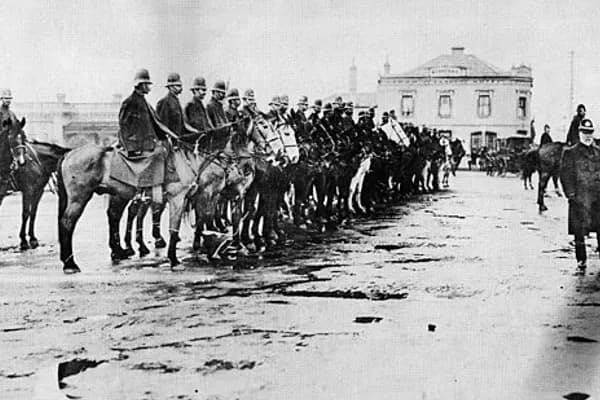
"Free Speech" campaigns occurred in Brunswick during 1933, as protestors countered the actions of police who sought to prevent "street meetings" of communists. On 19 May 1933, two incidents occurred on Sydney Road. Large numbers of police officers were in the area to prevent expected street meetings and, when Reginald Patullo was spotted addressing a crowd from the roof of a tram, the police gave chase. As Patullo attempted to evade capture, one of the pursuing officers tripped and shot Patullo in the thigh.
On the same night, a "well-dressed young man" appeared in a cage on the back of a lorry. He used a megaphone to address the crowd and the cage itself bore slogans such as "We want free speech". Police dispersed the crowd and the young man was eventually freed and then arrested. By June 1933, Brunswick residents and local council members were criticising the police action, and Councillor Wylie stated: "Without any discretion, mounted troopers drove men, women, and children off the footpaths in Sydney road into the path of traffic on Friday nights."
Post-World War II era
In the post-World War II era, Brunswick became the home of a large number of migrants from southern Europe, particularly from Italy, Greece and Malta. More recently, migrants from Lebanon, Turkey and other countries have arrived. The brickworks and much of the textile industry also began to close as gentrification accelerated in the 1990s. Many old buildings were renovated and new residential developments begun during this period.
In 2004, Brunswick and nearby Carlton were the location of several murders in what has been widely reported in Melbourne's media as an "underworld war".
Commerce
Commercial activity is mainly centred on Sydney Road and Lygon Street in neighbouring Brunswick East. While separated from the tourist strip in Carlton, northern Lygon Street has a substantial number of restaurants. Barkly Square, extensively renovated in 2014, is Brunswick's major covered shopping centre, located on the east side of Sydney Road, close to Jewell railway station, although there is a wide variety of supermarkets to be found all along the Sydney Road strip.
Demographics
In the 2021 census, there were 24,896 people in Brunswick.
The most common ancestries were English 31.1%, Australian 25.2%, Irish 15.5%, Scottish 10.8% and Italian 10.4%.
66.4% of people were born in Australia. The next most common countries of birth were England 3.6%, New Zealand 3.0%, Italy 2.6%, Greece 2.5% and United States of America 1.3%.
72.9% of people spoke only English at home. Other languages spoken at home included Greek 4.5%, Italian 3.9%, Mandarin 1.8%, Arabic 1.8% and Spanish 1.4%.
The most common responses for religion were No Religion 61.2%, Catholic 13.8%, Eastern Orthodox 5.6%, Not stated 4.8% and Islam 2.9%.
Politics
During the Great Depression in 1933, Brunswick was the site of free speech meetings by members of the Unemployed Workers Movement, who were harassed and suppressed by the police. The young artist Noel Counihan played a significant part in this campaign. A Free Speech memorial was built in 1994 outside the Mechanics' Institute on the corner of Sydney and Glenlyon Roads to commemorate the free speech fights. Counihan's work as an artist and local resident is also commemorated by the Counihan Gallery in the Brunswick Town Hall, at the corner of Sydney Road and Dawson Street, run by the City of Merri-bek.
Brunswick has long been a stronghold of left-wing politics in Melbourne, with the federal and state parliamentary seats held by the Australian Labor Party with very comfortable margins. In the 21st century these margins have been encroached upon by the increasingly popular Australian Greens, who at the 2016 Australian federal election polled a majority of the two-party-preferred vote against the Australian Labor Party in every booth in Brunswick. However, as well as the "mainstream" left, Brunswick and nearby suburbs have for many years been a holdout of other left-wing parties, radical socialists, and anarchists.
In 2018 the Victorian state electoral district of Brunswick elected a Greens member, Tim Read, for the first time. He was re-elected in 2022 with an increased margin of 13.5%, making Brunswick a safe seat for the Greens.
Brunswick falls into the local City of Merri-bek's South Ward; at the 2020 election, the South Ward elected two Greens (James Conlan and Mark Riley) and one Labor councillor (Lambros Tapinos). James Conlan would later leave the Greens in February 2023.
The Brunswick Progress Association, formed in 1905, has had an active role in representing residents, particularly on local issues to Merri-bek Council, but also at the state and federal levels.
Culture
In the 1980s, Brunswick's major nightspot was the Bombay Rock, a notoriously dangerous venue that saw considerable violence between ethnic groups. It was featured in the 1991 movie Death In Brunswick and destroyed by a fire in the mid-1990s.
The Sarah Sands Hotel has hosted tours from a number of local and international acts, mostly punk, skinhead, goth or alternative in nature.
The Sarah Sands Hotel was closed since 2017, reopening in June 2021, following an extensive redevelopment with the construction of attached apartment buildings.
Brunswick was the location of the "Brunswick Massive" art collective, which was run by local youths involved in Australian Hip Hop and Electronic Music events.
Beyonce visited Brunswick when she toured Melbourne in 2013 - the then dilapidated home at 20 Beith Street Brunswick featured in the No Angel music video. After filming, Queen Bey and her entourage were spotted enjoying a beverage at The Retreat Hotel at 280 Sydney Road Brunswick.
Kanye West, at the time recently married to Melbourne local Bianca Censori, was rumoured to have been spotted at A1 bakery in Brunswick, in January 2023. Although the rumour was largely debunked, the memes entered the cultural lore for locals.
The Sydney Road Street Party, held annually in late February, is a major event in the suburb, during which a large proportion of Sydney Road is closed to all traffic. The festival is a prelude to the Brunswick Music Festival, held in March, featuring blues, roots, and world music.
Sport
Brunswick has two soccer clubs, Brunswick Juventus and Brunswick City, but Moreland United, Moreland City and Essendon Royals also have strong links to the suburb. There are two cricket clubs,(Brunswick Cricket Club, and Royal Park). The Brunswick Cricket Club, located at Gillon Oval, has a long history dating back to the 1860s and for the last 80 years has been part of the Victorian Sub-District Cricket Association. There is a tennis club (West Brunswick, which is actually located at Raeburn Reserve) and three Australian Rules football clubs. The main sites for sporting activity in Brunswick are focused around Clifton and Gilpin Park and the Gillon Oval, though there are many other ovals and pitches around the suburb. A hockey ground is located at Brunswick Secondary College. The hockey ground is owned by Brunswick Hockey Club. The Brunswick Velodrome is in Brunswick East. Brunswick Athletic Club has been operating since 1953, competes in the North West Region of Athletics Victoria and has produced athletes who have represented Victoria and Australia. West Brunswick Football Club, North Old Boys Football Club and North Brunswick compete in the VAFA. Brunswick Netball Club is for all ages. The Brunswick Junior Football Club is based at Gillion Oval, West Brunswick. The North Brunswick Junior Football Club is based at Allard Park, East Brunswick. Both of these teams play in the Yarra Junior Football League. The Brunswick Netball Club is also based at Gillion Oval. The Brunswick Bowling Club is located in East Brunswick at 104-106 Victoria Street. The Brunswick Trugo Club is in Temple Park, at 29 Hodgson Street. Established in 1994, The Brunswick Lacrosse Club (established as Moreland Lacrosse) is based at Fleming Park, with new clubrooms built in 2023 to support its multiple junior and senior teams.
Facilities and services
Encyclopedic content adapted from the Wikipedia article on Brunswick, used under CC BY-SA 4.0.