About the neighborhood
Buddhist temple in Hiroshima Prefecture, Japan
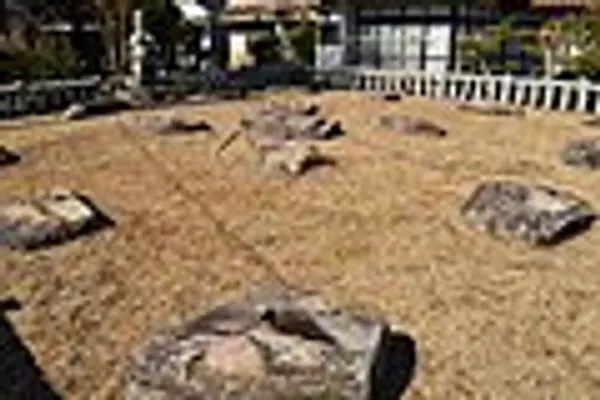
Aki Kokubun-ji (安芸国分寺) is an Omuro-school Shingon-sect Buddhist temple in the Yoshiyuki Saijomachi neighborhood of the city of Higashihiroshima, Hiroshima, Japan. It is one of the few surviving provincial temples established by Emperor Shōmu during the Nara period (710794). Due to this connection, the foundation stones of the Nara period temple were designated as a National Historic Site in 1932, with the area under protection expanded in 1977, and again in 2002.
History
The Shoku Nihongi records that in 741, as the country recovered from a major smallpox epidemic, Emperor Shōmu ordered that a monastery and nunnery be established in every province, the kokubunji (国分寺). These temples were built to a semi-standardized template, and served both to spread Buddhist orthodoxy to the provinces, and to emphasize the power of the Nara period centralized government under the Ritsuryō system.
The Aki Kokubun-ji is located on a terrace at the southern foot of Mount Ryūō on the north side of the Saijō Basin in central Hiroshima Prefecture. In the vicinity of the temple is the route of the ancient Sanyōdō highway which connected the Kinai region of Japan with Kyushu, as well as what is believed to be the site of the Nara period provincial capital and the Aki Kokubun-niji nunnery. The exact date of the temple's foundation is unknown; however, during archaeological excavations conducted from 1969 to 1971 and in 1977, a large amount of wooden tablets, Sue ware pottery and roof tiles were uncovered, some of which had dated inscriptions, the earliest of which was 750 AD. A Edo Period history states that the temple was founded by a son of the semi-legendary Emperor Yomei and was later converted to a kokubunji temple, but no archaeological evidence has yet been found to support this. The temple is listed in the Heian period Engishiki records dared 927AD. Temple legend states that it the temple was burned down by Minamoto no Noriyori in the Genpei War when soldiers from the Heike clan barricaded themselves within: however, the temple's own "Kokugun Shigechoshōshō" records dated 1283 make no mention of such an incident. Archaeological evidence in this case confirms that the Pagoda was destroyed by a fire and that the temple buildings were reconstructed in the middle of the Heian period. During the Muromachi period, the temple was supported by local feudal lords, such as the Ouchi clan and Mōri clan. However, with the establishment of the Tokugawa shogunate, the temple estates were seized, and only a nominal amount was allotted by Hiroshima Domain for its upkeep. By the Hōei era (1704–1711), the temple was in serious decline. A fire in 1759 destroyed all structures except for the Niōmon gate, including all of the honzon Yakushi Nyorai statue except for its head. The surviving temple bell was subsequently relocated to the temple of Shōfuku-ji in the Jike neighborhood of Highashihiroshima.
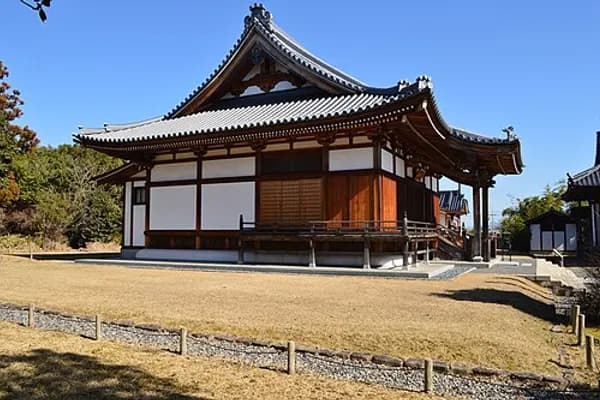
The main hall of the current temple was rebuilt in 2004. The principal image, the Yakushi Nyorai seated statue, is designated as an important cultural property by Higashihiroshima City. The Goma-do, located in front of the main hall and facing west, was built in the latter half of the 18th century to the beginning of the 19th century in the late Edo period. It was constructed by the Asano clan, daimyō of Hiroshima Domain and is also designated as an important cultural property of Higashihiroshima. The Niōmon Gate on the south side of the temple grounds was built in 1547 during the Muromachi period. It is also designated as an important cultural property by Higashihiroshima.
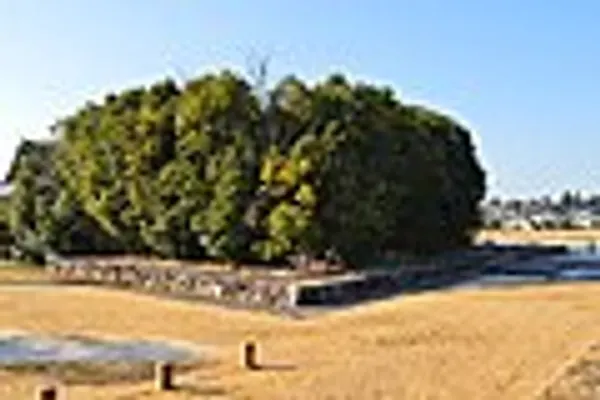
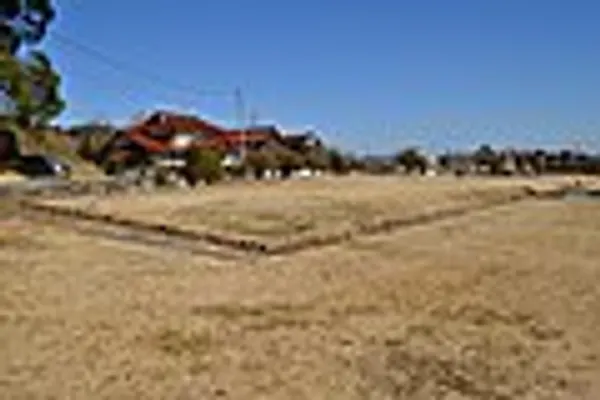
The ruins of the Nara period temple overlap with the layout of the existing temple, and the current Main Hall is roughly on the cite of the original Kondō of the temple. The distance between the east and west walls of the temple compound has been determined to have been about 255 meters. The north and south boundaries have yet to be discovered. Currently, the site is open to the public as Aki Kokubunji Historical Park. It is about seven minutes on foot from Saijō Station on the JR West San'yō Main Line.
Gallery
See also
List of Historic Sites of Japan (Hiroshima)
Provincial temple
References
External links
Official website
Hiroshima Prefectural Board of Education official site(in Japanese)
Higashihiroshima city home page(in Japanese)
Wikimedia Commons has media related to Aki Kokubun-ji.
Encyclopedic content adapted from the Wikipedia article on Saijō, used under CC BY-SA 4.0.
What makes Saijō special
Saijō stands out among Hiroshima’s neighborhoods for its distinctive character: hiroshima's sake-brewing town. Ranked #5 in Hiroshima, it offers the kind of experience that defines a great city trip — a place where the streets themselves tell a story and every block rewards curiosity.
Best for
Our take on Saijō
Saijō occupies a distinctive place in Hiroshima's neighborhood landscape. It is the kind of district that rewards travelers who venture beyond the obvious choices — quieter than the tourist-facing areas, richer in local character, and full of the small details that make a city trip memorable.
What makes Saijō worth the visit is the texture of daily life here. It is a neighborhood that functions for the people who live in it — not just for the visitors who pass through. The shops serve local needs, the restaurants feed local appetites, and the streets have a rhythm that reflects genuine community rather than tourism infrastructure. That is the quality our editors prize most, and Saijō has it in abundance.
Our editors recommend budgeting at least half a day here — enough time to walk the main streets, sit down for coffee, and discover the side streets where Saijō's real character lives.
Living in Saijō
Saijō is connected to the rest of Hiroshima by public transit, and most visitors find it straightforward to reach from the city center or airport. Once you arrive, the neighborhood is best explored on foot — the scale is human and the streets reward wandering.
Day-to-day life in Saijō has the rhythm of a genuine residential neighborhood. You will find grocery stores, pharmacies, cafés with morning regulars, and the kind of small independent shops that only survive where locals support them. For visitors, this means the infrastructure you need — good coffee, a decent meal, a quiet place to sit — is always within a short walk.
Accommodation in Saijō ranges from boutique hotels to short-term rentals. We generally recommend staying within the neighborhood itself rather than commuting from a hotel elsewhere in Hiroshima — the experience of waking up inside a great neighborhood is fundamentally different from visiting one as a day trip.
What locals say about Saijō
Long-term residents of Saijō tend to describe their neighborhood with a mix of pride and protectiveness. Like any district with genuine character, Saijō inspires loyalty — the kind of place people move to and never quite leave, or leave and spend years trying to get back to.
What locals appreciate most about Saijō is its consistency — the feeling that the neighborhood works the same way on a Tuesday morning as it does on a Saturday night. It is not a place that performs for visitors and then goes quiet. The rhythm is genuine, the community is real, and the daily experience of living here is what draws people and keeps them.
Compared to the more famous districts in Hiroshima, Saijō has maintained a lower profile, which many residents consider an advantage. The neighborhood evolves gradually rather than being reshaped by sudden attention, and the result is a community that still feels organic rather than curated.
Visitor tips
- Saijō is located in Hiroshima, Japan. The neighborhood is accessible by public transport, taxi, or rideshare from most parts of the city.
- Morning is often the best time to explore — the streets are quieter, the light is better for photography, and cafes are at their most welcoming.
- Wear comfortable walking shoes — the best way to experience Saijō is on foot, wandering the side streets and discovering what lies around each corner.