About the neighborhood
Buddhist temple in Nara, Japan
Saidai-ji (西大寺) is a Buddhist temple located in the Saidiaji-Shiba neighborhood of the city of Nara, Nara Prefecture, Japan. It became the head temple of the Shingon Risshu (真言律宗) sect after the sect's founder, Eison (叡尊), took over administration in 1238. The honzon of the temple is a statue of Shaka Nyorai, enshrined by Eison in 1249. The temple was once one of the powerful Seven Great Temples of the ancient capital of Heijō-kyō.
History
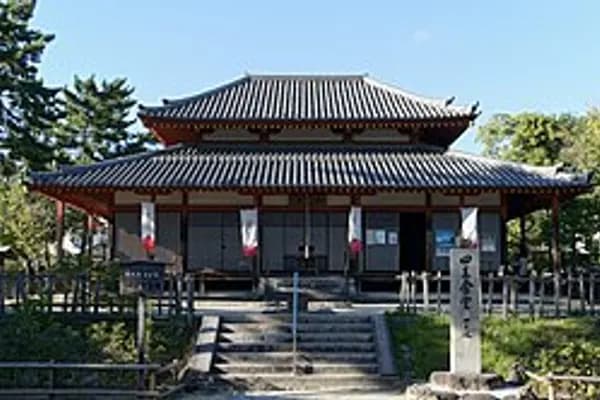
According to the Saidaiji Zaizairyukicho (西大寺資財流記帳) from 780, in September 764 the retired Empress Koken requested the construction of a gilt bronze statue of the Four Heavenly Kings to pray for the end of the Fujiwara no Nakamaro Rebellion. In October of the same year, Empress Koken re-enthroned as Empress Shōtoku. The following year, in 765, the aforementioned statues of the Four Heavenly Kings were completed and Saidai-ji Temple was founded. These four statues are still enshrined in Saidai-ji's Shiōdō Hall, but only the demons that each statue steps on are from the time of the temple's founding, and the statues themselves have been replaced by later works. At the time of Saidai-ji's founding, the monk Dōkyō held great influence in the political world, and it is believed that Dōkyō's ideological influence was also great in the construction of Saidai-ji Temple. The temple's name of "Saidai-ji" is a counterpoint to the great national temple of Tōdai-ji and thus a challenge to the existing political and religious power structure.
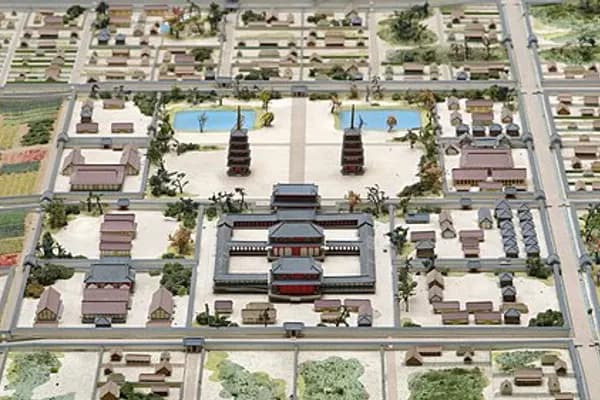
The temple in its initial form was a huge complex and was counted as one of the Seven Great Temples of Nara. It has two Main Halls: the Yakushi Kondō and the Miroku Kondō, numerous smaller halls (including the Shio-do, Juichimen-do), and twin five-story pagodas on the east and west. According to the "Zaizairyuki-cho", these halls housed many Buddhist statues and were decorated with many mirrors. In the Miroku Kondō alone, a total of 77 Buddhist statues were placed, and the Yakushi Kondō housed 21 statues. However, the temple fell quickly into decline during the Heian period, and many of its halls and pagodas were lost to fires and typhoons, and it came under the control of Kofuku-ji.
The temple was restored in the Kamakura period by the monk Eison. He began the restoration in 1238 and over a 50 year period worked to transform the temple into a center for social welfare work, especially to help the poor and sick. Many of the Buddhist statues and crafts that remain at the temple today were created during the time of Eison. The temple also produced many noteworthy priests, such as Ninsho, who worked to restore ruined temples of various provinces, including several of the kokubunji temples. In the Muromachi period, the temple was burned down in December 1499 during the wars of the early Sengoku period, and its surviving East Pagoda was destroyed by a fire in 1502. During the Edo period, the temple received a fief of 300 koku from the Tokugawa shogunate and began reconstruction. All of the current temple buildings were rebuilt after the Edo Period.
Saidai-ji became independent from the Shingon sect in June 1895, and established the Shingon Ritsu sect. The temple houses numerous National Treasures and Important Cultural Properties.
The precincts of Saidai-ji were designated a National Historic Site in 1965.
Building list
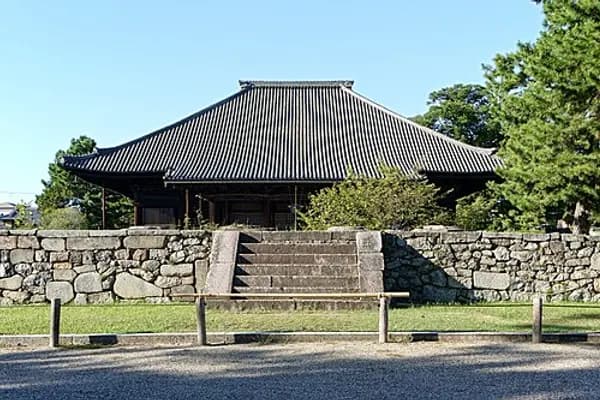
Main Hall (Hondō – 本堂) – Important Cultural Property. It was rebuilt in 1808.
Shiō-dō (四王堂) – It was rebuilt in 1674.
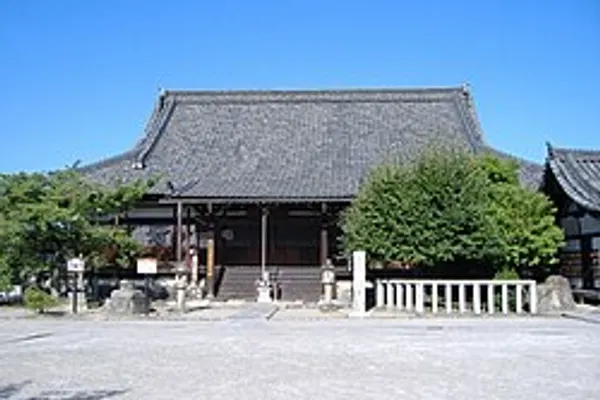
Aizen-dō (愛染堂) – It was reconstructed in 1762.
See also
List of National Treasures of Japan (crafts-others)
List of National Treasures of Japan (paintings)
List of National Treasures of Japan (sculptures)
List of National Treasures of Japan (writings)
Nanto Shichi Daiji, Seven Great Temples of Nanto.
Thirteen Buddhist Sites of Yamato
List of Historic Sites of Japan (Nara)
References
Further reading
Minoru Ooka, Temples of Nara and Their Art (Tokyo: Heibonsha; New York: Weatherhill, 1973) ISBN0834810107
External links
"Saidai-ji Temple Homepage" (in Japanese). Retrieved 2010-02-05.
Media related to Saidai-ji at Wikimedia Commons
Schools and objects of worshipOther elements
Encyclopedic content adapted from the Wikipedia article on Saidaiji, used under CC BY-SA 4.0.
What makes Saidaiji special
Saidaiji stands out among Nara’s neighborhoods for its distinctive character: west nara's old temple town. Ranked #3 in Nara, it offers the kind of experience that defines a great city trip — a place where the streets themselves tell a story and every block rewards curiosity.
Best for
Our take on Saidaiji
Saidaiji is one of the strongest neighborhoods in Nara, and it consistently appears in our editors' personal favorites lists. It may not always get the same attention as the city's most famous district, but among travelers who know Nara well, Saidaiji is often the first recommendation.
What makes Saidaiji worth the visit is the texture of daily life here. It is a neighborhood that functions for the people who live in it — not just for the visitors who pass through. The shops serve local needs, the restaurants feed local appetites, and the streets have a rhythm that reflects genuine community rather than tourism infrastructure. That is the quality our editors prize most, and Saidaiji has it in abundance.
Our editors recommend budgeting at least half a day here — enough time to walk the main streets, sit down for coffee, and discover the side streets where Saidaiji's real character lives.
Living in Saidaiji
Saidaiji is connected to the rest of Nara by public transit, and most visitors find it straightforward to reach from the city center or airport. Once you arrive, the neighborhood is best explored on foot — the scale is human and the streets reward wandering.
Day-to-day life in Saidaiji has the rhythm of a genuine residential neighborhood. You will find grocery stores, pharmacies, cafés with morning regulars, and the kind of small independent shops that only survive where locals support them. For visitors, this means the infrastructure you need — good coffee, a decent meal, a quiet place to sit — is always within a short walk.
Accommodation in Saidaiji ranges from boutique hotels to short-term rentals. We generally recommend staying within the neighborhood itself rather than commuting from a hotel elsewhere in Nara — the experience of waking up inside a great neighborhood is fundamentally different from visiting one as a day trip.
What locals say about Saidaiji
Long-term residents of Saidaiji tend to describe their neighborhood with a mix of pride and protectiveness. Like any district with genuine character, Saidaiji inspires loyalty — the kind of place people move to and never quite leave, or leave and spend years trying to get back to.
What locals appreciate most about Saidaiji is its consistency — the feeling that the neighborhood works the same way on a Tuesday morning as it does on a Saturday night. It is not a place that performs for visitors and then goes quiet. The rhythm is genuine, the community is real, and the daily experience of living here is what draws people and keeps them.
Compared to the more famous districts in Nara, Saidaiji has maintained a lower profile, which many residents consider an advantage. The neighborhood evolves gradually rather than being reshaped by sudden attention, and the result is a community that still feels organic rather than curated.
Visitor tips
- Saidaiji is located in Nara, Japan. The neighborhood is accessible by public transport, taxi, or rideshare from most parts of the city.
- Morning is often the best time to explore — the streets are quieter, the light is better for photography, and cafes are at their most welcoming.
- Wear comfortable walking shoes — the best way to experience Saidaiji is on foot, wandering the side streets and discovering what lies around each corner.
- Save the neighborhood's location on your phone before you arrive. Offline maps are especially useful for navigating the smaller side streets.