About the neighborhood
English abbot and saint
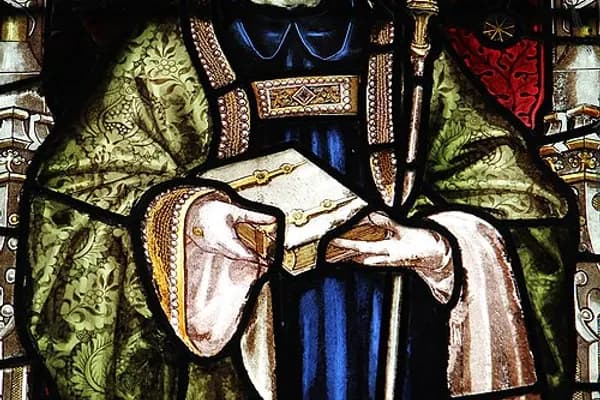
Botolph of Thorney (/ˈbɒtʊlf/; also called Botolph, Botulph or Botulf; later known as Saint Botolph; died c.680) was an English abbot and saint. He is regarded as the patron saint of boundaries, and by extension, of trade and travel, as well as various aspects of farming. His feast day is celebrated either on 17 June (England) or 25 June (Scotland).
Life and works
Little is known about the life of Botolph, other than doubtful details in an account written four hundred years after his death by the 11th-century monk Folcard. Botolph was born sometime in the early 7th century to noble Saxon parents who were Christians. He and his brother Adulph were educated by Saint Fursey at Cnobheresburg monastery. They were then sent to study on the Continent, where they became Benedictines. Adulph remained abroad, where he is said to have become a Bishop.
Botolph, returning to England, found favour with a certain "King of the southern Angles", whose sisters he had known in Germany, and was by him permitted to choose a tract of desolate land upon which to build a monastery. The Anglo-Saxon Chronicle records for the year 654: "The Middle Angles, under earldorman Peada, received the true faith. King Anna was killed and Botolph began to build the church at Ikanho".
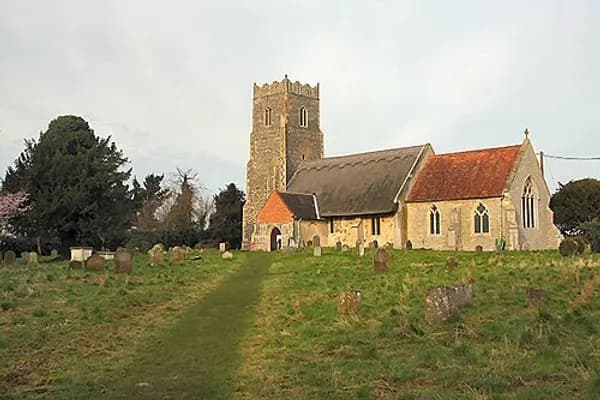
Botolph founded the monastery of Icanho. Icanho, which means 'ox hill', has been identified as Iken, located by the estuary of the River Alde in Suffolk; a church still remains on top of an isolated hill in the parish. At the time, the site was a tidal island all but surrounded by water, but Botolph attracted other monks and hermits and together they turned areas of marsh and scrub into productive grazing and farm land. The monks built several structures, and the monastery grew. Botolph also worked as an itinerant missionary in East Anglia, Kent and Sussex.
The Life of St Ceolfrith, written around the time of Bede by an unknown author, mentions an abbot named Botolph in East Anglia, "a man of remarkable life and learning, full of the grace of the Holy Spirit". Ceolfrith visited him about the year 670.
Botolph is supposed to have been originally buried at his foundation of Icanho, but in 970 Edgar I of England gave permission for the remains of Botolph to be transferred to Burgh, near Woodbridge, to prevent them from being destroyed by invading Danes. They remained for some fifty years before being transferred to their own tomb at Bury St Edmunds Abbey on the instructions of Cnut. The saint's relics were later transferred again, along with those of his brother Adulph, to Thorney Abbey, although his head was transferred to Ely Abbey and various body parts to other houses, including Westminster Abbey.
Church dedications
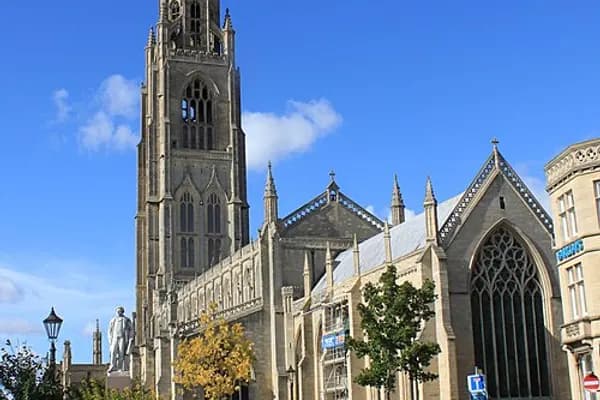
Many English churches are dedicated to Botolph. According to the Oxford Dictionary of Saints, 64 ancient English churches were dedicated to him, but later research has suggested the true number may have been as high as 71, with a high concentration of dedications in East Anglia. St Botolph's Church in Boston, Lincolnshire, known locally as "The Stump", is one of the most famous. Boston, or 'Botolph's town' also gave Boston, Massachusetts its name.
St Botolph's Priory in Colchester, Essex, the first Augustinian monastery in England, was built on an earlier Anglo-Saxon church dedicated to Botolph. St Botolph's Church in Hardham, West Sussex, houses some of the most ancient surviving wall paintings in Britain, including the earliest known depiction of St. George in England.
In Botolph's role as a patron saint of travellers, four City of London churches were dedicated to him, all of which were close to gates in the City walls: St Botolph Billingsgate, which was destroyed in the Great Fire and never rebuilt; St Botolph's, Aldersgate, St Botolph-without-Bishopsgate, where the poet John Keats was baptised, and St Botolph's Aldgate. It is believed that these dedications were made because the churches provided places for incoming travellers to give thanks for their safe arrival and for outgoing travellers to pray for a safe journey. An alternative possibility is that the churches were dedicated to the saint because his relics came through the four gates when Edgar moved them from Iken to Westminster Abbey.
Beyond the North Sea, Budolfi Church (Sankt Budolfi kirke) in Aalborg, Denmark, originally a smallish building, grew to be the major church of the town by the late Middle Ages and is now the cathedral church of the diocese of Aalborg.
Secular connections
Botolph is remembered in the names of the market town of Boston, Lincolnshire in the United Kingdom and thereby Boston, Massachusetts, in the United States. Boston was originally Botolphston (from "Botolph's stone" or "Botolph's town").
In Boston, Massachusetts, Botolph gives his name to the St Botolph Club, a private club, a street in Boston's Back Bay neighborhood, and the President's House at Boston College.
The University of Cambridge's poetry journal in the 1950s was called St Botolph's Review. It was named for St Botolph's Church, Cambridge as one of its founders, Lucas Myers, lived at the rectory of St Botolph's Church in Cambridge. A second edition of the journal was published in 2006. "St Botolph's College" has been used as a hypothetical college in Cambridge University communications and Tripos examinations.
The parish of Buttsbury in Essex was initially called Botolfvespirie, meaning Botolph's Pear Tree. It is sometimes surmised that the name refers to a tree under which St Botolph preached.
There is a St Botolph's Brook on the boundary between Colchester and the village of West Bergholt. Despite there being a St Botolph's church in Colchester, J. Horace Round, the Victorian historian, agreed with the earlier theory that in this case Botolph is a corruption of Godulf, an Anglo-Saxon name.
See also
Saints portal
England portal
Christianity portal
Anglo-Saxon Christianity
Christianisation of Anglo-Saxon England
List of Catholic saints
Footnotes
References
Sources
Attwater, D., The Penguin Dictionary of Saints, London (1965)
Care Evans, A., The Sutton Hoo Ship Burial, London (1986) ISBN0-7141-0544-9
Ryan, George E., Botolph Of Boston, Christopher Publishing House (1971) ISBN0-8158-0252-8
Savage, A., The Anglo-Saxon Chronicles, Godalming (1995) ISBN1-85833-478-0
This article incorporates text from a publication now in the public domain:Herbermann, Charles, ed. (1913). "St. Botulph". Catholic Encyclopedia. New York: Robert Appleton Company.
External links
English translations and Latin text of the medieval Life of St Botolph by Folcard
External links
Church of St Botolph, Cambridge
Society of St Botolph - an association of the churches dedicated to St. Botolph and those interested in his cult.
Encyclopedic content adapted from the Wikipedia article on Romsey, used under CC BY-SA 4.0.
What makes Romsey special
Romsey stands out among Cambridge’s neighborhoods for its distinctive character: cambridge's residential east. Ranked #3 in Cambridge, it offers the kind of experience that defines a great city trip — a place where the streets themselves tell a story and every block rewards curiosity.
Best for
Our take on Romsey
Romsey is one of the strongest neighborhoods in Cambridge, and it consistently appears in our editors' personal favorites lists. It may not always get the same attention as the city's most famous district, but among travelers who know Cambridge well, Romsey is often the first recommendation.
What makes Romsey worth the visit is the texture of daily life here. It is a neighborhood that functions for the people who live in it — not just for the visitors who pass through. The shops serve local needs, the restaurants feed local appetites, and the streets have a rhythm that reflects genuine community rather than tourism infrastructure. That is the quality our editors prize most, and Romsey has it in abundance.
Our editors recommend budgeting at least half a day here — enough time to walk the main streets, sit down for coffee, and discover the side streets where Romsey's real character lives.
Living in Romsey
Romsey is connected to the rest of Cambridge by public transit, and most visitors find it straightforward to reach from the city center or airport. Once you arrive, the neighborhood is best explored on foot — the scale is human and the streets reward wandering.
This is a neighborhood with strong residential roots, which means the infrastructure of daily life is well-established: grocery stores, pharmacies, parks, playgrounds, and the kind of quiet side streets where children play and neighbors greet each other. For visitors, this translates into a feeling of safety and belonging that more tourist-oriented districts rarely provide.
Accommodation in Romsey ranges from boutique hotels to short-term rentals. We generally recommend staying within the neighborhood itself rather than commuting from a hotel elsewhere in Cambridge — the experience of waking up inside a great neighborhood is fundamentally different from visiting one as a day trip.
What locals say about Romsey
Long-term residents of Romsey tend to describe their neighborhood with a mix of pride and protectiveness. Like any district with genuine character, Romsey inspires loyalty — the kind of place people move to and never quite leave, or leave and spend years trying to get back to.
What locals appreciate most about Romsey is its consistency — the feeling that the neighborhood works the same way on a Tuesday morning as it does on a Saturday night. It is not a place that performs for visitors and then goes quiet. The rhythm is genuine, the community is real, and the daily experience of living here is what draws people and keeps them.
Compared to the more famous districts in Cambridge, Romsey has maintained a lower profile, which many residents consider an advantage. The neighborhood evolves gradually rather than being reshaped by sudden attention, and the result is a community that still feels organic rather than curated.
Visitor tips
- Romsey is located in Cambridge, United Kingdom. The neighborhood is accessible by public transport, taxi, or rideshare from most parts of the city.
- Morning is often the best time to explore — the streets are quieter, the light is better for photography, and cafes are at their most welcoming.
- Wear comfortable walking shoes — the best way to experience Romsey is on foot, wandering the side streets and discovering what lies around each corner.