About the neighborhood
Capital of Rajasthan, India
Jaipur (Rajasthani: Jayapura, pronounced ˈd͡ʑɛpʊɾᵊ) is the capital and the largest city of the north-western Indian state of Rajasthan. As of 2011, the city had a population of 3.1 million, making it the tenth most populous city in the country. Located 268km (167 miles) from the national capital New Delhi, Jaipur is also known as the Pink City due to the dominant colour scheme of its buildings in the old city.
Jaipur was founded in 1727 by Sawai Jai Singh II, the Kachhwaha Rajput ruler of Amer, after whom the city is named. It is one of the earliest planned cities of modern India, designed by Vidyadhar Bhattacharya. During the British colonial period, the city served as the capital of Jaipur State. After Indian independence in 1947, Jaipur became the capital of the newly formed state of Rajasthan in 1949.
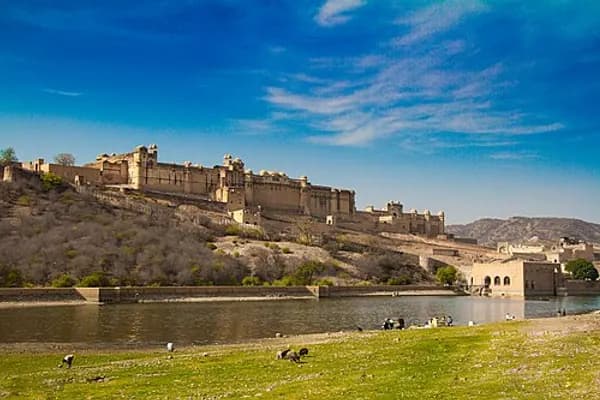
Jaipur is a popular tourist destination in India, forming a part of the Western Golden Triangle tourist circuit along with Delhi and Agra. The city serves as a gateway to other tourist destinations in Rajasthan, such as Jodhpur, Jaisalmer, Bikaner, Udaipur, Bundi, Kota, and Mount Abu; it has two World heritage sites, Amer Fort, Hawa Mahal and Jantar Mantar. On 6 July 2019, the city was placed on the World Heritage Cities list. It is also known as the Paris of India. Due to its beauty, C.V. Raman called it the "Island of Glory".
Etymology
Jaipur derives its name from Sawai Jai Singh II, the Kachhwaha ruler of Amer, who founded the city in 1727. In Sanskrit, variations of the word "pur" or "pura" are commonly used to refer to a city or town. So "Jaipur" essentially means "The City of Jai" or "Jai's City".
History
Jaipur was founded by the Rajput chief of Kachhwaha clan, Jai Singh II, on 18 November 1727, who ruled the region from 1699 to 1743. He planned to shift his capital from Amber, 11 kilometres (7mi) to Jaipur to accommodate the growing population and increasing scarcity of water. Jai Singh consulted several architects while planning the layout of Jaipur and established the city based on the principles of Vastu Shastra and Shilpa Shastra, under the architectural guidance of Vidyadhar Bhattacharya. The construction of the city began in 1726. During the rule of Sawai Ram Singh II, the city was painted pink to welcome Albert Edward, Prince of Wales in 1876. Many of the avenues remain painted in pink, giving Jaipur a distinctive appearance and the epithet Pink City.
In the 19th century, the city grew rapidly and had a population of 160,000 by 1900. The wide boulevards were paved, and its chief industries included metalwork and marble, fostered by a school of art founded in 1868. In August 1981, large areas of the city including the airport, were flooded due to heavy rains from a cloudburst, resulting in the deaths of eight people and much damage to the city's Dravyavati River. On 6 July 2019, the city was named to the World Heritage Cities list.
Geography
Topography
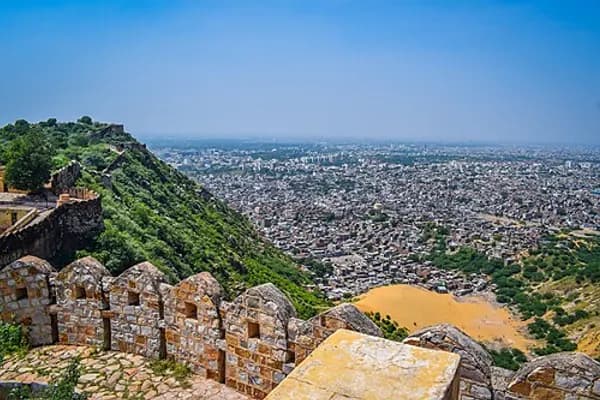
Jaipur is located in the northeastern part of Rajasthan and covers a total area of 467 square kilometres (180sqmi). The city is surrounded by fertile alluvial plains to the east and south, and hill chains and desert areas to the north and west. Jaipur generally slopes downwards from north to south and then to the southeast. The city is surrounded by the Nahargarh hills in the north and Jhalana in the east, which is a part of the Aravalli range.
The Dravyavati River is the primary drainage channel, which by 2014 had degenerated into an untreated sewage nallah. To address this issue, a plan for the rejuvenation of the river was developed by Jaipur Development Authority (JDA) in 2015. A 13km (8.1mi) stretch of Dravyavati riverfront out of 47.5km (29.5mi) was opened after rejuvenation in 2018 and the remaining project was completed in 2022.
Climate
Jaipur has a monsoon-influenced hot semi-arid climate (Köppen climate classification BSh) with long, extremely hot summers and short mild to warm winters. Annual precipitation is over 625 millimetres or 25 inches, falling mostly in July and August due to the southwest monsoon, causing the average temperatures in these two months to be lower compared to drier May and June. During the monsoon, there are frequent, heavy rains and thunderstorms, but flooding is not common. The highest temperature ever recorded was 49.0°C (120.2°F), on 23 May 1994. The city's average temperature remains below 20°C or 68°F between December and February. These months are mild, dry, and pleasant, sometimes chilly. The lowest temperature ever recorded was −2.2°C (28.0°F) on 31 January 1905, 1 February 1905, and 16 January 1964. Jaipur, like many other major cities of the world, is a significant urban heat island zone with surrounding rural temperatures occasionally falling below freezing in winters.
Jaipur has been ranked 33rd best “National Clean Air City” (under Category 1 >10L Population cities) in India.
Demographics
As of the official report, Jaipur Municipal Corporation had 5,99,507 households and a population of 3,046,163. 3,87,354 (12.72%) were under the age of 7. Jaipur had a sex ratio of 900 females per 1000 males and a literacy rate of 83.33% for those 7 years and above. Scheduled Castes and Scheduled Tribes made up 392,285 (12.88%) and 115,258 (3.78%) of the population, respectively.
Languages
Hindi (69.7%)
Rajasthani (9.85%)
Urdu (5.86%)
Marwari (4.36%)
Dhundari (3.93%)
Sindhi (2.54%)
Others (3.77%)
The official language of Jaipur is Hindi and the additional official language is English. The native and main dialect of the city is Dhundari with Marwari and Standard Hindi dialects are also spoken, along with English.
According to the 2011 census, 69.69% of the population recorded their language as Hindi, 9.85% Rajasthani, 5.86% Urdu, 4.36% Marwari, 3.93% Dhundari, and 2.54% Sindhi as their first language.
Religion
According to the 2011 census, Hindus form the majority religious group, accounting for 77.9% of the city's population, followed by Muslims (18.6%), Jains (2.4%) and others (1.1%).
Government and politics
Administration
Jaipur Development Authority is the main planning authority of the city. Jaipur Municipal Corporation (JMC) was established in the year 1994. The area of the municipal corporation is 467km (180sqmi) and is headed by a mayor. In 2020, JMC was bifurcated into two Municipal Corporations, namely Greater Jaipur Municipal Corporation and Jaipur Heritage Municipal Corporation with 150 and 100 wards respectively. The latest elections were held in October 2020. The current mayor of Greater JMC is Somya Gurjar and the mayor for Heritage JMC is Munesh Gurjar since 10 November 2020. The administration duties are carried out by the municipal commissioner and his group of officials. The estimated municipal budget for the year 2022–23 is ₹8,950 lakh (US$11million). The key revenue sources for the corporation are taxes which include House tax, Urban Development tax and octroi compensation along with various fees and user charges. Law and order is maintained by the Jaipur city police under the jurisdiction of the Rajasthan state department. There is a district and sessions court at Jaipur to handle civil and criminal cases.
Politics
Jaipur consists of two parliamentary constituencies Jaipur and Jaipur Rural. The Jaipur Lok Sabha constituency comprises eight legislative assembly segments, all of which fall partly in Jaipur city.
Infrastructure
Jaipur Development Authority is the nodal government agency responsible for the planning and development of Jaipur. The municipal corporation is responsible for maintaining the city's civic infrastructure and carrying out associated administrative duties. Electricity is distributed through Jaipur Vidyut Vitaran Nigam Limited (JVVNL) owned by the Government of Rajasthan. Jaipur municipal corporaiton has a fire department wing with 11 fire stations and 50 fire tenders.
Established in 2018, Jaipur Water Supply and Sewerage Board (JWSSB) is responsible for the management of water supply and sewerage services in the city. The agency is responsible for water supply as per the standards stipulated by the Bureau of Indian Standards, the State Pollution Control Board and the Public Health Engineering Department (PHED). It will also be responsible for financing, designing, constructing, altering, repairing, operating, and maintaining various water supply and sewerage schemes in addition to commercial services such as meter reading, billing, and revenue collection. The city has been divided into four main drainage zones, with the northern and central zones draining into the Dravyavati river, while the western zone drains into the Chandler lake, and the eastern and southern areas combined drain into the Dhundh River. Sewerage systems and STPs have been constructed accordingly, with the installed capacity being 730km of sewer lines and 442 MLD of sewage treatment. The corporation has a solid waste management system that includes door-to-door collection, transportation of garbage in covered vehicles, proper deployment of dustbins, use of modern equipment. The system ensures private investment as well as public participation with a small amount of monthly user charges. The size of the JMC garbage can be kept at a manageable level. Sanitation work in three zones has been contracted out to private agencies.
Economy
As per the official records released by the Directorate of Economics and Statistics (Rajasthan), the GDP (nominal) of Jaipur district is estimated at INR 1,22,140 crores ($15.8 billion) in 2020–21, with a per-capita GDP of INR 141,305. In addition to its role as the provincial capital, educational, and administrative center, the economy of Jaipur is fuelled by tourism, gemstone cutting, the manufacture of jewellery and luxury textiles, and information technology.
Three major trade promotion organisations have their offices in Jaipur: Federation of Indian Chambers of Commerce & Industry, (FICCI) the PHD Chamber of Commerce and Industry (PHDCCI) and the Confederation of Indian Industry (CII) which has its regional offices here. In 2008, Jaipur was ranked 31 among the 50 Emerging Global Outsourcing cities. Jaipur Stock Exchange was one of the regional stock exchanges in India and was founded in 1989 but was closed in March 2015.
Jaipur has emerged as a hub of automotive industries with JCB, Hero MotoCorp and Robert Bosch GmbH having their manufacturing plants in Jaipur. There are chemical manufacturers in the city including Emami and National Engineering Industries. The city is among top emerging IT hubs of India. Mahindra World City is an integrated business zone in Jaipur with several software and IT companies. The Government of Rajasthan have built Asia's largest incubator in Jaipur – the Bhamashah Techno Hub.
Jaipur is a major hub for arts and crafts. It has many traditional shops selling antiques, jewellery, handicrafts, gems, bangles, pottery, carpets, textiles, leather, and metal products. Jaipur is one of India's largest manufacturers of hand-knotted rugs. Jaipur foot, a rubber-based prosthetic leg for people with below-knee amputations, was designed and is produced in Jaipur. World Trade Park Jaipur, is a shopping mall in Jaipur opened in 2012.
Culture and cityscape
Tourism
Jaipur is a major tourist destination in India forming a part of the Golden Triangle. In the 2008 Conde Nast Traveller Readers Choice Survey, Jaipur was ranked the seventh best place to visit in Asia. According to TripAdvisor's 2015 Traveller's Choice Awards, Jaipur was ranked first among the Indian destinations for the year. The Presidential Suite at the Raj Palace Hotel, billed at US$45,000 per night, was listed in second place on CNN's World's 15 most expensive hotel suites in 2012. Jaipur was ranked eighth in "The Top 15 Cities in Asia".
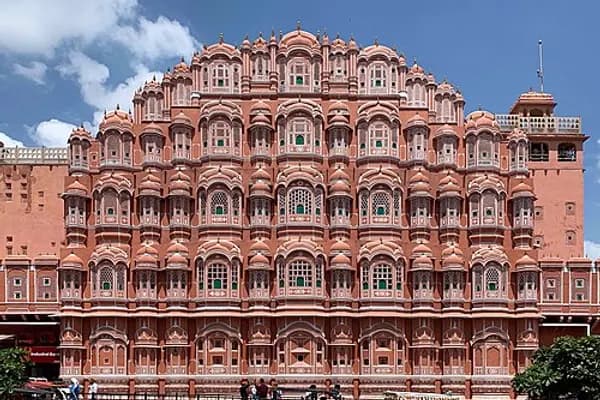
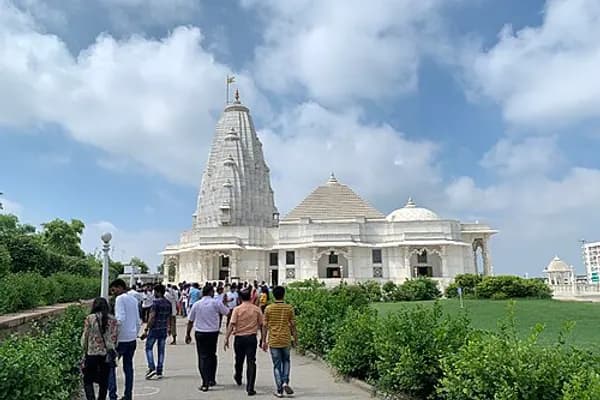
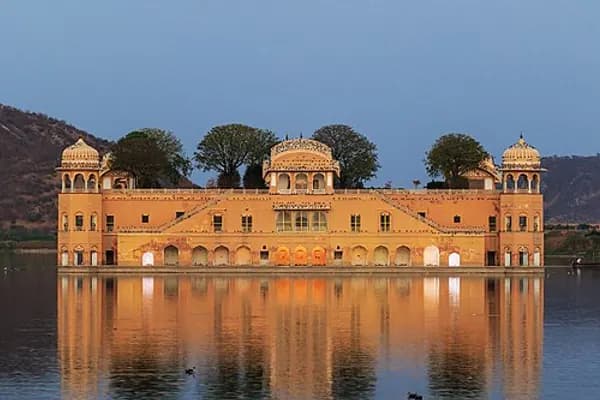
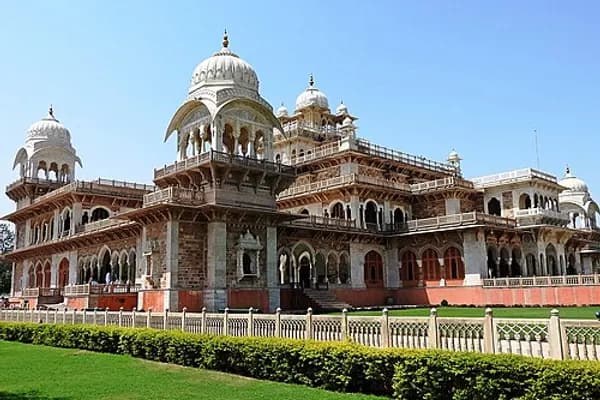
Jaipur Exhibition & Convention Centre (JECC) is Rajasthan's biggest convention and exhibition center. Visitor attractions include the Albert Hall Museum, Hawa Mahal, Jal Mahal, City Palace, Amer Fort, Jantar Mantar, Nahargarh Fort, Jaigarh Fort, Birla Mandir, Galtaji, Govind Dev Ji Temple, Garh Ganesh Temple, Moti Dungri Ganesh Temple, Gator Chhatri, Sanghiji Jain temple and the Jaipur Zoo. The Jantar Mantar observatory, a collection of 19 astronomical instruments and Amer Fort are World Heritage Sites. Hawa Mahal is a five-storey pyramidal shaped monument with 953 windows that rises 15 metres (50ft) from its high base. Sisodiya Rani Bagh and Kanak Vrindavan are the major parks in Jaipur. Sambhar Lake is about 56 kms from the city.
Culture
Jaipur has many cultural sites like Jawahar Kala Kendra established by Charles Correa and Ravindra Manch. The Government Central Museum hosts several art and antiquities. There is a government museum at Hawa Mahal and an art gallery at Viratnagar. There are statues depicting Rajasthani culture around the city. Jaipur has many traditional shops selling antiques and handicrafts, as well as contemporary brands reviving traditional techniques, such as Anokhi. The prior rulers of Jaipur patronised some arts and crafts. They invited skilled artisans, artists, and craftsmen from India and abroad who settled in the city. Some of the crafts include bandhani, block printing, stone carving and sculpture, tarkashi, zari, gota-patti, kinari and zardozi, silver jewellery, gems, kundan, meenakari and jewellery, Lakh ki Chudiya, miniature paintings, blue pottery, ivory carving, shellac work and leather ware.
Jaipur has its own performing arts. The Jaipur Gharana for Kathak is one of the three gharanas of the major north Indian classical dance form of Kathak. The Jaipur Gharana of Kathak is known for its rapid intricate dance forms, vivacious body movements and subtle Abhinaya. The Ghoomar is a popular folk dance style. Tamasha is an art form where Kathputli puppet dance is shown in play form. Major festivals celebrated in Jaipur include Elephant Festival, Gangaur, Makar Sankranti, Holi, Diwali, Vijayadashami, Teej, Eid, Mahavir Jayanti and Christmas. Jaipur is also famous for the Jaipur Literature Festival, the world's largest free literature festival in which authors, writers, and literature lovers from all over the country participate.
Architecture
Encyclopedic content adapted from the Wikipedia article on Pink City, used under CC BY-SA 4.0.