About the neighborhood
Historic district in Illinois, United States
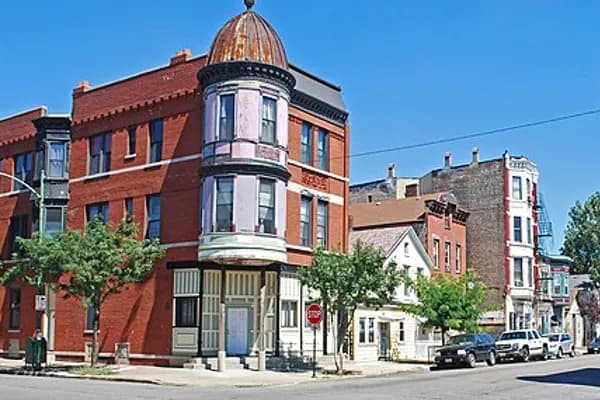
The Pilsen Historic District is located in the Lower West Side community area of Chicago and is among the few neighborhoods with buildings that survived the Great Chicago Fire of 1871.
History
Pilsen was formally founded in 1878, making the neighborhood a factor in the political and economic change planned in Chicago. In the late 19th century Pilsen was inhabited by Czech immigrants who named the district after Plzeň (German: Pilsen), the fourth largest city in today's Czech Republic. The population also included in smaller numbers other ethnic groups from Austria-Hungary including Slovaks, Slovenes, Croats and Austrians, as well as immigrants of Polish and Lithuanian heritage. In 1934 majority of Czechs, Croatians, Poles, and Slovaks sustained Pilsen, making it an ethnic working-class neighborhood.
In 1945, the Committee on Minority Groups established a Subcommittee on Social Services for Mexican Migratory Workers due to the increasing migration of Mexican migrant contract workers (braceros). The Czechs had replaced the Germans, who had settled there first with the Irish in the mid-19th century. Although there was a growing Mexican American presence in the late 1950s, it was not until 1962-63 when there was a significant increase in the numbers of Mexican Americans in Pilsen due to the destruction of the neighborhood west of Halsted Street between Roosevelt and Taylor Streets to create room for the construction of the University of Illinois at Chicago. The destruction closed nearby factories where Mexican migrants worked. Other contributing factors to the increasing numbers include the state-sponsored mass labor importation programs in the United States of majority Mexican and Puerto Rican migrants.
Although this area was predominantly Czech American, it was also an important entry point for Mexican immigrants for several decades. Latinos became the majority in 1970 when they surpassed the Slavic population. The neighborhood continued to serve as port of entry for immigrants, both documented and undocumented, mostly from Mexico. In a 2003 case study, Mexican residents remember the early experience of living in early Pilsen. Signs that read ‘No dogs or Mexicans’ were put up all around businesses from the 1950s to 1960s, during the major influx of Mexican immigrants. Other experiences included banks refusing to give mortgages because Pilsen had the largest population of Mexican immigrants.
Since 2000, the Mexican population in Pilsen has decreased somewhat. In 2003, Pilsen was 93% Mexican-American, and the Chicagoland Chamber of Commerce identified Pilsen as "an authentically Mexican neighborhood” and “a true Chicago Barrio”.
On February 1, 2006, Pilsen was selected for the National Register of Historic Places.
Pilsen is home to Chicago's largest migrant shelter, located between Cermak Road and the southern branch of the Chicago River, opened in fall 2023. People living at the shelter have described it as having "harsh shelter conditions, including cramped living quarters, mistreatment from workers, freezing temperatures, and unsanitary bathrooms," with an analysis by Borderless Magazine concluding that the shelter "fails to meet the basic standards for emergency shelter laid out by the U.N. Refugee Agency." In December 2023, several children staying at the shelter became ill, with one of them dying.
As early as 1985, Pilsen's proximity to the downtown area and its low-value property became an ideal neighborhood for gentrification. Pilsen residents and community institutions mobilized against two major redevelopments Chicago 21 Plan (the mid-1970s) and Chicago 1992 World's Fair (early to mid-1980s). The neighborhood's long-lasting defense is prompted by its alliance of local developers, Pilsen homeowners, and the city. As of 2014 growing community activists like The Pilsen Alliance, an organization from 1998 that mobilized against the expansion of the University of Illinois at Chicago (UIC) in Pilsen, continued to display an extensive stronghold against real estate developer and city plans.
In 2016 increasing gentrification led to the displacement of residents, the shutting down of businesses, and a cultural change in the historically Mexican neighborhood. According to the Chicago Sun-Times as of 2023 Pilsen community organizations are protesting the increasing property taxes that continue to force residents out of their homes.
See also
National Register of Historic Places listings in West Side Chicago
Czechs in Chicago
Poles in Chicago
Mexicans in Chicago
References
External links
National Register of Historic Places - Registration Form
Pilsen gets state historical landmark status
Tax freeze preserves Pilsen buildings
Other landmarks Gads Hill Center
National Museum of Mexican Art
South Water Market
Thalia Hall
CTA stations 18th
Ashland
Damen (Pink Line)
Western (Pink Line)
Metra stations Western Avenue station (BNSF Railway)
Encyclopedic content adapted from the Wikipedia article on Pilsen, used under CC BY-SA 4.0.
What makes Pilsen special
Pilsen stands out among Chicago’s neighborhoods for its distinctive character: mexican heritage, murals and mercados. Ranked #3 in Chicago, it offers the kind of experience that defines a great city trip — a place where the streets themselves tell a story and every block rewards curiosity.
Best for
Our take on Pilsen
Pilsen is one of the strongest neighborhoods in Chicago, and it consistently appears in our editors' personal favorites lists. It may not always get the same attention as the city's most famous district, but among travelers who know Chicago well, Pilsen is often the first recommendation.
Walking through Pilsen is like reading a history book with your feet. The architecture tells the story of decades — sometimes centuries — of evolution, and the neighborhood has managed to preserve its historical character without becoming a museum piece. People still live here, still run businesses here, still argue about parking here. That living quality is what separates a great historic neighborhood from a pretty but lifeless one.
Our editors recommend budgeting at least half a day here — enough time to walk the main streets, sit down for coffee, and discover the side streets where Pilsen's real character lives.
Living in Pilsen
Pilsen is connected to the rest of Chicago by public transit, and most visitors find it straightforward to reach from the city center or airport. Once you arrive, the neighborhood is best explored on foot — the scale is human and the streets reward wandering.
Day-to-day life in Pilsen has the rhythm of a genuine residential neighborhood. You will find grocery stores, pharmacies, cafés with morning regulars, and the kind of small independent shops that only survive where locals support them. For visitors, this means the infrastructure you need — good coffee, a decent meal, a quiet place to sit — is always within a short walk.
Accommodation in Pilsen ranges from boutique hotels to short-term rentals. We generally recommend staying within the neighborhood itself rather than commuting from a hotel elsewhere in Chicago — the experience of waking up inside a great neighborhood is fundamentally different from visiting one as a day trip.
What locals say about Pilsen
Long-term residents of Pilsen tend to describe their neighborhood with a mix of pride and protectiveness. Like any district with genuine character, Pilsen inspires loyalty — the kind of place people move to and never quite leave, or leave and spend years trying to get back to.
Long-time residents speak about Pilsen with a historian's eye — they know which buildings are original, which streets have been renamed, which family has run the corner shop for decades. This accumulated knowledge gives the neighborhood a depth that guidebooks cannot replicate. The best way to access it is simply to talk to people.
Compared to the more famous districts in Chicago, Pilsen has maintained a lower profile, which many residents consider an advantage. The neighborhood evolves gradually rather than being reshaped by sudden attention, and the result is a community that still feels organic rather than curated.
Visitor tips
- Pilsen is located in Chicago, United States. The neighborhood is accessible by public transport, taxi, or rideshare from most parts of the city.
- Morning is often the best time to explore — the streets are quieter, the light is better for photography, and cafes are at their most welcoming.
- Wear comfortable walking shoes — the best way to experience Pilsen is on foot, wandering the side streets and discovering what lies around each corner.
- Save the neighborhood's location on your phone before you arrive. Offline maps are especially useful for navigating the smaller side streets.