About the neighborhood
Locality of Düsseldorf, Germany
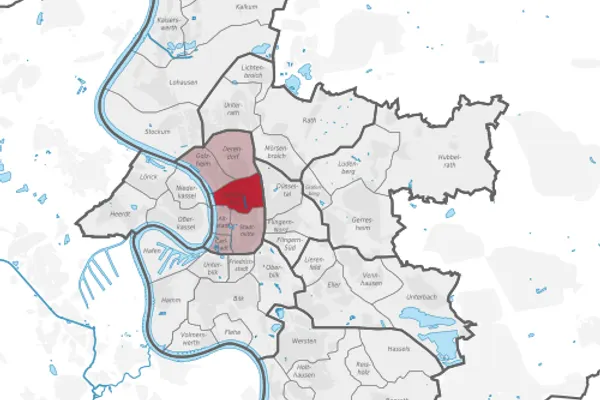
Pempelfort (German pronunciation: ˈpɛmpl̩ˌfɔʁt) is a city part in the North-east of the central Borough 1 of Düsseldorf.
It borders on Stadtmitte, Derendorf, the Cologne–Duisburg railway, connecting Flingern and Düsseltal, Oberbilk, Golzheim and the river Rhine.
Pempelfort has 33,137 inhabitants (2020) in an area of 2.70km, or over 12,000 inhabitants per km. Some important institutions such as the District Administration / Prefecture of Düsseldorf (Bezirksregierung Düsseldorf) and the Higher Court of Düsseldorf (Oberlandesgericht) are located in Pempelfort. The head offices of the energy company E.ON and the Victoria Insurance company are also in Pempelfort.
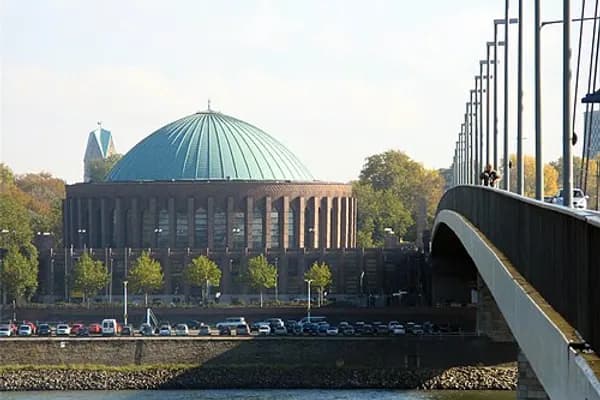
There are museums and a music hall in Pempelfort:
Theatermuseum (Museum of Theatre)
Museum Kunstpalast (Ehrenhof)
NRW Forum (Ehrenhof)
Tonhalle Düsseldorf (Music Hall, Ehrenhof)
The Central Park of Düsseldorf, the Hofgarten, and the Rheinpark are the two green areas in the borough.
The Rochuskirche, a church dedicated to St. Rochus, was partially destroyed in World War II and has only one surviving tower; the rest of the church is in experimental style.
References
Wikimedia Commons has media related to Düsseldorf-Pempelfort.
51°14′17″N 6°47′13″E / 51.23806°N 6.78694°E / 51.23806; 6.78694
Encyclopedic content adapted from the Wikipedia article on Pempelfort, used under CC BY-SA 4.0.
What makes Pempelfort special
Pempelfort stands out among Düsseldorf’s neighborhoods for its distinctive character: düsseldorf's elegant residential quarter. Ranked #2 in Düsseldorf, it offers the kind of experience that defines a great city trip — a place where the streets themselves tell a story and every block rewards curiosity.
Best for
Our take on Pempelfort
Pempelfort is one of the strongest neighborhoods in Düsseldorf, and it consistently appears in our editors' personal favorites lists. It may not always get the same attention as the city's most famous district, but among travelers who know Düsseldorf well, Pempelfort is often the first recommendation.
What makes Pempelfort exceptional is the density of its cultural life. Art galleries, independent bookshops, small theaters, and creative studios are woven into the fabric of the neighborhood rather than clustered in a single zone. You encounter culture here by accident, which is how the best cultural experiences always happen.
Our editors recommend budgeting at least half a day here — enough time to walk the main streets, sit down for coffee, and discover the side streets where Pempelfort's real character lives.
Living in Pempelfort
Pempelfort is connected to the rest of Düsseldorf by public transit, and most visitors find it straightforward to reach from the city center or airport. Once you arrive, the neighborhood is best explored on foot — the scale is human and the streets reward wandering.
This is a neighborhood with strong residential roots, which means the infrastructure of daily life is well-established: grocery stores, pharmacies, parks, playgrounds, and the kind of quiet side streets where children play and neighbors greet each other. For visitors, this translates into a feeling of safety and belonging that more tourist-oriented districts rarely provide.
Accommodation in Pempelfort ranges from boutique hotels to short-term rentals. We generally recommend staying within the neighborhood itself rather than commuting from a hotel elsewhere in Düsseldorf — the experience of waking up inside a great neighborhood is fundamentally different from visiting one as a day trip.
What locals say about Pempelfort
Long-term residents of Pempelfort tend to describe their neighborhood with a mix of pride and protectiveness. Like any district with genuine character, Pempelfort inspires loyalty — the kind of place people move to and never quite leave, or leave and spend years trying to get back to.
The creative community in Pempelfort is genuine, not aspirational. Residents include working artists, writers, musicians, and designers who chose the neighborhood because it supported their work — affordable studio space, a community that values craft, and enough foot traffic to sustain independent galleries and shops.
Like any neighborhood that has earned attention, Pempelfort is navigating the tension between popularity and preservation. Rents have risen, new businesses have arrived, and long-time residents occasionally grumble that the neighborhood is not what it was. But the fundamentals — the walkability, the food, the community — remain strong, and most locals we speak to believe the neighborhood is still gaining more than it is losing.
Visitor tips
- Pempelfort is located in Düsseldorf, Germany. The neighborhood is accessible by public transport, taxi, or rideshare from most parts of the city.
- Morning is often the best time to explore — the streets are quieter, the light is better for photography, and cafes are at their most welcoming.
- Wear comfortable walking shoes — the best way to experience Pempelfort is on foot, wandering the side streets and discovering what lies around each corner.
- Save the neighborhood's location on your phone before you arrive. Offline maps are especially useful for navigating the smaller side streets.