About the neighborhood
Neighbourhood and central business district in Lyon, France
La Part-Dieu (French: la paʁdjø) is a central business district in the 3rd arrondissement of Lyon, France. It is the second-largest tertiary district in France, after La Défense in Greater Paris. The area also contains Lyon's principal railway station, Gare de La Part-Dieu.
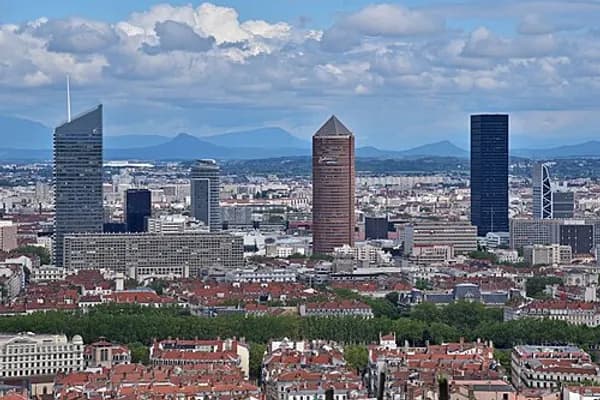
The district hosts major commercial, cultural, and entertainment facilities, including Westfield La Part-Dieu shopping centre, Paul Bocuse indoor food market, café terraces, the Auditorium concert hall, the Bourse du Travail theatre, the Municipal Library, the Departmental Archives and Fort Montluc. It is home to several high-rise buildings, such as Tour Incity (202m (663ft)), Tour To-Lyon (171m (561ft)) and Tour Part-Dieu (164m (538ft)).
The central business district is undergoing a large-scale renovation and redevelopment programme, representing €2.5 billion in combined public and private investment.
History
Etymology
Various theories attempt to explain the origins of the "Part-Dieu" name (literally "Property of God"). One possibility is that it derives from the tenacity with which several landlords managed to save pieces of land from the waters of the Rhône river. Another is that Guillaume de Fuer named his parcel "Pardeu" towards the end of the 12th century. A final theory holds that Marc-Antoine Mazenod donated his 140 hectares land to Hôtel-Dieu public hospitals after his daughter was miraculously saved, naming it "Gift from God".
Farmlands
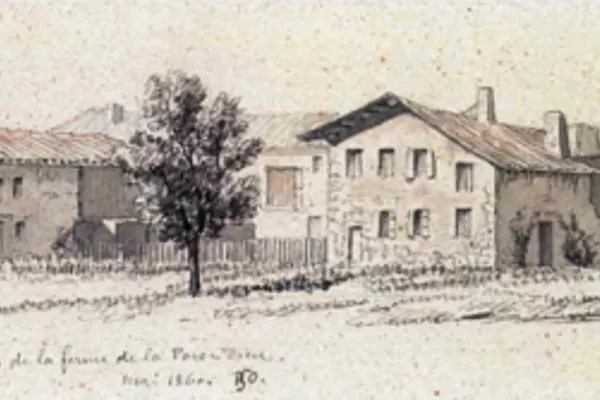
Before the 1850s, La Part-Dieu consisted largely of rural floodplains. In 1737, the Mazenod-Servient family ceded the estate to the Hôtel-Dieu de Lyon public hospitals. The embankment of the Rhône river and construction of bridges (see Bridges of Lyon) from 1772 onwards reduced flood risks and facilitated urbanisation of the river's eastern bank. By the end of the 18th century, the La Part-Dieu estate was a substantial property situated between the Brotteaux and Guillotière districts.
The completion of the Lafayette Bridge in 1872 accelerated eastward urban development, while reclaimed farmland was converted to wheat cultivation. Between 1830 and 1848, the city erected defensive walls against potential foreign invasions, and Montluc Fort was constructed in 1831, giving La Part-Dieu a military role. Owing to Lyon's administrative, urban, and geological complexity, the expansion of rail transport led to the creation of multiple stations; The Part-Dieu station at this time served exclusively as a freight terminal.
Cavalry barracks
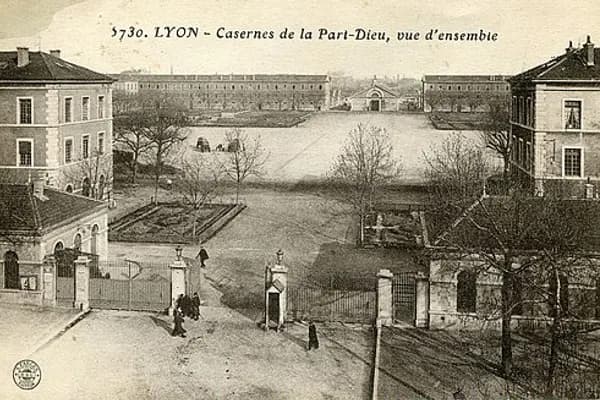
In 1844, the public hospitals sold the land to the military administration, which built cavalry barracks between 1851 and 1863. Urban growth was constrained by the district's limited thoroughfares, as Rue Lafayette remained the only direct road link between La Part-Dieu and Central Lyon.The district was incorporated into the administrative boundaries of Lyon in 1852. To connect Lyon with Geneva, the Chemins de fer de Paris à Lyon et à la Méditerranée constructed Gare des Brotteaux, necessitating the dismantling of the city's fortifications to make way for railway lines. Meanwhile, the military compound took on the orthogonal footprint of the original farm estate. The military compound retained the orthogonal layout of the original farm estate, and many cavalry units stationed there were mobilised during the First World War.
At the beginning of the 20th century, Édouard Herriot was elected Mayor of Lyon, then the most prominent French city outside Paris due to its dynamic industrial and commercial activity. Influenced by the French hygiéniste urban movement, akin to Baron Haussmann's renovation of Paris, Herriot initiated extensive works to improve urban infrastructure and public spaces. The continued expansion of rail and road networks to the east transformed the La Part-Dieu marshalling yards. In 1926, an urban development plan inspired by American downtowns was proposed.
Post-war housing
Following the Second World War, France's top priorities were to rebuild the housing stock fast, to push for economic development and to favour efficient movements by car. France prioritised rapid reconstruction of housing, economic growth, and improved car transport infrastructure. Owing to changes in military strategy, La Part-Dieu's military compound lost its strategic importance and was incorporated into a major housing development plan.
In 1960, the French State sold the land to the private developer SERL to initiate the project. Demolition of existing structures lasted five years. The presence of extensive land holdings owned by public bodies—including the hospitals, the SNCF, and the military—enabled a complete transformation of the site within the city centre.
The project evolved under the mandate of Mayor Louis Pradel, extending beyond housing to include the creation of an administrative centre and private office space for public services such as radio stations and police headquarters. The winning architectural design followed the principles of the Athens Charter, a modernist urban planning doctrine developed by Le Corbusier.
This approach promoted the separation of pedestrian and vehicular traffic through elevated concrete walkways, similar to the design of La Défense fashion, with vehicles occupying the lower street level. Overhead, orthogonal buildings on reinforced concrete stilts reflected the Unité d'habitation concept. Architects Jacques Perrin-Fayolle, Jean Sillan, and Jean Zumbrunnen designed several of the structures; however, only one-third of the planned buildings were ultimately constructed.
Directional center
While the Charles de Gaulle government promoted the decentralisation of France, the car-centred urbanism of the Trente Glorieuses period encouraged peripheral expansion at the expense of city centres. In response, a master plan was developed by urban planners Charles Delfante and Jean Zumbrunnen under the direction of Mayor Louis Pradel. The plan aimed to establish La Part-Dieu as a symbol of modernity, with commercial, business, and cultural functions designed to compete with Paris and other international cities. A central railway station was proposed, but the SNCF declined to finance it, undermining the vision for the district as a major directional centre.
Lyon was intended to serve as a “balancing metropolis”, supported by regional cities such as Grenoble and Saint Etienne, to counter urban decline and depopulation through a network of motorways intersecting at La Part-Dieu. The original design envisaged major east–west and north–south green corridors, pedestrian-friendly public spaces including a central square well served by public transport, and an iconic tower matching the height of the Basilica of Notre-Dame de Fourvière on its historical hill.
The oil crises of the 1970s and subsequent housing shortages shifted priorities towards profitability, which contributed to the district's isolation from the wider city. Pedestrian movement was hindered by the disruption of major thoroughfares caused by the expansion of the central shopping centre, by the prioritisation of car traffic over public transport, and by the construction of elevated concrete walkways that left individual buildings as isolated “islands”. Despite these limitations, several landmark structures were completed in the decade, including the Municipal Library (1972), the shopping centre and Auditorium (1975) and Tour Part-Dieu (1977). The district distinguished itself from the historic centre through a strong architectural identity and a concentration of high-end business functions and public services.
Major rail node
In 1974, a decision was taken to relocate the former Brotteaux station to La Part-Dieu, capitalising on its central position. Lyon Métro Line reached the site in 1978, with a station constructed beneath the shopping centre. Half of the marshalling yards were redeveloped into a large-scale real estate project to finance the new station, built on both sides of the railway tracks. The goal was to better integrate the district's rail infrastructure, linking central Lyon with its eastern neighbourhoods. In 1983, La Part-Dieu became the terminus of France's first high-speed rail line (TGV), connecting Lyon and Paris. However, major urban roads such as Boulevard Vivier-Merle continued to separate the business district and the station from central Lyon.
European business district
During the 1990s, expansion of La Part-Dieu slowed due to significant urban development elsewhere in the metropolitan area, particularly in the Confluence district, the Cité Internationale, Gerland, and the La Doua campus. The City Council sought to reduce car use and promote public transport within the city, while also aspiring to establish a European-scale business district by doubling office capacity and adding seven new high-rise buildings, including the Swiss Life and Oxygène towers. Many of these proposals were ultimately abandoned as municipal priorities shifted.
Other objectives included reintegrating the district into its urban surroundings by reconfiguring major thoroughfares, introducing the T1 tramway, renovating public spaces, improving connections between the metro and the main railway station, and demolishing elevated pedestrian bridges.
Urbanity
Urban and green space
La Part-Dieu, home to approximately 21,000 inhabitants, extends on both sides of the railway line and is characterised by a mix of high-rise and low-rise architecture. According to the SPL Lyon Part-Dieu, the district located in Lyon's 3rd arrondissement is roughly bounded by Rue Garibaldi to the west (adjacent to the Rhône Docks and Place Guichard), Rue Juliette Récamier to the north (Brotteaux), Boulevard Maurice Flandin to the east (La Villette), and the former La Buire automotive plants to the south (ZAC de La Buire). The district's original development was modelled on the urban planning principles of La Défense in Greater Paris.
The River Rize once flowed through La Part-Dieu but has since been channelled into a covered sewer system. Contemporary urban planning strategies focus on mitigating the urban heat island effects through the creation and enhancement of green spaces. For example, Rue Garibaldi—formerly a major urban thoroughfare—has been redeveloped as part of a green corridor linking Tête d’Or Park to Sergent Blandan Park and Gerland Park. Public spaces in the district include several plazas (Europe, Gérard Collomb, Voltaire, and Francfort), gardens (Jugan, Jacob-Kaplan, and Sainte-Marie-Perrin), Montluc Fort and Nelson Mandela Park. The district also retains century-old plane trees dating from the former cavalry barracks.
Governance
The current mayor of the 3rd arrondissement is environmentalist Véronique Bertrand-Dubois, who serves on the permanent commission of Lyon Metropolis as an adviser on urban housing, planning, and policy matters.
The SPL Lyon Part-Dieu, a publicly owned local development corporation, acts as an operational body for local authorities. Established in 2014, it is governed by a board chaired by David Kimelfeld, president of Lyon Metropolis. The organisation employs around 20 staff working on urban, economic, and resource-related issues, and is responsible for managing, coordinating, promoting, and overseeing the La Part-Dieu redevelopment project.
Lyon Metropolis has its headquarters in La Part-Dieu, in a brutalist-style constructed in the 1970s on Rue Garibaldi. The building accommodates hundreds of civil servants and regularly hosts meetings of local officials. Other key institutions in the district include the Police Headquarters, located in Fort Montluc, and the headquarters of SYTRAL Mobilités, the Lyon public transport authority.
Urban services
La Part-Dieu contains a range of urban amenities, including four sports facilities, nine private nurseries, concierge services such as dry cleaning and postal provision, primary schools, business schools, and the Manufacture des Tabacs campus of Jean Moulin University Lyon 3.
Economy
Regional and urban context
The Auvergne-Rhône-Alpes region, with a GDP of €250 billion, is the second-largest French and fourth-largest European region in terms of GDP. Approximately 70,000 companies are created there each year. It is the leading industrial region in France (employing 500,000 people in industry across 50,000 sites) and second in terms of exports (imports account for 11.2% and exports for 12.4% of France's total trade). Chemicals are the main export sector.
According to a 2018 study by the Globalization and World Cities Research Network (GaWC), Lyon is classified as a Beta- city, meaning that it is an important globalised city, instrumental in linking its region or state into the world economy. It is also a credible alternative to Paris, with a GDP of €74.6 billion and France's second-largest business park.
Economic landscape
Over half of the La Part-Dieu district's economic activity is dedicated to sustainable city and smart systems, showing growth of 16% between 2008 and 2013 and now representing more than 30,000 jobs out of 45,000 tertiary jobs and 60,000 total jobs inside the district.
City infrastructure and urban services (18,000 jobs) City and building construction (Bouygues, Icade, Foncia, Lyon Metropolis, Préfecture du Rhône, Nexity)
Energy (EDF, GRDF, SPIE, Energy Pool, Vinci, Dalkia)
Transport and mobility (SNCF, Keolis, XPOLogistics, Axxès, Clasqui)
Other public services (INSEE, La Poste, Police Headquarters)
Engineering and digital systems (11,500 jobs) Information and digital technology (DCS Easywear, Intitek, Orange, Bouygues Telecom, Euriware, RFI)
Tertiary functions of the industrial sector (Areva, Elkem Silicones, Solvay)
Engineering service provider (Egis, Setec, Tractebel, engineering GDF Suez, Artelia, Davidson, Burgeap)
Traditional business and support services (11,500 jobs) Financial activities (Caisse d'Épargne, BNP Paribas, Agence France Locale, Caisse des impôts, Société Générale, Natixis, BPI France, Banque Populaire)
Audit, consulting, juridical advisory and high value added services (Ernst&Young, Adamas, ManPower, Randstad NV, Amaris)
Life and non-life insurance (AXA, Klesia, MAAF, April, MMA, Swiss Life)
La Part-Dieu hosts national and regional headquarters of banks (Caisse d’Épargne, Banque Populaire, Banque Rhône-Alpes, Société Générale, etc.), national and regional headquarters of leading consultancy firms (EY, Mc Kinsey, Adamas, and Manpower) and global headquarters of international groups (April Group and Elkem Silicones).
Key Figures
1,150 000 m of office space
a flexible offer of 50 to 50,000 m
rents from €120 to €320 per m
97% occupancy rate
2500 companies
2000 hotel rooms and residences from one to four stars
20 places for seminars and reunions
8 business centres
available fibre optic network
Landmarks
Skyscrapers and high-rise buildings
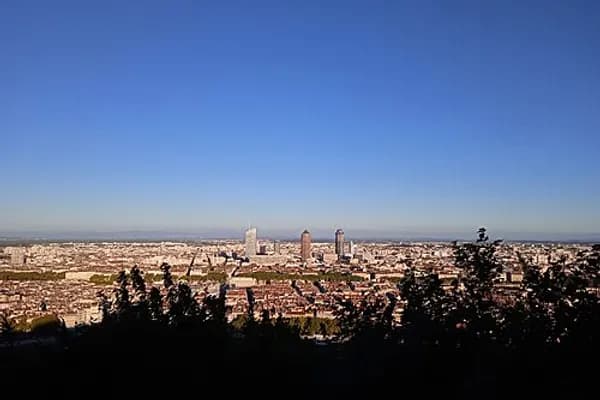
The skyline is being shaped to reflect the Alpine mountain range.
Encyclopedic content adapted from the Wikipedia article on Part-Dieu, used under CC BY-SA 4.0.