About the neighborhood
Study of silk industry players in Lyon
The history of silk production in Lyon involves the study of all the key players in the silk industry in Lyon. Over time, Lyon’s silk sector has encompassed every stage of producing and selling silk fabric from raw silk: spinning, creating patterns, weaving, finishing, and marketing. Collectively, this sector is referred to as the "Fabrique."
This history, spanning five centuries, originated on the banks of the Saône River during the Renaissance period. Fairs at this location facilitated the settlement of fabric merchants. The first weavers settled in Lyon under the auspices of a royal decree by King Francis I, and they rapidly prospered. However, this initial industrial momentum was interrupted by the Wars of Religion.
In the early 17th century, the invention of the drawloom enabled the Fabrique to master patterned fabrics. Its European expansion began during the reign of Louis XIV, as the fashions of the Versailles court set trends for all other European courts, propelling Lyon’s silk industry into prominence. During the 18th century, Lyon’s silk producers maintained their position through constant technical innovations, high-quality designers, and ongoing stylistic creativity.
The French Revolution dealt a severe blow to the Fabrique, but Napoleon strongly supported the sector, which peaked during the 19th century. Lyon became the global capital of silk, outpacing all other European silk industries and exporting a wide range of fabrics worldwide. Under the Second Empire, it was France’s most powerful export industry.
Although the first challenges arose in the 1880s, the advent of artificial textiles eventually ended Lyon’s industrial silk production in the 20th century. Traditional manufacturers struggled to adapt or did so too late. The silk industry collapsed in the 1930s, and despite numerous attempts at revival after World War II, the city’s activity became limited to haute couture and the restoration of antique fabrics.
Silk before it arrived in Lyon
Chinese origins
The technique of producing silk thread from silkworm cocoons was discovered in China during the Shang dynasty (17th–11th century BCE). For a long time, silk production remained a Chinese monopoly, with the Roman Empire importing it at great expense until the 6th century CE. According to legend, monks sent by the Byzantine Emperor Justinian I smuggled silkworm eggs into Europe.
Introduction in Europe
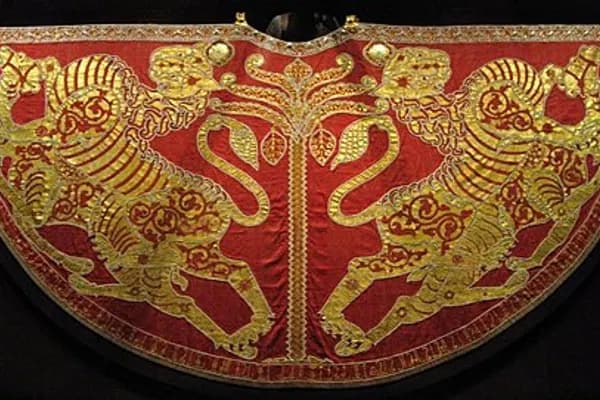
Silk has been present in Europe since the 4th century, originating in the Byzantine world. The silk weaving technique was later transmitted to the Muslim civilization, where it flourished during the Middle Ages. Through this channel, silk weaving was introduced into the medieval Christian world. When Roger of Hauteville conquered Muslim Sicily in the latter half of the 11th century, he partially preserved its culture, giving rise to a unique civilization known as Norman Sicily. A notable artifact of this cultural transmission is the coronation mantle of Roger II, King of Sicily, made of embroidered silk. Until the 13th century, silk weaving in Christian Europe was confined to Sicily and Calabria, before spreading to Lucca, Venice, and other Italian cities. Another significant transmission route was Muslim Spain, gradually reconquered by Christians over several centuries. Despite this, the technical and artistic contributions of the Muslim world were significant, as evidenced by typical Spanish motifs reproduced in Italian cities.
The Renaissance: the birth of the fabrique
Silk manufacturing in Lyon emerged during the Renaissance. Benefiting from a highly favorable environment created by trade fairs, significant freedom in organizing the craft, and the regular presence of monarchs, the silk industry grew rapidly. It reached its first golden age under the reign of Henry II before experiencing a severe crisis during the Wars of Religion.
Initial attempts
During the 15th century, Lyon became a significant trading hub, with Charles VII granting the city the right to hold two tax-free fairs. These grew to three and then four annually by 1463, becoming key events in European Renaissance commerce. Among other goods, many silks—primarily from Italy—were traded.
To curb the outflow of funds caused by the French elite’s insatiable demand for foreign silk, Louis XI sought to establish a silk manufacturing industry in Lyon. By the ordinance of November 23, 1466, he urged Lyon’s bourgeoisie to finance workshops. However, the merchants hesitated, not wanting to disrupt their relationships with Italian trade partners. The few workers who settled in Lyon were later sent to Tours, to the Château de Plessis-lès-Tours, in 1470.
This refusal by Lyonnais merchants can also be explained by economic conditions that seemed unfavorable for such an industry at the time. The local workforce was insufficient to enable low-cost production, and the profits from simply trading silk were comparatively certain and consistent. Italian silk merchants were essential to the success of the emerging fairs, and supporting the creation of an industry that would compete with their home cities risked driving them away. It was the transformation of these circumstances that, around fifty years later, allowed for the true establishment of Lyon's silk industry.
In the meantime, a merchant from Lucca, Nicolas de Guide, attempted to weave silk in Lyon in 1514. However, he was violently opposed by his compatriots, who accused him of competing with his city. Lacking support from the consulatefr, he ultimately abandoned his efforts.
Turquet and Naris: the birth of Lyon’s silk industry
In 1536, Étienne Turquetfr and Barthélemy Naris, Piedmontese merchants established in Lyon, sought to create factories for the production of precious fabrics. Through royal letters patent, King Francis I granted them the same privileges as those in the city of Tours, thereby establishing the guild of workers in “cloths of gold, silver, and silk.” Turquet, Naris, and their workers were exempted from all taxes, guard duties, and militia service, on the condition that they worked within the city and not outside it. Turquet founded the “Fabrique Lyonnaise de Soierie” with the help of Lyonnais bourgeois such as the Senneton brothers and bankers like Camus, La Porte, and Faure. He also brought in workers from Avignon and Genoa.
The immediate rise of the silk industry
Supported by the king, who granted Lyon a monopoly on importing raw silk in 1540, the silk industry quickly flourished. By 1548, during the procession marking the entrance of King Henry II, 459 master craftsmen participated, and between 800 and 1,000 people made a living from silk production in Lyon. This rapid growth was due in part to favorable economic conditions, an abundant supply of labor, and a flexible regulatory framework. At the time, Lyon was a particularly free city where artisans were not constrained by restrictive guilds, a liberty safeguarded by royal letters patent from 1486 and 1511. The initial company established by Turquet and Naris dissolved in 1540, with each continuing independently. New master silk weavers emerged, including Gibert de Crémone (who also operated in Saint-Chamond), Leydeul, and Rollet Viard, who owned looms in Avignon as well.
The rapid expansion of activity necessitated the creation of the first regulations for organizing the industry and the guild by 1554. These rules were drafted by the master craftsmen and the notable members of the consulate and were later formalized by the king. According to Roger Doucet, the apex of this initial period of Lyon’s silk industry occurred during the reign of Henry II. However, accurately measuring the production growth is challenging. Records provided by the consulate are often exaggerated and combine silk and wool workers into a single category. Despite these difficulties, the new industry successfully competed against imported Italian silks by offering lower prices on entry-level fabrics. Historian Richard Gascon estimated production growth based on the entry of bales of unprocessed or semi-processed silk intended for fabric production: from 1522 to 1544, the volume may have increased 2.5 times, and by eightfold between 1544 and 1569.
This success should not obscure the fact that, during this period, the Fabrique was only capable of producing plain fabrics, which did not rival the high-end creations of Italian cities. Despite some simple patterns achieved using ties or rods by Lyonnais artisans, Italian craftsmen remained the unrivaled masters of patterned silk production. It was not until the 1600s, with technical advancements brought by Claude Dangonfr—likely imported from Italy—that Lyon began to compete in this domain.
The Religious wars crisis
The occupation of Lyon by Protestant forces in 1562 and 1563fr triggered a crisis that could have been temporary but, combined with other negative events, plunged Lyon’s silk industry into its first cyclical depression.
With Protestants seizing power in Lyon in 1562, many leading merchants—who were also major manufacturers—left the city. This sudden departure led to a shortage of raw materials for the workshops, while the commercial networks for selling their production were severely disrupted. The plague that followed in subsequent years exacerbated the depression. In their petitions to the king, the remaining master silk weavers claimed that two-thirds of the workers had disappeared.
Adding to these temporary catastrophes was an event that further weakened Lyon’s silk industry, which now faced fierce competition. In 1563, Charles IX, then just 13 years old and newly crowned in a kingdom ravaged by religious divisions, imposed a 50% tax on raw silk imports. This significantly reduced the competitiveness of Lyon’s weavers, as foreign products—often smuggled into France—became cheaper than local goods. At the same time, rival cities such as Geneva, Besançon, Turin, Milan, Modena, and Reggio began producing low-quality plain and striped fabrics at low prices. These cities attracted part of Lyon’s workforce, which was suffering from a lack of employment opportunities.
The decline in workforce numbers and production levels is difficult to quantify. Historian Richard Gascon estimates that the number of looms in Lyon dropped from about 3,000 in the late 1550s to roughly 200 in the 1570s.
At the end of the 16th century, King Henry IV, seeking to make France self-sufficient in silk thread production, encouraged the cultivation of silkworms. Supported by Olivier de Serres, who briefly planted mulberry trees in the gardens of the Tuileries, Henry IV promoted this development, particularly in the Cévennes and Ardèche regions, where the climate was favorable. Mulberry cultivation had already been initiated in Languedoc and Provence in 1564 by François Traucat, leading to the establishment of France’s first silkworm farms.
17th and 18th centuries: Lyon’s silk at the Royal Court
During the 17th and 18th centuries, Lyon’s silk industry was closely tied to the royal court and, to a lesser extent, to the conflicts affecting European monarchies. This dependence explains the alternating periods of prosperity and hardship that marked the silk workers’ lives and the trade as a whole.
From Henry IV to Louis XIV
At the beginning of the 17th century, the Fabrique in Lyon consisted of fewer than 1,000 master weavers, operating fewer than 2,000 looms and employing fewer than 3,000 people in total. Under Henry IV, Lyon's silk industry underwent two significant developments.
The first was the introduction of the drawloom (métier à la grande tire) by Claude Dangonfr, imported from Italy, which enabled the weaving of patterned fabrics. This innovation allowed Lyon to compete with Paris and Tours and match the quality of the productions from Italian cities. At the time, northern and central Italian cities dominated European silk production in both quality and quantity, setting the styles sought after by elites across the continent. The quality of Lyonnais silk further improved in 1655 with the introduction of silk polishing, brought to the city by Octavio Mey.
The second major development was the establishment of regulations governing the profession. Until then, master weavers were free to organize their work as they saw fit. In 1596, apprenticeships were set at five years, followed by a two-year period as a journeyman. Masters were allowed no more than two apprentices and were prohibited from employing people outside their families for auxiliary tasks such as preparing warps and wefts.
Despite these advancements, Lyon remained a minor silk center compared to Italian cities until the mid-17th century. The trade-in luxury fabrics was still dominated by Italian merchants.
Colbert's reforms
In 1667, Jean-Baptiste Colbert issued several ordinances to regulate the "Grande Fabrique de Soie" in Lyon. These decrees established strict guidelines for production, detailing the quality standards for royal orders and specifying factors such as fabric width and the number of threads to be used. They also mandated the maintenance of production logs. Extravagant fabrics were produced in Lyon for members of the royal court and to furnish royal residences such as the Château de Saint-Germain-en-Laye and the Palace of Versailles. For example, the "brocade of love" in six pieces adorned the king’s chamber in 1673. Unfortunately, no pieces from this era survive, as worn fabrics were melted down to recover precious metals.
Colbert's mercantilist policies strongly supported the growth of French industrial production. His efforts were particularly effective for the Fabrique, as the number of weavers tripled between 1665 and 1690. To avoid alienating a clientele still attached to traditional Italian styles, French merchant-manufacturers refrained from innovating with motifs. In some cases, they even marketed their fabrics as Italian to reassure customers. The industry’s growth was not significantly disrupted by the revocation of the Edict of Nantes (1685), although many Protestant silk workers emigrated, taking refuge in places like Zurich and London (notably in the Spitalfields area).
Commercial and stylistic evolution
From the late 17th century to the 1720s, royal commissions ceased entirely. The final years of Louis XIV's reign were challenging for the Lyonnais silk industry, as royal mourning periods reduced the demand for luxury fabrics.
Encyclopedic content adapted from the Wikipedia article on Confluence, used under CC BY-SA 4.0.