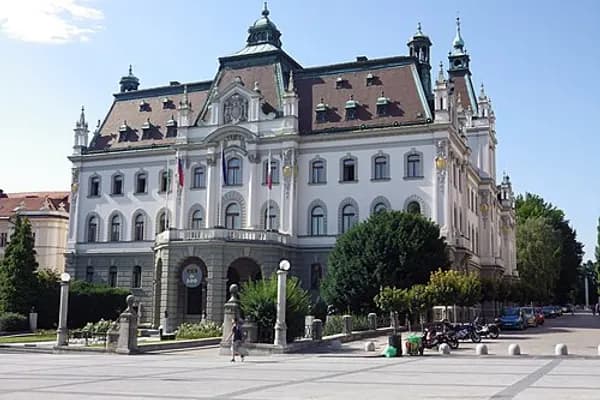
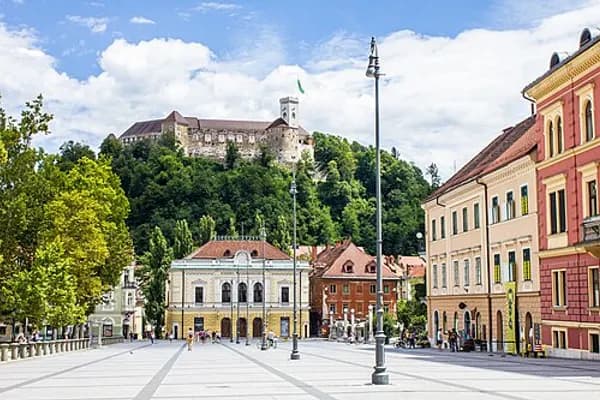
About the neighborhood
Capital and largest city of Slovenia
Historical affiliations
Archbishop of Salzburg (1112–1555)
Habsburg Monarchy (1555–1804)
Austrian Empire (1804–1809)
Illyrian Provinces (1809–1814; capital)
Austrian Empire (1814–1867)
Austria-Hungary (1867–1918)
State of Slovenes, Croats and Serbs (1918)
Kingdom of Yugoslavia (1918–1941)
Kingdom of Italy (1941–1945; annexed)
Nazi Germany (1943–1945; de facto)
SFR Yugoslavia (1945–1991)
Slovenia (1991–present; capital)
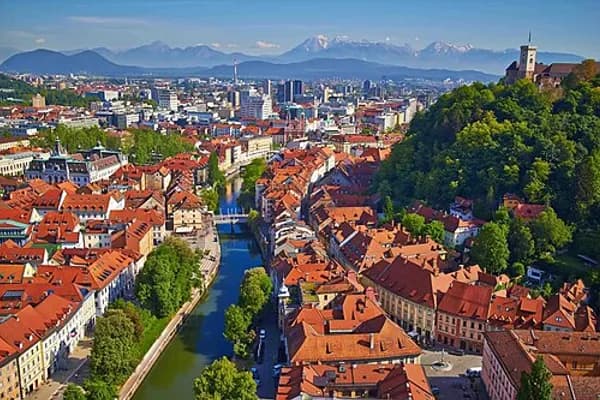
Ljubljana (spoken Slovene: Lublana; also known by other historical names) is the capital and largest city of Slovenia, located along a trade route between the northern Adriatic Sea and the Danube region, north of the country's largest marsh, it has been inhabited since prehistoric times. It is the country's cultural, educational, economic, political and administrative center and the seat of the Urban Municipality of Ljubljana.
During antiquity, a Roman city called Emona stood in the area. The city was first mentioned in the first half of the 12th century. It was the historical capital of Carniola, one of the Slovene-inhabited parts of the Habsburg monarchy. It was under Habsburg rule from the Middle Ages until the dissolution of the Austro-Hungarian Empire in 1918. After World War II, Ljubljana became the capital of the Socialist Republic of Slovenia, part of the Socialist Federal Republic of Yugoslavia. The city retained this status until Slovenia became independent in 1991 and Ljubljana became the capital of the newly formed state.
Name
The exact origin of the name Ljubljana is unclear. In medieval times, both the river and the town were also called Laibach in German. This name was used within the region until 1918 and continues to be used in German. In Italian, the city is referred to as Lubiana, and in Latin, it is known as Labacum. An archaic English form of the city's name is Lublyana, used primarily by Slovene Americans.
The German name was first documented in 1144, and the Slovenian form appeared in records as early as 1146. The 10th-century work Life of Gregentios provides the Greek variant Λυπλιανές (Lyplianés) and situates it among the Avars in the 6th century. This account is influenced by an earlier northern Italian source written shortly after the conquest of 774.
The connection between the Slovene and German names has posed a puzzle for scholars. In 2007, linguist Tijmen Pronk, an authority in comparative Indo-European linguistics and Slovene dialectology from the University of Leiden, provided strong support for the theory that the Slavic ljub- 'to love, like' was the most likely origin. He argued that the river's name likely stemmed from the settlement's name. Silvo Torkar, a linguist with expertise in Slovene names, put forth the idea that Ljubljana's name has its roots in Ljubija, the original name of the Ljubljanica River. This can be traced back to the Old Slavic male name Ljubovid, which translates to 'the one with a lovely appearance'. Torkar also asserted that the name Laibach is a combination of German and Slovene, sharing its origins with the same personal name.
Dragon symbol
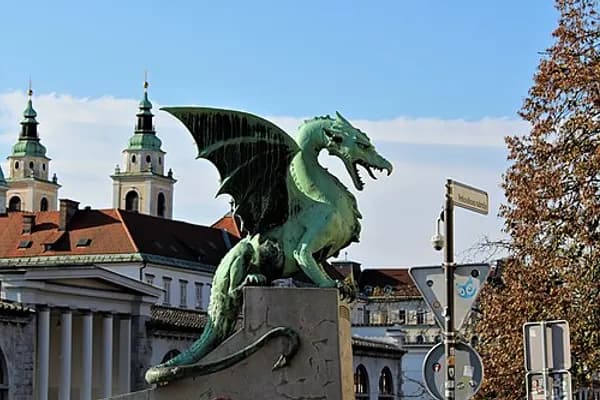
The city's symbol is the Ljubljana Dragon. It is depicted on the top of the tower of Ljubljana Castle in the Ljubljana coat of arms and on the Ljubljanica-crossing Dragon Bridge (Zmajski most). It represents power, courage, and greatness.
Several explanations describe the origin of the Ljubljana Dragon. According to a Slavic myth, the slaying of a dragon releases the waters and ensures the fertility of the earth, and it is thought that the myth is tied to the Ljubljana Marsh, the expansive marshy area that periodically threatens Ljubljana with flooding. According to Greek legend, the Argonauts on their return home after having taken the Golden Fleece found a large lake surrounded by a marsh between the present-day towns of Vrhnika and Ljubljana. There Jason struck down a monster. This monster evolved into the dragon that today is present in the city coat of arms and flag.
It is historically more believable that the dragon was adopted from Saint George, the patron of the Ljubljana Castle chapel built in the 15th century. In the legend of Saint George, the dragon represents the old ancestral paganism overcome by Christianity. According to another explanation, related to the second, the dragon was at first only a decoration above the city coat of arms. In the Baroque, it became part of the coat of arms and, in the 19th and especially the 20th century, it outstripped the tower and other elements in importance.
History
Prehistory
Around 2000 BC, the Ljubljana Marsh was settled by people living in pile dwellings. Prehistoric pile dwellings and the oldest wooden wheel in the world are among the most notable archeological findings from the marshland. These lake-dwelling people survived through hunting, fishing and primitive agriculture. To get around the marshes, they used dugout canoes made by cutting out the inside of tree trunks. Their archaeological remains, nowadays in the Municipality of Ig, have been designated a UNESCO World Heritage Site since June 2011, in the common nomination of six Alpine states.
Later, the area remained a transit point, for groups including the Illyrians, followed by a mixed nation of the Celts and the Illyrians called the Iapodes, and then in the 3rd century BC a Celtic tribe, the Taurisci.
Antiquity
Around 50 BC, the Romans built a military encampment that later became a permanent settlement called Iulia Aemona. This entrenched fort was occupied by the Legio XV Apollinaris. In 452, it was destroyed by the Huns under Attila's orders, and later by the Ostrogoths and the Lombards. Emona housed 5,000 to 6,000 inhabitants and played an important role during battles. Its plastered brick houses, painted in different colours, were connected to a drainage system.
In the 6th century, the ancestors of the Slovenes moved in. In the 9th century, they fell under Frankish domination, while experiencing frequent Magyar raids. Not much is known about the area during the settlement of Slavs in the period between the downfall of Emona and the Early Middle Ages.
Middle Ages
The parchment sheet Nomina defunctorum ("Names of the Dead"), most probably written in the second half of 1161, mentions the nobleman Rudolf of Tarcento, a lawyer of the Patriarchate of Aquileia, who had bestowed a canon with 20 farmsteads beside the castle of Ljubljana (castrum Leibach) to the Patriarchate. According to the historian Peter Štih's deduction, this happened between 1112 and 1125, the earliest mention of Ljubljana.
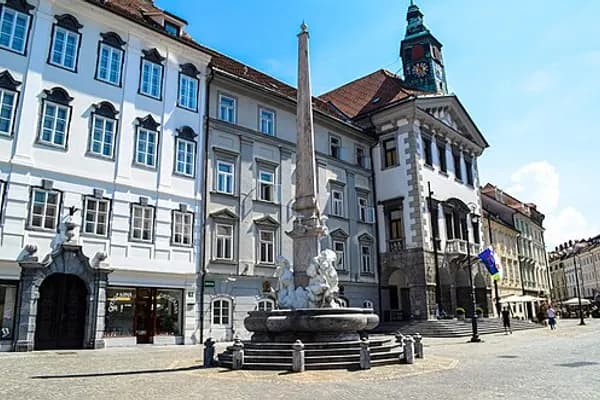
The property changed hands repeatedly until the first half of the 12th century. The territory south of the Sava where Ljubljana developed, gradually became property of the Carinthian Dukes of the House of Sponheim. Urban settlement started in the second half of the 12th century. At around 1200, market rights were granted to Old Square (Stari trg), which at the time was one of Ljubljana's three original districts. The other two districts were an area called "Town" (Mesto), built around the predecessor of the present-day Ljubljana Cathedral at one side of the Ljubljanica River, and New Square (Novi trg) at the other side. The Franciscan Bridge, a predecessor of the present-day Triple Bridge, and the Butchers' Bridge connected the walled areas with wooden buildings. Ljubljana acquired the town privileges at some time between 1220 and 1243. Seven fires erupted during the Middle Ages. Artisans organised themselves into craft guilds. The Teutonic Knights, the Conventual Franciscans, and the Franciscans settled there. In 1256, when the Carinthian duke Ulrich III of Spanheim became lord of Carniola, the provincial capital was moved from Kamnik to Ljubljana.
In the late 1270s, Ljubljana was conquered by King Ottokar II of Bohemia. In 1278, after Ottokar's defeat, it became—together with the rest of Carniola—property of Rudolph of Habsburg. It was administered by the Counts of Gorizia from 1279 until 1335, when it became the capital town of Carniola. Renamed Laibach, it was owned by the House of Habsburg until 1797. In 1327, the Ljubljana's "Jewish Quarter"—now only "Jewish Street" (Židovska ulica) remains—was established with a synagogue, and lasted until Emperor Maximilian I in 1515 and expelled the Jews from Ljubljana at the request of its citizens, for which he demanded a certain payment from the town. In 1382, in front of St. Bartholomew's Church in Šiška, at the time a nearby village, now part of Ljubljana, a peace treaty was signed between the Republic of Venice and Leopold III of Habsburg.
Early modern
In the 15th century, Ljubljana became recognised for its art, particularly painting and sculpture. The Latin Catholic Archdiocese of Ljubljana was established in 1461 and the Church of St. Nicholas became the diocesan cathedral. After the 1511 Idrija earthquake, the city was rebuilt in the Renaissance style and a new wall was built around it. Wooden buildings were forbidden after a large fire at New Square in 1524.
In the 16th century, the population of Ljubljana numbered 5,000, 70% of whom spoke Slovene as their first language, with most of the rest using German. The first secondary school, public library and printing house opened in Ljubljana. Ljubljana became an important educational centre.
From 1529, Ljubljana had an active Slovene Protestant community. They were expelled in 1598, marking the beginning of the Counter-Reformation. Catholic Bishop Thomas Chrön ordered the public burning of eight cartloads of Protestant books.
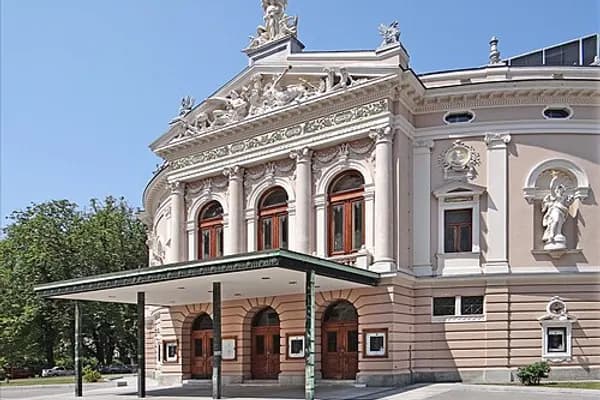
In 1597, the Jesuits arrived, followed in 1606 by the Capuchins, seeking to eradicate Protestantism. Only 5% of all the residents of Ljubljana at the time were Catholic, but eventually they re-Catholicized the town. The Jesuits staged the first theatre productions, fostered the development of Baroque music, and established Catholic schools. In the middle and the second half of the 17th century, foreign architects built and renovated monasteries, churches, and palaces and introduced Baroque architecture. In 1702, the Ursulines settled in the town, and the following year they opened the first public school for girls in the Slovene Lands. Some years later, the construction of the Ursuline Church of the Holy Trinity started. In 1779, St. Christopher's Cemetery replaced the cemetery at St. Peter's Church as Ljubljana's main cemetery.
Late modern
From 1809 to 1813, during the "Napoleonic interlude", Ljubljana (as Laybach) was the capital of the Illyrian Provinces. In 1813, the city returned to Austria and from 1815 to 1849 was the administrative centre of the Kingdom of Illyria in the Austrian Empire. In 1821, it hosted the Congress of Laibach, which fixed European political borders for that period. The first train arrived in 1849 from Vienna and in 1857 the line extended to Trieste.
In 1895, Ljubljana, then a city of 31,000, suffered a severe earthquake with a moment magnitude of 6.1 and a maximum EMS intensity of VIII–IX ("heavily damaging – destructive"). 21 people died due to the earthquake and some 10% of the city's 1,400 buildings were destroyed. During the subsequent reconstruction, some districts were rebuilt in the Vienna Secession style. Public electric lighting arrived in 1898. The rebuilding period between 1896 and 1910 is referred to as the "revival of Ljubljana" because of architectural changes that defined the city and for reform of urban administration, health, education and tourism. The rebuilding and quick modernisation of the city were led by the mayor Ivan Hribar.
In 1918, following the dissolution of Austria-Hungary, the region joined the Kingdom of Serbs, Croats and Slovenes. In 1929, Ljubljana became the capital of the Drava Banovina, a Yugoslav province.
In 1941, during World War II, Fascist Italy occupied the city, and then on 3 May 1941 made Lubiana the capital of Italy's Province of Ljubljana with former Yugoslav general Leon Rupnik as mayor. After the Italian capitulation, Nazi Germany with SS-general Erwin Rösener and Friedrich Rainer took control in 1943, but formally the city remained the capital of an Italian province until 9 May 1945. In Ljubljana, the Axis forces established strongholds and command centres of Quisling organisations, the Anti-Communist Volunteer Militia under Italy and the Home Guard under German control. Starting in February 1942, the city was surrounded by barbed wire, later fortified by bunkers, to prevent co-operation between the resistance movements that operated inside and outside the fence. Since 1985, the commemorative trail has ringed the city where this iron fence once stood. Postwar reprisals filled mass graves.
After World War II, Ljubljana became the capital of the Socialist Republic of Slovenia, part of the Socialist Federal Republic of Yugoslavia. It retained this status until Slovene independence in 1991.
Contemporary situation
Ljubljana is the capital of independent Slovenia, which joined the European Union in 2004.
Geography
The city covers 163.8km (63.2sqmi). It is situated in the Ljubljana Basin in Central Slovenia, between the Alps and the Karst. Ljubljana is located some 320km (200mi) south of Munich, 477km (296mi) east of Zürich, 250km (160mi) east of Venice, 350km (220mi) southwest of Vienna, 124km (77mi) west of Zagreb and 400km (250mi) southwest of Budapest. Ljubljana has grown considerably since the 1970s, mainly by merging with nearby settlements.
Geology
The city stretches out on an alluvial plain dating to the Quaternary era. The mountainous regions nearby are older, dating from the Mesozoic (Triassic) or Paleozoic. Earthquakes have repeatedly devastated Ljubljana, notably in 1511 and 1895.
Topography
Ljubljana has an elevation of 295m (968ft). The city centre, located along the river, sits at 298m (978ft). Ljubljana Castle, which sits atop Castle Hill (Grajski grič) south of the city centre, has an elevation of 366m (1,201ft). The highest point of the city, called Grmada, reaches 676m (2,218ft), 3m (9.8ft) more than the nearby Mount Saint Mary (Šmarna gora) peak, a popular hiking destination. These are located in the northern part of the city.
View to the south from Ljubljana Castle with the Ljubljana Marsh in the back. The building density there is substantially lower due to unsuitable ground for construction.View to the north from Ljubljana Castle with the Karawanks (left), Mount Saint Mary (center), and Kamnik–Savinja Alps (right) in the background Bodies of water
Encyclopedic content adapted from the Wikipedia article on Old Town, used under CC BY-SA 4.0.