About the neighborhood
Neighborhood in Boston, Massachusetts
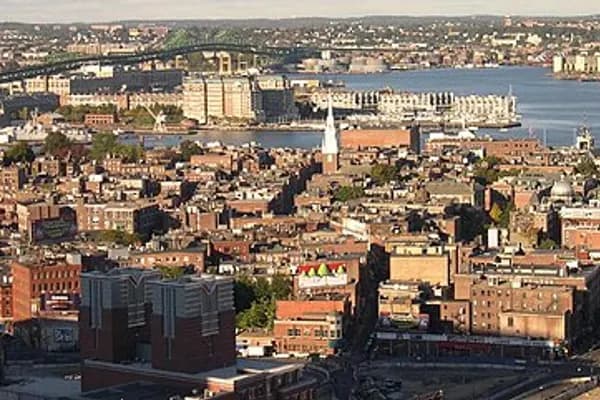
The North End is a neighborhood of Boston, Massachusetts, United States. It is the city's oldest residential community, having been inhabited since it was colonized in the 1630s. It covers 0.36 square miles (0.93km), but the neighborhood has nearly one hundred establishments and a variety of tourist attractions. It is known for its Italian American population and Italian restaurants.
History
17th century
The North End as a distinct community of Boston was evident as early as 1646. Three years later, the area had a large enough population to support the North Meeting House. The construction of the building also led to the development of the North Square, which was the center of community life.
Increase Mather was the minister of the North Meeting House, an influential and powerful figure who attracted residents to the North End. On November 27, 1676, Mather's home, the meeting house, and a total of 45 buildings were destroyed by a fire—Boston organized the first paid fire department in America two years later. The meeting house was rebuilt soon afterwards, and the Paul Revere House was later constructed on the site of the Mather House. Part of Copp's Hill was converted to a cemetery, called the North Burying Ground (now known as Copp's Hill Burying Ground); the earliest grave markers in the cemetery date to 1661.
18th century
The North End became a fashionable place to live in the 18th century. Wealthy families shared the neighborhood with artisans, journeymen, and laborers. After the Revolutionary War, some of these individuals who were also British loyalists ended up leaving the North End for England or Canada. Two brick townhouses are still standing from this period: the Pierce-Hichborn House and the Clough House on Unity Street. The Old North Church was constructed during this time as well, now known as Christ Church. It is the oldest surviving church building in Boston.
The Hutchinson Mansion in North Square was attacked by anti-Stamp Act rioters on the evening of August 26, 1765, forcing Lieutenant Governor Thomas Hutchinson to flee through his garden. In 1770, 11 year-old Christopher Seider was part of an angry crowd that attacked the home of Ebenezer Richardson which was located on Hanover Street. Richardson fired a gun into the crowd, hitting and fatally wounding the boy.
During the Siege of Boston, the North Meeting House was dismantled by the British for use as firewood.
19th century
In the first half of the 19th century, the North End experienced a significant amount of commercial development. This activity was concentrated on Commercial, Fulton, and Lewis Streets. During this time the neighborhood also developed a red-light district, known as the Black Sea. By the late 1840s, living conditions in the crowded North End were among the worst in the city. Successive waves of immigrants came to Boston and settled in the neighborhood, beginning with the Irish and continuing with Eastern European Jews and Italians. Boston as a whole was prosperous, however, and the wealthy residents of the North End moved to newer, more fashionable neighborhoods such as Beacon Hill.
In 1849, a cholera epidemic swept through Boston, hitting the North End most harshly; most of the seven hundred victims were North Enders. In 1859, tensions between the Catholic Irish immigrants and the existing Protestant community led to the Eliot School Rebellion. By 1880, the Protestant churches had left the neighborhood.
The Boston Draft Riot of July 14, 1863, began on Prince Street in the North End.
In the latter half of the 19th century, several charitable groups were formed in the North End to provide aid to its impoverished residents. These groups included The Home for Little Wanderers and the North End Mission. The North Bennet Street Industrial School (now known as North Bennet Street School) was also founded at around this time to provide North End residents with the opportunity to gain skills that would help them find employment. Beginning in the 1880s, North End residents began to replace the dilapidated wooden housing with four- and five-story brick apartment buildings, most of which still stand today. The city contributed to the revitalization of the neighborhood by constructing the North End Park and Beach, Copp's Hill Terrace, and the North End Playground.
20th century
In the early 20th century, the North End was dominated by Jewish and Italian immigrants. Three Italian immigrants founded the Prince Macaroni Company, one example of the successful businesses created in this community. Also during this time, the city of Boston upgraded many public facilities in the neighborhood: the Christopher Columbus School (now a condominium building), a public bathhouse, and a branch of the Boston Public Library were built. These investments, as well as the creation of the Paul Revere Mall (also known as the Prado), contributed to the North End's modernization. The Civic Service House's Night School, established in 1901, set out to do specialized settlement work along civic lines, and purposed to reach a constituency approaching or within the privileges of citizenship.
In 1918, the Spanish Influenza Pandemic hit the crowded North End severely; so many children were orphaned as a result of the pandemic that the city created the Home for Italian Children to care for them. The following year, in 1919, the Purity Distilling Company's 2.3 million gallon molasses storage tank explosively burst open, causing the Great Molasses Flood. A 25ft wave of molasses flowed down Commercial Street towards the waterfront, sweeping away everything in its path. The wave killed 21 people, injured 150, and caused damage worth $100 million in today's money.
In 1927, the Sacco and Vanzetti wake was held in undertaker Joseph A. Langone Jr.'s Hanover Street premises. The funeral procession that conveyed Sacco and Vanzetti's bodies to the Forest Hills Cemetery began in the North End.
In 1934, the Sumner Tunnel was constructed to connect the North End to Italian East Boston, the location of the then-new Boston Airport (now Logan International Airport). In the 1950s the John F. Fitzgerald Expressway (locally known as the Central Artery) was built to relieve Boston's traffic congestion. Hundreds of North End buildings were demolished below Cross Street, and the Artery walled off the North End from downtown, isolating the neighborhood. The increased traffic led to the construction of a second tunnel between the North End and East Boston; this second tunnel (the Callahan Tunnel) opened in 1961. Although the construction of the Central Artery created years' worth of disorder, in the 1950s the North End had low disease rates, low mortality rates, and little street crime. As described by Jane Jacobs in The Death and Life of Great American Cities, in 1959 the North End's "streets were alive with children playing, people shopping, people strolling, people talking. Had it not been a cold January day, there would surely have been people sitting. The general street atmosphere of buoyancy, friendliness, and good health was so infectious that I began asking directions of people just for the fun of getting in on some talk."
Throughout the 1960s and 1970s, the North End experienced population loss. During this time, many shops in the neighborhood closed, the St. Mary's Catholic School and the St. Mary's Catholic Church closed, and the waterfront industries either relocated or went defunct. During the 1970s and 1980s, the Boston Redevelopment Authority approved high-rise, high-density housing projects in the neighborhood while North End residents worked to build affordable housing for the elderly. One of these projects, the Casa Maria Apartments, stands on the site of the St. Mary's Catholic Church.
In 1976, the neighborhood welcomed President Ford and Queen Elizabeth II, who each visited the North End as part of the United States Bicentennial Celebrations.
During the late 20th century through the early 21st century, the Central Artery was dismantled and replaced by the Big Dig project. Throughout the construction process, access to the North End was difficult for both residents and visitors; as a result, many North End businesses closed. The Rose Kennedy Greenway is now located on the former site of the Central Artery.
Geography
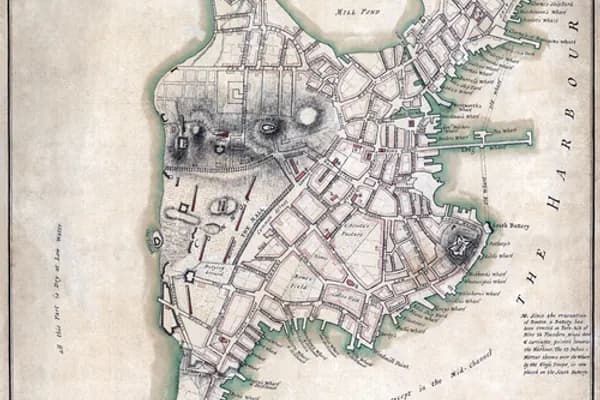
The North End describes its location in the historic Shawmut Peninsula, which centuries of infill have obscured. Copp's Hill is the largest geographic feature and is close to the center of the neighborhood.
The North End's modern boundaries are to the northeast of the Rose Fitzgerald Kennedy Greenway, with the outlet of the Charles and Mystic Rivers to the North, and Boston Harbor to the East. Government Center, Quincy Market, and the Bulfinch Triangle neighborhoods lie across Greenway. The Bill Russell Bridge crosses the mouth of the Charles River to connect the North End to Charlestown, while the Callahan Tunnel, Sumner Tunnel, and MBTA Blue Line tunnel connect it to East Boston.
Commercial Street and Atlantic Avenue border the neighborhood on the harbor side, while Hanover Street bisects the neighborhood and is the main north–south street. Cross Street and North Washington Street runs along the community's western edge. The North End Parks of the Greenway occupy the site of the former elevated Central Artery (demolished in 2003). Other notable green spaces include Cutillo Park, Polcari Park, Langone Park, DeFilippo Playground, the Paul Revere Mall (The Prado), and the Christopher Columbus Waterfront Park.
No MBTA subway station is within the neighborhood, but stations serving the Blue, Orange, and Green Lines are within five- to ten-minute walks, including Aquarium, Haymarket, and North Station.
Demographics
According to the 2010 Census data, the neighborhood's population is 10,131, a 5.13% rise from 2000. The majority of the North End's residents are White (90.88%), followed by Hispanic or Latino (3.69%), Asian (2.83%), Black/African Americans (1.13%), two or more races/ethnicities (1.01%) other race/ethnicity (0.29%), American Indian and Alaska Native (0.15%), and Native Hawaiian and Other Pacific Islander (0.03%).
African American community
A small community of free African Americans lived at the base of Copp's Hill from the 17th to the 19th century. Members of this community were buried in the Copp's Hill Burying Ground, where a few remaining headstones can still be seen today. The community was served by the First Baptist Church.
By the late 19th century, the African American community of the North End was known as New Guinea. By that time, however, much of the community had actually moved to Beacon Hill.
Irish community
Between 1845 and 1853, a massive wave of Irish immigrants settled in the North End; the neighborhood became predominantly Irish (the city's overall population was also affected, going from a predominantly Yankee-Protestant city to being one-third Irish in just a few years). Between 1865 and 1880, the North End was almost exclusively Irish (or Irish-American) and Catholic.
Jewish community
In the late 19th century, a stable Jewish community began to develop in the North End. Much of the community settled along Salem Street. The community founded places of worship, a Hebrew School, and social programs. In 1903, the first and only new synagogue to be built in the North End was constructed. Carroll Place was renamed "Jerusalem Place" in honor of the new building. By 1922, however, the majority of Jewish residents had moved out of the North End, preferring other neighborhoods such as Roxbury.
Italian community
By 1890, the North Square area was known as Little Italy. The population of Italian immigrants in the North End grew steadily until reaching its peak, in 1930, of 44,000 (99.9% of the neighborhood's total population). Although many businesses, social clubs, and religious institutions celebrate the neighborhood's Italian heritage, the North End is now increasingly diverse. Both the population of the North End and the percent of that population who are Italian have decreased over the years; as of 2014 the population of the North End was 7,360, of whom 824 (11%) had been born in Italy and an additional 2,772 (38%) were of Italian heritage.
In 1923, the Michael Angelo (later renamed "Michelangelo") School was built in the North End and named in honor of the Italian residents. The street on which the building was constructed was renamed Michelangelo Street, and remains the only street in the North End with an Italian name. The Michelangelo School closed in 1989, and the building was converted into housing.
Italian bakeries, restaurants, small shops, and groceries opened in the first half of the 20th century. The first immigrants found work selling fruit, vegetables, wine, cheese and olive oil. Later immigrants found more opportunities in the construction trades, and by 1920 the neighborhood was served by Italian physicians, dentists, funeral homes, and barbers. Residents founded businesses, some of which still exist today, including Prince Pasta, the Pastene Corporation, and Pizzeria Regina.
The Italian American community faced anti-Italian sentiment, prejudice, and neglect. After World War II, however, Italian Americans began to gain political power which then helped the community to address these issues. Today, the "old world" Italian atmosphere of the North End helps to drive tourism, and many of the small neighborhood shops have been replaced by restaurants. Italian feasts, such as the Feast of St. Anthony and the Fisherman's Feast, are still celebrated in the streets of the North End, and draw large crowds.
Arts and culture
Arts
The North End Music and Performing Arts Center (NEMPAC) and the Improv Asylum Theater are located on Hanover Street. All Saints Way, a private art project located on Battery Street, is occasionally open to the public. It consists of framed portraits of Roman Catholic saints hung on a brick wall, some of which are visible from the street.
Cuisine
At the end of the 19th century the North End was filled with small restaurants that served inexpensive meals. In 1909, there were 12 active Italian restaurants, and by the 1930s a few of these restaurants were renowned. Today, the North End's streets are lined with cafes, small grocery stores, and Italian restaurants. These restaurants are a popular destination for both locals and tourists.
Sicilian immigrants also started food companies specializing in their native cuisine, which after successful expansion moved out of the neighborhood. The Pastene company began as a family pushcart in the North End in 1848. Beginning in 1912, Prince pasta was manufactured in the North End and sold at 92 Prince Street. (The brand is now owned by New World Pasta.)
Private education
Encyclopedic content adapted from the Wikipedia article on North End, used under CC BY-SA 4.0.