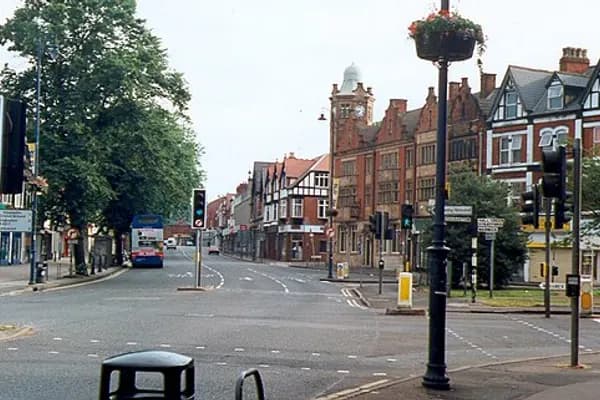
About the neighborhood
Area of Birmingham, England
Moseley (/ˈmoʊzliː/ MOZE-lee) is an affluent suburb in south Birmingham, England, three miles (five kilometres) south of the city centre.
It is located within the eponymous Moseley ward of the constituency of Hall Green and Moseley in the ceremonial county of the West Midlands. It historically lay within Worcestershire, abutting the county border with Warwickshire.
History
Moseley was listed as a settlement within the manor of Bromsgrove in the Domesday Book of 1086 as Museleie, from the Anglo-Saxon mús (mouse) + leáh (lea, meadow), which translates as either 'mouse clearing' or 'mouse-sized (i.e. small) clearing'.
St Mary's Church, Moseley was licensed by the Bishop of Worcester (authorised by Pope Innocent VII) in February 1405. St Anne's Church, Moseley was opened in 1874 for the now extinct parish of Park Hill. The 600th anniversary of St Mary's was celebrated in 2005 with a series of special events. In 2012 the church bells, which had been named the worst-sounding in the country, were replaced.
Either before or as a result of the dissolution of the monasteries, Moseley became a manor in its own right, though records of this are not evident. Certainly, Moseley Hall was 'rebuilt' in parkland in the early 1600s by the Grevis family, and rebuilt again by 1795 after being set on fire during rioting in 1791. It was donated in 1891 to the City of Birmingham by Richard Cadbury and now forms part of Moseley Hall Hospital.
Spring Hill College, a Gothic revival construction built in 1857 and now home to Moseley School, is located in the south of the district. Former pupils include comedian Jasper Carrott and musician Bev Bevan of the Electric Light Orchestra.
Moseley local centre is formed around the Victorian shopping precinct known as Moseley Village, which forms part of a historical conservation area. Moseley and the surrounding areas were much developed after 1910, being built upon the once extensive farm land that was predominant in this area. The new properties being mostly of large houses, designed to cater for the Edwardian middle-class families that settled in the suburbs surrounding Birmingham's industrial centre. These large houses relied upon at least one servant or 'tweeny' as they were often termed, to help the lady of the house run the household. With the advent of the First World War, staff were hard to find to maintain houses of this size. The heating bills and high maintenance made them unpopular after the war and many were split into flats to cater for the requirements of the expanding working population who moved from the city centre as extensive redevelopment took place in the 1960s.
In some respects Moseley and the surrounding area suffered a serious decline in the last part of the 20th century. Much property fell into neglect, and problems with crime, drugs and prostitution became commonplace in the areas bordering Balsall Heath. During this same period, however, with a great deal of cheap accommodation on offer, it is arguable that Moseley also enjoyed its most creative and cosmopolitan phase as the focus of artistic and student communities. In 1970s, the small triangular shaped green in the heart of Moseley village, which was then home to the underground public toilets, was a convenient meeting place for local youth, and was known as "Bog Island".
Local band Ocean Colour Scene were active in the mid-1990s British Britpop–indie scene with songs such as "The Riverboat Song", inspired by locations within the suburb of Moseley. Their most successful album (in terms of weeks on chart) was Moseley Shoals. Moseley is also the birthplace of Nick Rhodes of Duran Duran.
The politician Joseph Chamberlain had his Birmingham residence at Highbury, near the edge of Moseley. The property was entrusted to the city after Chamberlain's death and is currently used for multiple occasions under the purview of the Chamberlain Highbury Trust.
Literature
J. R. R. Tolkien spent his early years in Moseley, living close to Sarehole Mill in Hall Green before moving to the site now occupied by Shades Music off the Alcester Road. Sarehole Mill is believed to have been his inspiration for the tranquil Shire in The Lord of the Rings. He also drew inspiration from Moseley Bog for the landscape of Middle-earth.
Sport
Moseley has a rich history of success in Rugby Union. Its most famous team is Moseley Rugby Football Club, who were one of Europe's best teams in the late 1960s to the 1980s. Notable players include Sam Doble, J. F. Byrne, Peter Cranmer, Alain Rolland, Mike Teague and Victor Ubogu.
The Moseley Wanderers team of 1900 won the Silver Medal in the Rugby Union competition at the 1900 Olympics.
Present
A monthly Farmers' Market in Moseley – set up by the Moseley Neighbourhood Forum – has won various awards including best FARMA Certified Urban Farmers' Market 2009 and in 2009 local farmer Dominic Butler won the Most Unique Produce award with his micro blue beetroots. Similarly, Moseley has a well defined and established community spirit and ethos, exemplified by Moseley Neighbourhood Forum – a neighbourhood forum – that works to develop the area for the betterment of everyone. The Moseley Society exists to protect the heritage of the area; meetings of the Society discuss and debate a wide range of local issues and the interests of its residents.
The Moseley Community Development Trust (CDT) invests in the social and physical capital of the area. Established with funding from charitable trust funds and with the support of the Moseley and Kings Heath Ward Committee, the CDT is now managing a series of initiatives to improve the environment of Moseley.
It has its own monthly magazine, Moseley B13 (formerly Birmingham 13), reporting on local events and personalities. It has been printing as of May 1973.
A group of volunteers have formed Moseley in Bloom (MiB). Much like the Moseley Community Development Trust, the group undertake many projects which look at the greener issues around Moseley. Many projects take place throughout the year to enhance the landscape of Moseley as well as renovate dilapidated areas.
Every summer Moseley hosts Moseley Festival, a festival of arts and culture that sees people in the community come together and hold a series of music, art, food, cultural and sporting events.
Moseley Folk & Arts Festival happens later in the year, and attracts big names from the world of folk. Moseley Jazz, Funk & Soul Festival takes place in Moseley Park during the summer as well. Moseley also has its own literary festival, Pow-Wow LitFest, which has taken place annually at the Prince of Wales pub as of 2011.
In 2015 Moseley was named as the "best urban place to live" by The Sunday Times, with the newspaper citing its 'Arts and Crafts', 'Bohemian culture' and 'Victorian Architecture' as reasons to live in the suburb. This award followed its being highlighted by The Guardian in 2013 as a place to move, with similar reasons being cited.
Education
Moseley has two secondary schools, Moseley School, a language college, and Queensbridge School, an arts college. It also has several primary schools such as Moseley C of E Primary School a one form entry school that has connections with St. Mary's Church and Park Hill Primary School on Alcester Road and St Martin de Porres Catholic Primary School.
Moseley is also home to Uffculme School, an all age special school for children on the autism spectrum. It is also home to James Brindley Academy's Willows Centre, which provides education to inpatients at Parkview Clinic.
Moseley also has Fox Hollies School.
Notable residents
Many people who have been born, lived or worked in Moseley have made important contributions, a few of the more high-profile ones are:
Kabir Ali, Worcestershire & England cricketer
Dave Haslam, British writer, broadcaster and Haçienda nightclub DJ
Edward Bach, doctor, best known for developing a range of remedies called the Bach flower remedies
Dan Bull, rapper and songwriter
Ali Campbell, singer in UB40
Austen Chamberlain MP, statesman, Lord Mayor of Birmingham, philanthropist and Nobel Peace Prize winner
Neville Chamberlain, Prime Minister, MP and Lord Mayor of Birmingham (declared World War II)
Carl Chinn, historian, radio presenter, newspaper columnist, and media personality
Alan Cottrell, metallurgist and physicist
Archibald John Davies, stained glass artist and founder of the glass studio of the Bromsgrove Guild of Applied Arts
Fyfe Dangerfield, musician, solo artist and lead singer of the Guillemots
Roger Jon Ellory, author
Simon Fowler, musician and lead singer of Ocean Colour Scene
Claudia Jessie, actress
Trish Keenan, songwriter, musician and lead singer of Broadcast
Frederick W. Lanchester, pioneer of the motor car
Joanne Malin, TV presenter, co-presenter of Central Tonight
Herbert Mason MC, film director, producer, actor, stage manager, choreographer, production manager and army officer in World War I
Jess Phillips, Member of Parliament for Birmingham Yardley.
Nick Rhodes, keyboardist in Duran Duran
Brian Travers, saxophonist in UB40
J. R. R. Tolkien, author of The Hobbit and The Lord of the Rings
See also
Moseley Conservation Area
St Agnes Moseley Conservation Area
References
External links
Wikivoyage has a travel guide for Moseley.
Wikimedia Commons has media related to Moseley.
Moseley Society
Moseley Forum – the neighbourhood forum for the village of Moseley
Moseley in Bloom – Moseley volunteers growing a cleaner, greener community
Moseley in the Domesday Book
Encyclopedic content adapted from the Wikipedia article on Moseley, used under CC BY-SA 4.0.
What makes Moseley special
Moseley stands out among Birmingham’s neighborhoods for its distinctive character: birmingham's leafy bohemian village. Ranked #3 in Birmingham, it offers the kind of experience that defines a great city trip — a place where the streets themselves tell a story and every block rewards curiosity.
Best for
Our take on Moseley
Moseley is one of the strongest neighborhoods in Birmingham, and it consistently appears in our editors' personal favorites lists. It may not always get the same attention as the city's most famous district, but among travelers who know Birmingham well, Moseley is often the first recommendation.
What makes Moseley worth the visit is the texture of daily life here. It is a neighborhood that functions for the people who live in it — not just for the visitors who pass through. The shops serve local needs, the restaurants feed local appetites, and the streets have a rhythm that reflects genuine community rather than tourism infrastructure. That is the quality our editors prize most, and Moseley has it in abundance.
Our editors recommend budgeting at least half a day here — enough time to walk the main streets, sit down for coffee, and discover the side streets where Moseley's real character lives.
Living in Moseley
Moseley is connected to the rest of Birmingham by public transit, and most visitors find it straightforward to reach from the city center or airport. Once you arrive, the neighborhood is best explored on foot — the scale is human and the streets reward wandering.
Day-to-day life in Moseley has the rhythm of a genuine residential neighborhood. You will find grocery stores, pharmacies, cafés with morning regulars, and the kind of small independent shops that only survive where locals support them. For visitors, this means the infrastructure you need — good coffee, a decent meal, a quiet place to sit — is always within a short walk.
Accommodation in Moseley ranges from boutique hotels to short-term rentals. We generally recommend staying within the neighborhood itself rather than commuting from a hotel elsewhere in Birmingham — the experience of waking up inside a great neighborhood is fundamentally different from visiting one as a day trip.
What locals say about Moseley
Long-term residents of Moseley tend to describe their neighborhood with a mix of pride and protectiveness. Like any district with genuine character, Moseley inspires loyalty — the kind of place people move to and never quite leave, or leave and spend years trying to get back to.
What locals appreciate most about Moseley is its consistency — the feeling that the neighborhood works the same way on a Tuesday morning as it does on a Saturday night. It is not a place that performs for visitors and then goes quiet. The rhythm is genuine, the community is real, and the daily experience of living here is what draws people and keeps them.
Compared to the more famous districts in Birmingham, Moseley has maintained a lower profile, which many residents consider an advantage. The neighborhood evolves gradually rather than being reshaped by sudden attention, and the result is a community that still feels organic rather than curated.
Visitor tips
- Moseley is located in Birmingham, United Kingdom. The neighborhood is accessible by public transport, taxi, or rideshare from most parts of the city.
- Morning is often the best time to explore — the streets are quieter, the light is better for photography, and cafes are at their most welcoming.
- Wear comfortable walking shoes — the best way to experience Moseley is on foot, wandering the side streets and discovering what lies around each corner.
- Save the neighborhood's location on your phone before you arrive. Offline maps are especially useful for navigating the smaller side streets.