About the neighborhood
95 sections of the large Pacific Northwest city
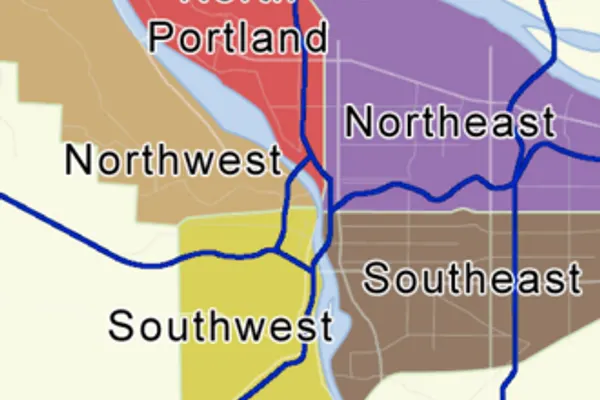
Portland, Oregon is divided into six sections: North Portland, Northeast Portland, Northwest Portland, South Portland, Southeast Portland, and Southwest Portland. There are 95 officially recognized neighborhoods, each of which is represented by a volunteer-based neighborhood association. No neighborhood associations overlap the Willamette River, but a few overlap the addressing sextants. For example, most addresses in the South Portland Neighborhood Association are South, but a portion of the neighborhood is west of SW View Point Terrace where addresses have a SW prefix. Similarly the Buckman Neighborhood Association spans both NE and SE Portland.
Neighborhood associations serve as the liaison between residents and the city government, as coordinated by the city's Office of Community & Civic Life, which was created in 1974 and known as the Office of Neighborhood Involvement until July 2018. The city subsequently provides funding to this "network of neighborhoods" through district coalitions, which are groupings of neighborhood associations. A few areas of Portland are "unclaimed" by any of the 95 neighborhood associations in Portland.
Neighborhoods
Each neighborhood association defines its own boundaries, which may include areas outside of Portland city limits and (if mutually agreed) areas that overlap with other neighborhoods. Neighborhoods may span boundaries between the six sections (North Portland, Northeast Portland, Northwest Portland, South Portland, Southeast Portland, and Southwest Portland) of the city as well. The segmentation adopted here is based on Office of Community & Civic Life's district coalition model, under which each neighborhood is part of at most one coalition (though some neighborhoods are not included in any).
Other areas and communities
Alberta Arts District, an art, retail, and restaurant area in the King, Vernon, and Concordia neighborhoods
Albina, a historical city which was consolidated into Portland in 1891
The Belmont Area, a retail and residential area in the Buckman, Sunnyside, and Mt. Tabor neighborhoods
Dunthorpe, an affluent unincorporated enclave just beyond the city limits, north of Lake Oswego
Unincorporated areas near Portland proper in Washington County (unincorporated neighborhoods expanding into Washington County) Bethany
Cedar Hills
Cedar Mill
Garden Home
Metzger
Oak Hills
Raleigh Hills
Rock Creek
West Haven-Sylvan
West Slope
East Portland, a historical city which was consolidated into Portland in 1891, not to be confused with the area of the same name that extends roughly east of I-205 to Portland's eastern boundary
East Portland, the area of Portland generally east of I-205, where approximately one quarter of residents reside, but which has historically not received adequate city services.
The Hawthorne District, a retail, restaurant, and cultural district running through the Buckman, Hosford-Abernethy, Sunnyside, Richmond, and Mt. Tabor neighborhoods
Maywood Park, a Northeast neighborhood incorporated as a separate city that is now completely surrounded by the city of Portland
Peacock Lane, a quaint English village in the heart of Sunnyside Neighborhood has been treating the city of Portland to free holiday lighting displays each December since the 1940s
Vanport, a city located in present-day North Portland destroyed by a flood in 1948
References
External links
Oregon portal
Office of Community & Civic Life
PortlandNeighborhood.com - includes neighborhood guides and a clickable map
PortlandMaps.com - city's public GIS database, including demographic and other statistics on the neighborhoods, as well as official boundaries
Study of Portland Neighborhood Associations: Neighborhood Association Survey Results (League of Women Voters of Portland, June 2006)
Encyclopedic content adapted from the Wikipedia article on Mississippi, used under CC BY-SA 4.0.
What makes Mississippi special
Mississippi stands out among Portland’s neighborhoods for its distinctive character: portland's boho-chic corridor. Ranked #4 in Portland, it offers the kind of experience that defines a great city trip — a place where the streets themselves tell a story and every block rewards curiosity.
Best for
Our take on Mississippi
Mississippi occupies a distinctive place in Portland's neighborhood landscape. It is the kind of district that rewards travelers who venture beyond the obvious choices — quieter than the tourist-facing areas, richer in local character, and full of the small details that make a city trip memorable.
What makes Mississippi worth the visit is the texture of daily life here. It is a neighborhood that functions for the people who live in it — not just for the visitors who pass through. The shops serve local needs, the restaurants feed local appetites, and the streets have a rhythm that reflects genuine community rather than tourism infrastructure. That is the quality our editors prize most, and Mississippi has it in abundance.
Our editors recommend budgeting at least half a day here — enough time to walk the main streets, sit down for coffee, and discover the side streets where Mississippi's real character lives.
Living in Mississippi
Mississippi is connected to the rest of Portland by public transit, and most visitors find it straightforward to reach from the city center or airport. Once you arrive, the neighborhood is best explored on foot — the scale is human and the streets reward wandering.
Day-to-day life in Mississippi has the rhythm of a genuine residential neighborhood. You will find grocery stores, pharmacies, cafés with morning regulars, and the kind of small independent shops that only survive where locals support them. For visitors, this means the infrastructure you need — good coffee, a decent meal, a quiet place to sit — is always within a short walk.
Accommodation in Mississippi ranges from boutique hotels to short-term rentals. We generally recommend staying within the neighborhood itself rather than commuting from a hotel elsewhere in Portland — the experience of waking up inside a great neighborhood is fundamentally different from visiting one as a day trip.
What locals say about Mississippi
Long-term residents of Mississippi tend to describe their neighborhood with a mix of pride and protectiveness. Like any district with genuine character, Mississippi inspires loyalty — the kind of place people move to and never quite leave, or leave and spend years trying to get back to.
What locals appreciate most about Mississippi is its consistency — the feeling that the neighborhood works the same way on a Tuesday morning as it does on a Saturday night. It is not a place that performs for visitors and then goes quiet. The rhythm is genuine, the community is real, and the daily experience of living here is what draws people and keeps them.
Compared to the more famous districts in Portland, Mississippi has maintained a lower profile, which many residents consider an advantage. The neighborhood evolves gradually rather than being reshaped by sudden attention, and the result is a community that still feels organic rather than curated.
Visitor tips
- Mississippi is located in Portland, United States. The neighborhood is accessible by public transport, taxi, or rideshare from most parts of the city.
- Morning is often the best time to explore — the streets are quieter, the light is better for photography, and cafes are at their most welcoming.
- Wear comfortable walking shoes — the best way to experience Mississippi is on foot, wandering the side streets and discovering what lies around each corner.