About the neighborhood
District in the Asian side of Istanbul, Turkey
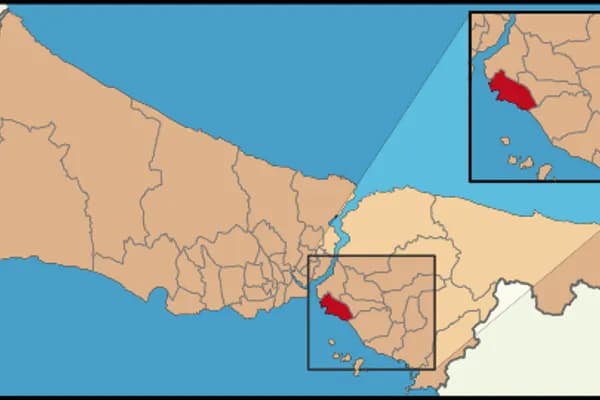
Kadıköy (Turkish pronunciation: kaˈdɯkøj ) is a municipality and district in Istanbul Province, Turkey. Its area is 25km, and its population is 467,919 (2023). It is a large and populous area in the Asian side of Istanbul, on the northern shore of the Sea of Marmara. It partially faces the historic city centre of Constantinople (modern Fatih) on the European side of the Bosporus. It is bordered by the districts of Üsküdar, to the northwest, Ataşehir, to the northeast, and Maltepe, to the southeast.
Kadıköy was known in classical antiquity and during the Roman and Byzantine eras as Chalcedon (Greek: Χαλκηδών). Chalcedon was known as the 'city of the blind'. The settlement has been under control of many empires, finally being taken by the Ottomans before the fall of Constantinople. At first, Chalcedon was rural, but with time it urbanized. Kadıköy separated from the Üsküdar district in 1928.
One of the most expensive places in Istanbul, Kadıköy is a residential and commercial area that, with its numerous bars, cinemas and bookshops, is the liberal cultural centre of the Anatolian side of Istanbul. Kadıköy contains the Bağdat Avenue, which is one of the most significant shopping streets in Turkey and it spans through the entirety of the district. Some main transportation routes connecting various districts of Istanbul pass through Kadıköy.
While the borders of the district extend from Bostancı to Koşuyolu, the central town which gives its name to the district encompasses only the limited area made up of the Rasimpaşa, Osmanağa, and Caferağa neighbourhoods. Outside of the centre, it is possible to see calmer, highly developed seaside settlements such as Caddebostan and Fenerbahçe. The most populated neighbourhoods of the district apart from the core of Kadıköy are Göztepe and Kozyatağı.
Kadıköy ranked 1st place in Human Development Index out of the 188 most populated districts in Turkey.
Etymology
Kadıköy was put under the administration of the courts of Constantinople, providing the origin of the name Kadıköy, literally meaning 'village of the judge'. It is also commonly thought that the modern name was a Turkification of the Greek name, Chalcedon.
History
Kadıköy is an older settlement than most of those on the Anatolian side of the city of Istanbul. Relics dating to 5500–3500 BC (Chalcolithic period) have been found at the Fikirtepe Mound, and articles of stone, bone, ceramic, jewelry and bronze show that there has been a continuous settlement since prehistoric times. A port settlement dating from the Phoenicians has also been discovered. Chalcedon was the first settlement that the Greeks from Megara established on the Bosphorus, in 685 BC, a few years before they established Byzantium on the other side of the strait in 667 BC. Towns such as Rouphinianai and Poleatikon were located in Chalcedon.
Chalcedon became known as the 'city of the blind', the story being that Byzantium was founded following a prophecy that a great capital would be built 'opposite the city of the blind' (meaning that the people of Chalcedon must have been blind not to see the obvious value of the peninsula on the Golden Horn as a natural defensive harbour). The fourth ecumenical church council, Council of Chalcedon, was held there in 451 AD.
Chalcedon changed hands time and time again, as Persians, Bithynians, Romans, Byzantines, Arabs, Crusaders, and Turks passed through the area, which was badly damaged during the Fourth Crusade and came into Ottoman hands in 1353, a full century before Constantinople. Thus, Kadıköy has the oldest mosque in Istanbul, built almost a century before the conquest of Constantinople in 1453.
At the time of the conquest, Chalcedon was a rural settlement outside the protection of the city. It was soon put under the jurisdiction of the Constantinople courts, hence the name Kadıköy, which means Village of the Judge. In the Ottoman period, Kadıköy became a market for agricultural goods and in time developed into a residential area for people who would commute to the city by boat.
According to Ottoman estimations of 1882, the district of Kadıköy had a total population of 6,733, consisting of 2,695 Muslims, 1,831 Armenians, 1,822 Greeks, 249 Jews, 92 Latins, 28 Bulgarians and 16 Catholics.
Kadıköy became a district in 1928 when it was separated from Üsküdar district. The neighbourhoods of Bostancı and Suadiye were also separated from the district of Kartal in the same year, and eventually joined the newly formed district of Kadıköy.
Geography
Composition
There are 21 neighbourhoods in Kadıköy District:
19 Mayıs
Acıbadem
Bostancı
Caddebostan
Caferağa
Dumlupınar
Eğitim
Erenköy
Fenerbahçe
Feneryolu
Fikirtepe
Göztepe
Hasanpaşa
Koşuyolu
Kozyatağı
Merdivenköy
Osmanağa
Rasimpaşa
Sahraycıedit
Suadiye
Zühtüpaşa
Transport
The major Haydarpaşa Terminal of the Turkish State Railways is located close to Kadıköy's centre and was opened in 1908 as the terminus of the Istanbul-Baghdad and Istanbul-Damascus-Medina railways. The terminal closed due to infrastructure works in 2013 and reopened in 2018, serving east- and south-bound international, domestic and regional trains.
The Söğütlüçeşme railway station, the next station after Haydarpaşa Terminal, is the terminus of the Metrobus line to European side of Istanbul.
The M4 line of the Istanbul Metro runs from Kadıköy to Tavşantepe daily between 6:00 and 23:57.
The centre of Kadıköy today is the transportation hub for people commuting between the Asian side of the city and the European side across the Bosphorus. There is a large bus and minibus terminal next to the ferry quay. Ferries are the most dominantly visible form of transport in Kadıköy, and the central market area is adjacent to the ferry quay.
Public transportation with terminus in Kadıköy:
Bus system
4 Kadıköy-Bostancı ring (via Bağdat Avenue)
8A West Ataşehir
10B Bostancı
16 Pendik (via Bağdat Avenue)
17 Pendik (via so-called minibus way)
19F Yeditepe University
19M Ataşehir via Ataşehir Boulevard.
130A Tuzla
222 Pendik (via Bağdat Avenue)
E-10 Sabiha Gökçen Airport
ER1 Ring Erenköy (passes through Bağdat Avenue)
ER2 Ring Erenköy (passes through Bağdat Avenue)
FB1 Ring Fenerbahçe (passes through west point of Bağdat Avenue)
FB2 Ring Fenerbahçe (passes through west point of Bağdat Avenue)
GZ1 Ring Göztepe (passes through Bağdat Avenue)
GZ2 Ring Göztepe (passes through Bağdat Avenue)
To European side,
110 Taksim
112 Taksim
500A Edirnekapı
For more lines, visit: http://www.iett.istanbul/en/main/hatlar
Metro
M4 Kadıköy-Sabiha Gökçen (Sabiha Gökçen International Airport)
M8
Marmaray
Nostalgic tram T3 (Ring) Mühürdar-Bahariye-Moda (in centrum)
Ferryboats Traditional ferries,
Eminönü
Karaköy
Kabataş
Beşiktaş
Princes' Islands
Sea buses,
Bostancı-Kadıköy-Yenikapı-Bakırköy
Kabataş
Kadıköy today
Politics
For the main opposition party Republican People's Party (CHP), Kadıköy has been a stronghold in both local and national elections. Since 1989, the local electorate have voted for social democratic candidates to be chosen mayors, namely from the CHP as well as the SHP, its 1980s coup-era counterpart. Kadıköy ranks 1st place on the Human Development Index scale, among all the other districts of Turkey, according to a 2020 report and ranks 4th place in socio-economic development.
Education
Marmara University has most of its buildings in Kadıköy, including the large and elegant Haydarpaşa Campus, while the largest private university in Istanbul, Yeditepe University, is located on the hill named "Kayışdağı" at the easternmost edge of the borough (Which later connected to Ataşehir). A new state university, İstanbul Medeniyet University, opened in 2010. It has its main building in Göztepe, Merdivenköy, and has begun to develop campuses in both Kadıköy and Üsküdar. The campuses are divided by the D-100 Highway. Each have a metro station close by.
Another private institution for higher education, the Doğuş University, is situated in the Acıbadem neighborhood of Kadıköy.
Remarkable and important high schools in the area include Atatürk Fen Lisesi, Kadıköy Anadolu Lisesi Erenköy Kız Lisesi, and Saint-Joseph French High School.
Shopping
Kadıköy is a busy shopping district, with a wide variety of atmospheres and architectural styles. The streets are varied, some being narrow alleyways and others, such as Bahariye Caddesi, being pedestrian zones. Turkey's biggest food market is there, starting next to the Osman Ağa Mosque, and has an immense turnover of fresh foods and other products from all around Turkey, including a wide range of fresh fish and seafood, olive oil soap, and so on. There are also modern shopping centres, most notably the large Tepe Nautilus Shopping Mall behind the center of Kadıköy, and pavements crowded with street vendors selling socks, unlicensed copies of popular novels, and other products. In the streets behind the main post office, there is a large number of well-known bookshops selling both new and second-hand books, craft-shops and picture-framers, and a number of shops selling music CDs and related ephemera such as film posters and T-shirts. Hard Rock and Heavy Metal music is sold in the arcade named Akmar Pasajı, where associated items are also sold. On Sundays this area becomes a large second-hand book and music street market. Being a crowded shopping district, Kadıköy has many buskers, shoe shine boys, glue sniffers and schoolchildren in the streets selling flowers, chewing gum and packets of tissues.
At the top of the shopping district there is an intersection, with a statue of a bull, called Altıyol (Six Ways), where a road leads to the civic buildings and a huge street market called Salı Pazarı (Tuesday Market). The working-class residential districts of Hasanpaşa and Fikirtepe are located behind the civic buildings.
Housing
There is a lot of residential property in the centre of Kadıköy, mostly somewhat dilapidated today, but there are still quiet suburban streets. The area is home to many students as well as a small number of foreign residents.
Attractions, entertainment and eating
Kadıköy has many narrow streets filled with cafés, bars and restaurants, as well as many cinemas. Süreyya Opera House is a recent redevelopment of the same named historic movie theatre.
The market area is mostly closed to traffic and contains a wide variety of fast food restaurants serving toasted sandwiches, hamburgers and döner. There are also traditional Turkish restaurants and patisseries, bridge schools, wine houses, bars with jazz, folk and rock music, as well as working class tea and backgammon houses.
Behind the coast, lies a large shopping and residential district winding uphill to the Bahariye Caddesi pedestrian zone. This area was transformed during the economic boom of the 1990s and shops were opened and bars at surrounding.
Kadıköy's entertainment is generally not of the affluent type. It has a more working class ambiance; therefore, it is easier to find food of the like of kebab and fried mussels than haute cuisine, although one of Istanbul's most traditional Turkish cuisine representatives, Yanyalı Fehmi Lokantası and the foreign tourist attracting Çiya is found here. Also, the oldest recorded maker of Turkish delight, Hacı Bekir and chocolate maker Baylan are located in Kadıköy.
Kadıköy does not have as much nightlife as Beyoğlu (where nightlife also continues much later into the night), nor does it have Nişantaşı's style of shopping or the Bosphorus for nightlife. Instead, it is often considered a modest alternative but may still be regarded as vibrant and cosy. Residents like to frequent the seaside to walk or sit in the grass with a view of the European side of Istanbul across the Bosporus.
Surrounding residential areas
Coastal areas
Along the coast, away from the centre of Kadıköy, there are many expensive shops and the area becomes more upmarket in neighbourhoods near the Bağdat Avenue. There is also the Moda quarter located south of central Kadıköy.
Moda is an old, quiet, cosmopolitan Istanbul settlement. As elsewhere in Istanbul, many historic houses have been demolished and replaced with apartment buildings; however, Moda is generally considered one of the more pleasant residential districts in the city. There are numerous churches in Moda with active congregations, and well-known schools, such as the Lycée Saint-Joseph and Kadıköy Anadolu Lisesi. There is a small, attractive theatre in Moda named Oyun Atölyesi, founded by actor Haluk Bilginer. The area is also well known for its multiple modern cafes, bars, shops and is popular among Istanbul's creative class and tourists.
Beyond this area, the huge stadium of Fenerbahçe Football Club dominates the skyline. From here, the long shopping street Bağdat Avenue heads east and there are many affluent neighbourhoods between the avenue and the coast. Until the 1950s these areas, such as Göztepe, Caddebostan, Erenköy, and Suadiye, were full of summer houses and mansions for the city's wealthy upper middle class. Since the Bosphorus Bridge was built, it has become easier to commute from here to the European side of Istanbul, and most of these summer houses have been demolished and replaced with modern apartment buildings. The coast here has a long stretch of seaside parks and yacht marinas, and the streets behind the coast in areas such as Caddebostan are lined with numerous bars and cafés. From Bostancı onwards the economic level progressively lessens, so there are more retired and working-class residents here. There are no more villas, excepting some on the coast at Dragos, and the apartment buildings are narrower and less widely spaced. Bostancı itself is a busy shopping district built around a railway station.
Inland areas
Encyclopedic content adapted from the Wikipedia article on Kadıköy, used under CC BY-SA 4.0.