About the neighborhood
District on the European side of Istanbul, Turkey
Beyoğlu (Turkish: ˈbejoːɫu) is a municipality and district of Istanbul Province, Turkey. Its area is 9km, and its population is 225,920 (2022). It is on the European side of Istanbul, Turkey, separated from the old city (historic peninsula of Constantinople now known as Fatih) by the Golden Horn.
Genoese traders founded Beyoğlu. In the 19th century, its population was largely composed of foreigners of European origin, including Catholic Levantines, along with local Christians and Jews. Events such as 1950s Istanbul pogrom and suburbanization led to high income Muslims, Armenians, Greeks, and Jews leaving for the suburbs, which resulted in decaying housing. Urban renewal projects and gentrification started in 1980s and 1990s. Cultural events such as Istanbul Film Festival, restaurants, and coffee shops were established, while middle-income and upper-income residents returned to the area. Present-day Beyoğlu is one of the main night-life areas in Istanbul.
The district encompasses other neighborhoods located north of the Golden Horn, including Galata (modern-day Karaköy), Tophane, Cihangir, Şişhane, Tepebaşı, Tarlabaşı, Dolapdere and Kasımpaşa, and is connected to the old city center across the Golden Horn through the Galata Bridge, Atatürk Bridge and Golden Horn Metro Bridge. Beyoğlu is also home to İstiklal Avenue and Taksim Square.
Name
Beyoğlu continued to be named Pera during the Middle Ages and, in western languages, into the early 20th century. Pera (Greek: Πέρα) means "beyond" in Greek.
According to the prevailing theory, the Turkish name of Pera, Beyoğlu, meaning "Bey's Son" in Turkish, is a modification by folk etymology of the Venetian title of Bailo. The 15th century ambassador of Venice in Istanbul, Andrea Gritti (who later became the Doge of Venice in 1523) had a mansion in this area. His son Alvise Gritti, who had close relations with the Sublime Porte, also stayed there and was probably the person who was specifically referred to as Bey Oğlu after his father became the Doge of Venice. Located further south in Beyoğlu and originally built in the early 16th century, the Palace of Venice was the seat of the Bailo. That building was reconstructed several times over the centuries, last in the 1910s, and currently hosts the Italian Consulate.
History
The area now known as Beyoğlu has been inhabited since Byzas founded the City of Byzantium in the 7th century BC, and predates the founding of Constantinople. During the Byzantine era, Greek speaking inhabitants named the hillside covered with orchards Sykai (The Fig Orchard), or Peran en Sykais (The Fig Field on the Other Side), referring to the "other side" of the Golden Horn. As the Byzantine Empire grew, so did Constantinople and its environs. The northern side of the Golden Horn became built up as a suburb of Byzantium as early as the 5th century. In this period the area began to be called Galata, and Emperor Theodosius II (reigned 402–450) built a fortress. The Greeks believe that the name comes either from galatas (meaning "milkman"), as the area was used by shepherds in the early medieval period, or from the word Galatai (meaning "Gauls"), as the Celtic tribe of Gauls were thought to have camped here during the Hellenistic period before settling into Galatia in central Anatolia, becoming known as the Galatians. The inhabitants of Galatia are famous for the Epistle to the Galatians and the Dying Galatian statue. The name may have also derived from the Italian word Calata, meaning "downward slope", as Galata, formerly a colony of the Republic of Genoa between 1273 and 1453, stands on a hilltop that goes downwards to the sea.
Genoese and Venetian periods
The area came to be the base of European merchants, particularly from Genoa and Venice, in what was then known as Pera. Following the Fourth Crusade in 1204, and during the Latin Empire of Constantinople (1204–1261), the Venetians became more prominent in Pera. The Dominican Church of St. Paul (1233), today known as the Arap Camii, is from this period.
In 1273 the Byzantine Emperor Michael VIII Palaiologos granted Pera to the Republic of Genoa in recognition of Genoa's support of the Empire after the Fourth Crusade and the sacking of Constantinople in 1204. Pera became a flourishing trade colony, ruled by a podestà.
The Genoese Palace (Palazzo del Comune) was built in 1316 by Montano de Marinis, the Podestà of Galata (Pera), and still remains today in ruins, near the Bankalar Caddesi (Banks Street) in Karaköy, along with its adjacent buildings and numerous Genoese houses from the early 14th century.
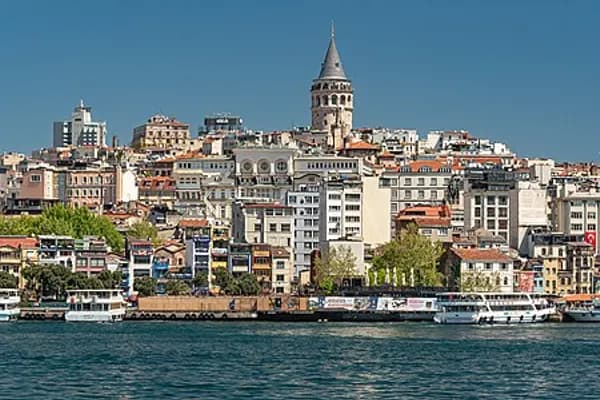
In 1348 the Genoese built the famous Galata Tower, one of the most prominent landmarks of Istanbul. Pera (Galata) remained under Genoese control until May 29, 1453, when it was conquered by the Ottomans along with the rest of the city, after the Siege of Constantinople.
During the Byzantine period, the Genoese Podestà ruled over the Italian community of Galata (Pera), which was mostly made up of the Genoese, Venetians, Tuscans and Ragusans.
Venice, Genoa's archrival, regained control in the strategic citadel of Galata (Pera), which they were forced to leave in 1261 when the Byzantines retook Constantinople and brought an end to the Latin Empire (1204–1261) that was established by Enrico Dandolo, the Doge of Venice.
In 1432, Bertrandon de la Broquière described Pera as "a large town, inhabited by Greeks, Jews and Genoese: the last are masters of it, under the duke of Milan, who styles himself Lord of Pera ... The port is the handsomest of all I have seen, and I believe I may add, of any in the possession of the Christians, for the largest genoese vessels may lie alongside the quay."
Following the Ottoman siege of Constantinople in 1453, during which the Genoese sided with the Byzantines and defended the city together with them, the Ottoman Sultan Mehmed II allowed the Genoese (who had fled to their colonies in the Aegean Sea such as Lesbos and Chios) to return to the city, but Galata was no longer run by a Genoese Podestà.
Venice immediately established political and commercial ties with the Ottoman Empire, and a Venetian Bailo was sent to Pera as an ambassador, during the Byzantine period. It was the Venetians who suggested Leonardo da Vinci to Bayezid II when the Sultan mentioned his intention to construct a bridge over the Golden Horn, and Leonardo designed his Galata Bridge in 1502.
The Bailo's seat was the Palace of Venice, originally built in Beyoğlu in the early 16th century and reconstructed several times since then. After having served after the fall of the Republic of Venice in 1797 as an embassy for the French Empire, the Habsburg monarchy and the Kingdom of Italy, it is now the Italian Consulate in Istanbul.
The Ottoman Empire had an interesting relationship with the Republic of Venice. Even though the two states often went to war over the control of East Mediterranean territories and islands, they were keen on restoring their trade pacts once the wars were over, such as the renewed trade pacts of 1479, 1503, 1522, 1540, and 1575, following major sea wars between the two sides. The Venetians were also the first Europeans to taste Ottoman delicacies such as coffee, centuries before other Europeans saw coffee beans for the first time in their lives during the Battle of Vienna in 1683. These encounters can be described as the beginning of today's rich "coffee culture" in both Venice (and later the rest of Italy) and Vienna.
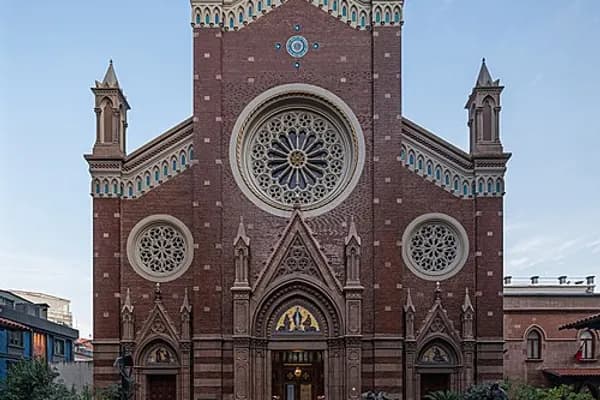
Following the conquest of Constantinople and Pera in 1453, the coast and the low-lying areas were quickly settled by the Turks, but the European presence in the area did not end. Several Roman Catholic churches, as St. Anthony of Padua, SS. Peter and Paul in Galata and St. Mary Draperis were established for the needs of the Levantine population.
Nineteenth-century
During the 19th century it was again home to many European traders, and housed many embassies, especially along the Grande Rue de Péra (today İstiklâl Avenue). Reyhan Zetler stated "Pera was considered to be a small copy of thesic 19th century Europe (especially Paris and London)." The presence of such a prominent European population - commonly referred to as Levantines - made it the most Westernized part of Constantinople, especially when compared to the Old City at the other side of the Golden Horn, and allowed for influxes of modern technology, fashion, and arts. Thus, Pera was one of the first parts of Constantinople to have telephone lines, electricity, trams, municipal government and even an underground railway, the Tünel, inaugurated in 1875 as the world's second subway line (after London's Underground) to carry the people of Pera up and down from the port of Galata and the nearby business and banking district of Karaköy, where the Bankalar Caddesi (Avenue of the Banks), the financial center of the Ottoman Empire, is located. The theatre, cinema, patisserie and café culture that still remains strong in Beyoğlu dates from this late Ottoman period. Shops like İnci, famous for its chocolate mousse and profiteroles, predate the founding of the republic and survived until recently.
Pera and Galata in the late 19th and early 20th centuries were a part of the Municipality of the Sixth Circle (French: Municipalité du VI Cercle), established under the laws of 11 Jumada al-Thani (Djem. II) and 24 Shawwal (Chev.) 1274, in 1858; the organisation of the central city in the city walls, "Stamboul" (Turkish: İstanbul), was not affected by these laws. All of Constantinople was in the Prefecture of the City of Constantinople (French: Préfecture de la Ville de Constantinople).
The foreign communities also built their own schools, many of which went on to educate the elite of future generations of Turks, and still survive today as some of the best schools in Istanbul (see list of schools in Istanbul).
The rapid modernization which took place in Europe and left Ottoman Turkey behind was symbolized by the differences between Beyoğlu, and the historic Turkish quarters such as Eminönü and Fatih across the Golden Horn, in the Old City. When the Ottoman sultans finally initiated a modernization program with the Edict of Tanzimat (Reorganization) in 1839, they started constructing numerous buildings in Pera that mixed traditional Ottoman styles with newer European ones.
In addition, Sultan Abdülmecid stopped living in the Topkapı Palace and built a new palace near Pera, called the Dolmabahçe Palace, which blended the Neo-Classical, Baroque and Rococo styles.
During the İstanbul bombings of 18 October 1918, the area suffered.
20th-21st centuries
When the Ottoman Empire collapsed and the Turkish Republic was founded (during and after the First World War) Pera, which became known as Beyoğlu in English in the modern era, went into gradual decline. The decline accelerated with the departure of the large Greek population of Beyoğlu and adjacent Galata as a result of Turkish pressure over the Cyprus conflict, during the 1950s and 1960s. The widespread political violence between leftist and rightist groups which troubled Turkey in the late 1970s also severely affected the lifestyle of the district, and accelerated its decline with the flight of the middle-class citizens to newer suburban areas such as Levent and Yeşilköy.
By the late 1980s, many of the grandiose Neoclassical and Art Nouveau apartment-blocks, formerly the residences of the late Ottoman élite, became home to immigrants from the countryside. While Beyoğlu continued to enjoy a reputation for its cosmopolitan and sophisticated atmosphere until the 1940s and 1950s, by the 1980s the area had become economically and socially troubled.
The first decades of the 21st century have witnessed the rapid gentrification of these neighborhoods. Istiklal Avenue has once again become a destination for tourists, and formerly bohemian neighborhoods like Cihangir have once again become fashionable and quite expensive. Some 19th and early 20th century buildings have been tastefully restored, while others have been converted into mammoth luxury malls of dubious aesthetic value. As newer, more international and affluent residents have begun to creep down the hills into Tophane and Tarlabasi, disagreements with more conservative elements in the neighborhoods have become common.
The low-lying areas such as Tophane, Kasımpaşa and Karaköy, and the side-streets of the area consist of older buildings.
Infrastructure
Roads
Parallel to İstiklal Avenue runs the wide bi-directional boulevard named Tarlabaşı Caddesi, which carries most of the traffic through the area and was constructed in the 1980s. The streets on either side of this road contain historic buildings and churches. The once cosmopolitan areas surrounding them have deteriorated. However, recent gentrification projects have seen some of the buildings restored. Istanbul's first beltway, the Kasımpaşa-Hasköy Tunnel, Piyalepaşa Avenue, Meclis-i Mebusan Avenue and Kulturuş Deresi Avenue are other major thoroughfares. Many Istanbul bus lines and the Istanbul Metrobus (only the Halıcıoğlu stop) provide transportation to the district.
Rail transport
The Istanbul metro M2 line runs through the district via Taksim and Şişhane stations. The T1 tram line runs in the district between the Kabataş and Karaköy stops and the T2 nostalgic tram line runs on the Istiklal Avenue. Funicular lines F1 and Tünel also provide transport for the district.
Culture
Foreigners, especially from Euro-Mediterranean and West European countries, have long resided in Beyoğlu. There is a cosmopolitan atmosphere in the heart of the district, where people from various cultures live in Cihangir and Gümüşsuyu. Beyoğlu also has a number of historical Tekkes and Türbes. Several Sufi orders, such as the Cihangirî order, were founded here.
Most of the consulates (former embassies until 1923, when Ankara became the new Turkish capital) are still in this area; the Italian, British, German, Greek, Russian, Dutch, and Swedish consulates are significant in terms of their history and architecture.
Beyoğlu is also home to many high schools like Galatasaray Lisesi, Deutsche Schule Istanbul, St. George's Austrian High School, Lycée Sainte Pulchérie, Liceo Italiano, Beyoğlu Anatolian High School, Beyoğlu Kız Lisesi, Zografeion Lyceum, Zappeion Lyceum, and numerous others.
The unique international art project United Buddy Bears was presented in Beyoğlu during the winter of 2004–2005.
Tourism
Encyclopedic content adapted from the Wikipedia article on Beyoğlu, used under CC BY-SA 4.0.