About the neighborhood
Neighborhood in San Francisco, California, United States
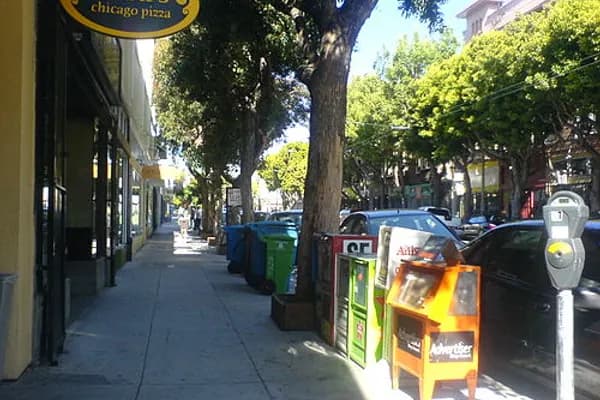
Hayes Valley is a neighborhood in the Western Addition district of San Francisco, California. It is located between the historical districts of Alamo Square and the Civic Center. Victorian, Queen Anne, and Edwardian townhouses are mixed with high-end boutiques, restaurants, and public housing complexes. The neighborhood gets its name from Hayes Street, which was named for Thomas Hayes, San Francisco's county clerk from 1853 to 1856 who also started the first Market Street Railway franchise.
Location
Although its boundaries are ill-defined, Hayes Valley is generally considered to be the area north and south of Hayes Street between Webster (near Alamo Square) and Franklin (near the Civic Center) streets. Hayes Valley's commercial center comprises the section of Hayes Street running from approximately Laguna Street in the west to Franklin Street in the east, with extensions on perpendicular Gough and Laguna streets.
As of April 2012, after changes to the district boundaries used by the Board of Supervisors, the Hayes Valley Neighborhood Association considers the neighborhood as a whole to be bound by Webster Street in the west, Van Ness Avenue in the east, Fulton Street in the north, and Hermann Street and Market Street in the south, with extensions as far west as Fillmore, between Haight Street and Hermann Street, as far north as McAllister Street, between Franklin Street and Van Ness Avenue, and as far south as Market Street, between Buchanan Street and Laguna Street. (This definition overlaps considerably with the Lower Haight.)
The San Francisco Association of Realtors considers the Hayes Valley to be extending from McAllister Street in the north, to Market Street and Duboce Avenue in the south, Franklin Street in the east, and Webster Street (north of Fell Street) and Divisadero Street (south of Fell Street) forming the western boundaries. (This definition includes the entire Lower Haight within Hayes Valley.)
Adjacent neighborhoods include the Lower Haight and small parts of the Duboce Triangle and SoMa in the south, Alamo Square in the west, Civic Center in the east, and the Fillmore District to the north.
Public transportation
Hayes Valley is served by several San Francisco Municipal Railway (MUNI) buses, including the #21, which runs through Hayes Valley on its east-west route between Golden Gate Park and the Ferry Building, the #5 (also east-west), the #22 (runs north-south along Fillmore Street) and the #6 and #7, which both run east-west along Haight. Hayes Valley shares the Van Ness Avenue Muni LRV car subway station with Civic Center, Mid-Market, and SoMa West. Here, residents can take J, K, M, L, N, and T cars throughout San Francisco.
History
Pre-Colonization Until 19th Century
Native people in many small bands, now referred to collectively as the Ohlone tribe, lived in San Francisco part of the year, gathering food in the Mission Creek area, which included seasonal Hayes Creek, and other parts of today's city. Hayes Valley would have been thickly covered with wildflowers every spring. When it was running in the winter, Hayes Creek cut diagonally through the current Hayes Valley. It is now underground year-round.
In 1776, local people came under the control of the Spanish empire with the Juan Bautista de Anza expedition, which established Mission San Francisco de Asís south of Hayes Valley.
19th century
After the 1849 California Gold Rush, Italian emigrants from around Genoa developed produce farms on the sandy soil of the Hayes Valley neighborhood.
The Western Addition was developed in the 1850s to expand the city to the west of Van Ness Avenue. Michael Hayes, who, in 1856, was on the committee which named the streets of this development, may have been instrumental in naming Hayes Street for his brother, Thomas, a large landholder in the neighborhood who was then serving as county clerk. Hayes Valley was built out with many grand Victorian residences, as well as the smaller residences built to house the craftspeople at work on the mansions. Primary streets with big houses were named for influential local citizens (Hayes and Gough) and families (McAllister), while streets with the smaller houses carry botanical names such as Lily, Ivy, Linden, and Hickory.
20th century
Hayes Valley south of McAllister Street was spared the fires that followed the 1906 San Francisco earthquake. It was a multi-ethnic neighborhood, becoming, with the blossoming of the Fillmore district after World War II, an African-American neighborhood. As recently as the mid-1980s, this neighborhood (and, indeed, the Western Addition in general) was considered one of the most dangerous places in the Bay Area.
21st century
Since the turn of the century, Hayes Valley has transformed into a vibrant urban destination, blending new local businesses with long-standing community character. Thanks to thoughtful housing policies and community advocacy, the neighborhood has maintained its diverse population while welcoming new residents and amenities. The area now features a mix of historic architecture, innovative housing developments, and thriving small businesses.
Central Freeway
The elevated Central Freeway section of U.S. Route 101 was built in the neighborhood during the 1950s. Damaged during the 1989 Loma Prieta earthquake, it was closed afterward and eventually demolished after local activists campaigned for its removal. The destruction of the Central Freeway has spurred gentrification which has revitalized the neighborhood, and has made it one of the trendier sections of town with an eclectic mix of boutiques, high-end restaurants, and hip stores on Hayes Street.
In 2005, a section of the freeway was rebuilt to end at Market Street, with the new, tree-lined Octavia Boulevard running north through Hayes Valley along the previous path of Octavia Street to Fell Street. Between Fell and Hayes streets, a neighborhood green terminates the boulevard, providing seating, green space, a play structure for children, and a changing exhibition of public art. It is named Patricia's Green for Patricia Walkup, a local activist who volunteered her time for many years to fight neighborhood crime, and co-led the campaign to tear down the remaining part of the Central Freeway that ran through Hayes Valley.
In 2010, the city-owned lots between Fell and Oak, and Laguna and Octavia, where the previous Central Freeway on- and off-ramps for Highway 101 were situated, were transformed into Hayes Valley Farm, an education and research project with a focus on urban permaculture and activating the urban commons. The project was founded on an interim use agreement between Hayes Valley Farm, the San Francisco Parks Alliance, and the Mayor's Office of Economic and Workforce Development. Community volunteers had permission to use the 2.2-acre lot until the city moved forward with other development plans for the site.
In June 2012, the media reported that approval had been given for retail premises and housing to be built on the site. An Avalon apartment complex is currently under construction at the site.
Culture
In early 2013, the SFJAZZ Center, a brand new jazz concert hall, opened in Hayes Valley. It is considered the "first free-standing building in the West built for jazz performance and education."
San Francisco Opera opened in 1923, and San Francisco Ballet opened in 1933.
Cerebral Valley
Cerebral Valley is a term referring to the concentration of generative AI-focused communities, startups, and "hacker houses" that emerged in Hayes Valley during the AI boom of the early 2020s. Events such as the Cerebral Valley AI Summit, hosted by Eric Newcomer and the voice-AI startup Volley, have since taken place in the neighborhood.
According to the Washington Post, investor Amber Yang of Bloomberg Beta popularized the term "Cerebral Valley" in January 2023 to refer to the concentration of AI-focused communities and "hacker houses" in the neighborhood.
Group hacker houses focused on artificial intelligence grew in popularity in the early 2020s due to layoffs in Big Tech, a return to in-person events after the COVID-19 pandemic, and lower barriers to entry to AI innovation. The Washington Post credited the rise in events and houses around AI as being part of the revival of the San Francisco tech scene. On the app Partiful, event listings increasingly advertised their locations as "Cerebral Valley." By June 2023, the New York Times described Cerebral Valley as the center of the AI scene. Garry Tan of accelerator Y Combinator stated in April 2023 that Hayes Valley had become Cerebral Valley that year.
Many of the hacker houses in Cerebral Valley are based out of historic Victorian homes near Alamo Square. According to the San Francisco Standard, the hacker houses and associated "grind culture" are a return to the roots of Silicon Valley that led to the growth of companies such as Facebook in the early 2000s.
Notable hacker houses in Cerebral Valley include AGI House and Genesis House, which was founded in March 2021.
Notable residents
George W.C. Baker, Los Angeles City Council member, 1931–1935, attended Hayes Valley Grammar School
Notable buildings and structures
Charles Dietle House
Ida B. Wells Continuation High School
International High School of San Francisco
San Francisco Zen Center
SFJAZZ Center
Smuggler's Cove
San Francisco Bay Area portal
References
External links
Wikimedia Commons has media related to Hayes Valley, San Francisco.
Wikivoyage has a travel guide for San Francisco/Western Addition.
Hayeswire: The Hayes Valley Blog
Hayes Valley Neighborhood Association
San Francisco's Irrepresible Hayes Valley
SFStation: Districts: Hayes Valley
Encyclopedic content adapted from the Wikipedia article on Hayes Valley, used under CC BY-SA 4.0.
What makes Hayes Valley special
Hayes Valley stands out among San Francisco’s neighborhoods for its distinctive character: boutique sf at its most stylish. Ranked #5 in San Francisco, it offers the kind of experience that defines a great city trip — a place where the streets themselves tell a story and every block rewards curiosity.
Best for
Our take on Hayes Valley
Hayes Valley occupies a distinctive place in San Francisco's neighborhood landscape. It is the kind of district that rewards travelers who venture beyond the obvious choices — quieter than the tourist-facing areas, richer in local character, and full of the small details that make a city trip memorable.
What makes Hayes Valley worth the visit is the texture of daily life here. It is a neighborhood that functions for the people who live in it — not just for the visitors who pass through. The shops serve local needs, the restaurants feed local appetites, and the streets have a rhythm that reflects genuine community rather than tourism infrastructure. That is the quality our editors prize most, and Hayes Valley has it in abundance.
Our editors recommend budgeting at least half a day here — enough time to walk the main streets, sit down for coffee, and discover the side streets where Hayes Valley's real character lives.
Living in Hayes Valley
Hayes Valley is connected to the rest of San Francisco by public transit, and most visitors find it straightforward to reach from the city center or airport. Once you arrive, the neighborhood is best explored on foot — the scale is human and the streets reward wandering.
Day-to-day life in Hayes Valley has the rhythm of a genuine residential neighborhood. You will find grocery stores, pharmacies, cafés with morning regulars, and the kind of small independent shops that only survive where locals support them. For visitors, this means the infrastructure you need — good coffee, a decent meal, a quiet place to sit — is always within a short walk.
Accommodation in Hayes Valley ranges from boutique hotels to short-term rentals. We generally recommend staying within the neighborhood itself rather than commuting from a hotel elsewhere in San Francisco — the experience of waking up inside a great neighborhood is fundamentally different from visiting one as a day trip.
What locals say about Hayes Valley
Long-term residents of Hayes Valley tend to describe their neighborhood with a mix of pride and protectiveness. Like any district with genuine character, Hayes Valley inspires loyalty — the kind of place people move to and never quite leave, or leave and spend years trying to get back to.
What locals appreciate most about Hayes Valley is its consistency — the feeling that the neighborhood works the same way on a Tuesday morning as it does on a Saturday night. It is not a place that performs for visitors and then goes quiet. The rhythm is genuine, the community is real, and the daily experience of living here is what draws people and keeps them.
Compared to the more famous districts in San Francisco, Hayes Valley has maintained a lower profile, which many residents consider an advantage. The neighborhood evolves gradually rather than being reshaped by sudden attention, and the result is a community that still feels organic rather than curated.
Visitor tips
- Hayes Valley is located in San Francisco, United States. The neighborhood is accessible by public transport, taxi, or rideshare from most parts of the city.
- Morning is often the best time to explore — the streets are quieter, the light is better for photography, and cafes are at their most welcoming.
- Wear comfortable walking shoes — the best way to experience Hayes Valley is on foot, wandering the side streets and discovering what lies around each corner.