About the neighborhood
Neighborhood of Los Angeles, California, US
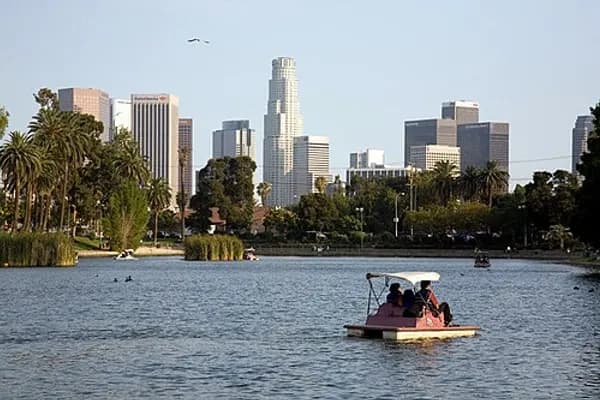
Echo Park is a neighborhood in the central region of Los Angeles, California. Located to the northwest of Downtown, it borders with Silver Lake to the west and Chinatown to the east. The culturally diverse neighborhood has become known for its trendy local businesses, as well as its popularity with artists, musicians and creative types. The neighborhood is centered on the eponymous Echo Park Lake.
History
Edendale
Established in 1892, and long before Hollywood became synonymous with the commercial film industry of the United States, the area of Echo Park known as Edendale was the center of filmmaking on the West Coast.
By the 1910s, several film studios were operating on Allesandro Avenue (now Glendale Boulevard) along the Echo Park-Silverlake border, including the Selig Polyscope Company, Mack Sennett's Keystone Studios, the Pathe West Coast Film Studio, and others.
Silent film stars who worked in the Edendale studios included Fatty Arbuckle, Harold Lloyd, Mabel Normand and Gloria Swanson. Charlie Chaplin's first film was made at Keystone Studios, as well as the very first feature-length comedy, which starred Chaplin and Normand.
The first pie-in-the-face scene was filmed at what later became the Mack Sennett Studios on Glendale Boulevard near Effie Street. The complex, which is now part of a storage facility, dates back to 1909 and includes one of the area's first permanent sound stages, the factories where movies are made. The former studio, 1712 Glendale Boulevard, is City of Los Angeles Historic-Cultural Monument No. 256.
Echo Park Lake
Echo Park Lake was established in 1868, as a drinking water reservoir, filled with water from a ditch that connects to the Los Angeles River in Los Feliz to the reservoir. In 1891, the four owners of the surrounding area gave up 33 acres (13ha) of land around the reservoir to the city so that it could be used as a park. The city began work landscaping the park in October 1892. City parks superintendent Joseph Henry Tomlinson chose the name because of echoes he heard during the construction of Echo Park Lake in 1892. The park and accompanying boathouse were completed in 1895. By the late 1910s, motion picture companies on Allesandro Street, now Glendale Boulevard, had been using the park as a filming location.
Echo Park Lake was identified as an impaired body of water in 2006, and the city allocated $64.7 million to fund its cleanup and revitalization. In the summer of 2011, the lake was closed off and drained when the rehabilitation project began. The lake reopened on June 5, 2013, after a $45 million renovation.
Starting in November 2019, a growing population of homeless people began moving into the lake grounds. The encampment included nearly 200 homeless tents, and four homeless individuals died at the park in 2020. On March 25, 2021, the park was closed for renovations and cleared of the homeless encampments. Closure notices were posted throughout the park days before the sweep. During the sweep over 200 protesters clashed with LAPD, who arrested 179 protesters. The encampment and ensuing incident became a major flashpoint in LA's homelessness crisis.
Of the 183 homeless individuals living at Echo Park Lake, only 17 had successfully transitioned into permanent housing as of March2022. In February 2023, councilmember Hugo Soto-Martinez announced plans to remove the fence that encircles the lake. The plans became divisive within the community, many of whom have advocated for the fence to remain, amid the ongoing homelessness crisis.
The fence surrounding the lake was removed May 30, 2023 by the city.
Transportation
Glendale Freeway termination
The Glendale Freeway (SR 2) was originally planned and constructed in 1959 to connect with the Hollywood Freeway (US-101) through the neighborhoods of Silver Lake and Echo Park, but terminates roughly 1.5 miles (2.4km) northeast of its intended terminus at the Hollywood Freeway due to opposition from residents living in, and developers building on, a hill that is now a private gated community called Hathaway Estates.
In 1962, as a result of this local community opposition, the full build-out plan was rescinded and construction was terminated at the present SR-2 terminus near Glendale Boulevard and Duane Street. Since then, commuter traffic exiting and entering on to SR-2 has passed through the community, primarily along Glendale Boulevard and Alvarado Street, which has contributed to congestion. Since that plan was scrapped, the freeway has been somewhat isolated from the remainder of the Los Angeles freeway system. There have been proposals to turn the freeway stub into a sort of public park.
Pacific Electric Railway
The Pacific Electric Railway, better known as the Red Cars, used to run through Echo Park along the center of Glendale Boulevard. The citywide system of electric trolleys began with the dawn of the 20th century, ultimately spinning a web of rail that linked cities in Los Angeles, Orange, San Bernardino and Riverside counties. It was the largest and most advanced public transit system in the world at the time.
The Red Car system was sold to Metropolitan Coach Lines, whose executive, Jesse Haugh, had connections to a public transportation company funded by General Motors and other auto-related industries. The Red Cars faded out of service not long afterwards, with the Los Angeles-Glendale-Burbank Line that traveled through Echo Park officially ending service on June 19, 1955.
Gangs
Echo Park was once infamous as a hot spot for gang activity. This was true in the 1980s and 1990s, but in the early 2010s as the neighborhood began gentrifying, rents started to skyrocket, and a controversial gang injunction forced gang members to move outside their turf, instances of gang violence waned.
In 2013, a Los Angeles judge signed off on a permanent gang injunction aimed at six rival gangs in the Echo Park area, creating what authorities call a "safety zone" for the area. The injunction targeted the members of six gangs, namely Echo Park Locos, the Crazys, the Big Top Locos, the Diamond Street Locos, Frogtown Rifa, and Head Hunters. The perimeter for the safety zone was roughly bound by the Los Angeles River to the north, the 110 Freeway to the east, Beverly Boulevard to south and Glendale Boulevard to the west. It included Echo Park Lake and Dodger Stadium.
The injunction, a civil order, prohibits two or more listed gang members from associating in any way in public or in common areas like courtyards. It also allows for stricter penalties if any listed gang member is caught with drugs, alcohol, guns or vandalizing property.
Geography
Echo Park has many rolling hills and valleys with a few flat areas like Echo Park Lake. Its main commercial corridors are Sunset and Glendale boulevards.
Location
According to the Los Angeles Times "Mapping L.A." project, Echo Park is in Central Los Angeles, between Hollywood and Downtown Los Angeles. It is situated near the 101, the 2, and the 5 freeways. Echo Park is flanked by Elysian Valley to the north and northeast, Elysian Park to the east, Chinatown and Downtown to the southeast, Westlake to the southwest and west, and Silver Lake to the northwest.
Boundaries are the Golden State Freeway–Glendale Freeway interchange at the north apex, Riverside Drive on the northeast, Elysian Park neighborhood on the east, Stadium Way and Beaudry Avenue on the southeast, the south apex being Beaudry Avenue and West Second Street and the west limit being an irregular line consisting of Second Street and Beverly Boulevard, then moving upward north along Benton Way and the Glendale Freeway.
Climate
Being in the central part of Los Angeles, Echo Park experiences a hot-summer Mediterranean climate (Csa). Temperatures here are almost identical to that of Downtown Los Angeles.
Districts
Within Echo Park are the following:
Angelino Heights
Angelino Heights is most notable for its Victorian era residences, although these are few in number. It lies at an elevation of 502 feet (153m).
Elysian Heights
Since the 1910s, Elysian Heights, along with Edendale, has been home to many of the counter-culture, political radicals, artists, writers, architects and filmmakers. The children of many progressives attended school there during the 1930s, 1940s and 1950s.
Population
2000
The 2000 U.S. census counted 40,455 residents in the 2.4-square-mile (6.2km) neighborhood—an average of 16,868 people per square mile, one of the highest densities in Los Angeles and among the highest densities for the county. In 2008 the city estimated that the population had increased to 43,832. The median age for residents was 30, about the same as the city norm.
Echo Park was considered moderately diverse ethnically. The breakdown was Hispanic and Latino Americans, 64%; Asian Americans, 18.8%; Non-Hispanic Whites, 12.9%; African Americans, 2%; and others, 2.3%. Mexico (41.3%) and El Salvador (15.2%) were the most common places of birth for the 53% of the residents who were born abroad, a figure that was considered high compared to the city as a whole.
2008
In 2008, the median household income in U.S. dollars was $37,708, a low figure for Los Angeles, and a high percentage of households earned $20,000 or less. The average household size of three people was about the same as the rest of the city. Renters occupied 76% of the housing units, and house- or apartment owners the rest.
The percentages of never-married men and women, 46.8% and 38.3%, respectively, were among the county's highest. The 2000 census found 5,325 families headed by single parents, a high rate for both the city and the county. There were 1,034 military veterans in 2000, or 3.5%, a low figure for Los Angeles.
2010
The 2010 U.S. census estimates that the neighborhood demographics for tract 1974.20 are as follows: Latinos still form the majority of the community, though the percentage fell from 69.8% in 2000 to 59.5% in 2010; Whites grew from 13.2% in 2000 to 23.2% in 2010; Asian population remained almost unchanged at 13.3% in 2010 compared to 13.2% in 2000; Other grew from 3.4% in 2000 to 4% in 2010. The number of people in the district shrank by almost 15% to around 3,500 people. This represents less than 10% of the number of residents considered to live in Echo Park. The demographic shift from Latino to White is generally acknowledged as the overall trend in the area.
Parks and recreation
Parks
Elysian Park
Elysian Park is one of the largest parks in Los Angeles at 600 acres (240ha). It is also the city's oldest park, founded in 1886 by the Elysian Park Enabling Ordinance. Most of Elysian Park falls in the Eastern neighborhood of the same name, but a small portion of the park does fall in Echo Park.
Angels Point, a small hill in Elysian Park overlooking Dodger Stadium and the Downtown Los Angeles Skyline. Atop the hill is a large metal sculpture art installation by local artist Peter Shire of the 1980s postmodern Memphis Group.
Chavez Ravine Arboretum, opened in 1893 and contains more than 100 varieties of trees from around the world, including what are believed to be the oldest and largest Cape Chestnut, Kauri, and Tipu trees in the United States.
Grace E. Simons Lodge, an event space with waterfalls and reception rooms.
Marion Harlow Memorial Grove is a small tree and plant grove along the Elysian Park hiking trail.
Echo Park Lake
Echo Park Lake provides recreational features and wildlife habitat, including wetlands. Echo Park Lake hosts community events, such as the annual Lotus Festival every July.
Echo Park boathouse restaurant and more than a dozen swan shaped paddle boats
Picnic tables, BBQ pits, public restrooms, water fountains, and grassy picnic areas
1-mile long looping promenade paved walking trail around the lake
Vista Hermosa Natural Park
Vista Hermosa Natural Park is a 10.5 acres (4ha) urban natural park that features walking trails, streams, meadows, oak savannahs, picnic grounds, sweeping views of Downtown Los Angeles skyline, and a nature-themed playground amid native Mediterranean vegetation.
Sports facilities
Chavez Ridge Disc Golf Course (in Elysian Park)
Echo Park Deep Pool (indoor pool)
Echo Park Recreation Complex Facility Features: Baseball Diamond (Lighted), Basketball Courts (Lighted / Indoor), Basketball Courts (Lighted / Outdoor), Children's Play Area, Community Rooms, 6 Tennis Courts (Lighted), Stage, Picnic Tables, Indoor Gym (without Weights), Skate park (opening in 2020)
Echo Park Youth Center
Elysian Fields (2 baseball diamonds in Elysian Park)
Elysian Park Adaptive Recreation Center (in Elysian Park) Facility Features: Basketball Courts (Unlighted / Outdoor), Children's Play Area, Indoor Gym (with Weights), Amphitheatre, Indoor Gym (without Weights), Classroom(s), Stage
Vista Hermosa Synthetic Soccer Field (lighted)
Government and infrastructure
Local government
Echo Park is split between Los Angeles's 13th City Council district under Councilmember Hugo Soto-Martinez and Los Angeles's 1st City Council district under Councilmember Eunisses Hernandez.
Echo Park Neighborhood Council meets regularly on a weekly basis to discuss local important issues and goings on in Echo Park. There are leadership roles with Executive Committee and breakout committee positions like Budget and Finance, Homelessness and Housing, or Planning and Land Use. Anyone in the neighborhood may contribute to the meetings or process through public comment or volunteering.
Echo Park Recreation Complex has a Park Advisory Board, which consists of the complex director, 3 elected officer positions, and 6 other general board members.
The Los Angeles Fire Department Station 20 is in the area.
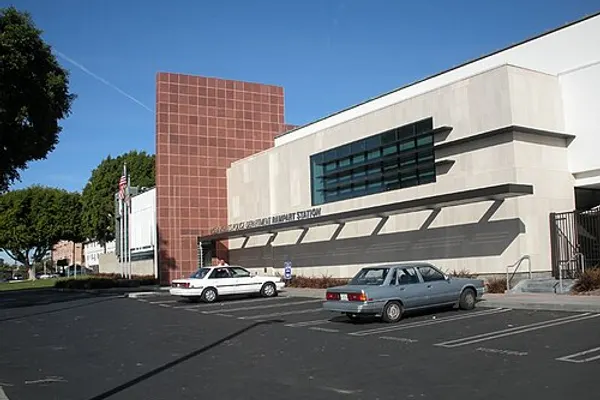
The Los Angeles Police Department (LAPD) operates the Rampart Community Police Station at 1401 West 6th St., 90017, located near Echo Park in the Westlake district of east-central Los Angeles. LAPD also operates an LAPD Police Academy training facility Including a weapons firing range in Elysian Park adjacent to Dodger Stadium.
Local community groups
Echo Park has various community groups that contribute to its well-being through volunteer action. Some of those groups include The Echo Park Improvement Association, Echo Park Chamber of Commerce, Echo Park Trash Club, and Echo Park Historical Society.
County, state, and federal representation
Echo Park sits in the following governmental districts:
1st County District of Los Angeles County Board of Supervisors, under Supervisor Hilda Solis
24th State Senate District, under California State Senator Maria Elena Durazo
52nd State District of the California State Assembly, under California State Assemblymember Jessica Caloza
30th Federal Congressional District, under Representative Laura Friedman
The Los Angeles County Department of Health Services operates the Central Health Center in Downtown Los Angeles, serving Echo Park.
Encyclopedic content adapted from the Wikipedia article on Echo Park, used under CC BY-SA 4.0.