About the neighborhood
Urban neighbourhood in Stari Grad, Belgrade, Serbia
Dorćol (Serbian Cyrillic: Дорћол; Serbo-Croatian pronunciation: dǒrtɕol) is an affluent urban neighborhood of Belgrade, the capital of Serbia. It is located in Belgrade's municipality of Stari Grad.
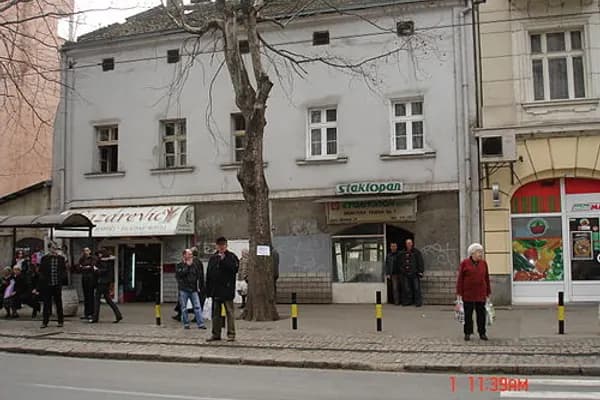
Located along the right bank of the Danube, Dorćol is the oldest surviving neighborhood in Belgrade. It is known for its specific urban charm and the mentality of its residents. The neighborhood has experienced artistic revival since the 2000s concurrently with the Savamala neighborhood on the opposite, Sava, bank. After being featured in numerous reports, including by the BBC and The Guardian, Time Out magazine placed Dorćol on their list of "50 coolest neighborhoods". It has been described as a Belgrade "phenomenon", an "exciting, creative and inventive spot", and the "authentic, organic soul of the city".
A section of Upper Dorćol was declared a spatial cultural-historical unit in 1989, and placed under protection as the "Area surrounding Dositej's Lyceum".
Location
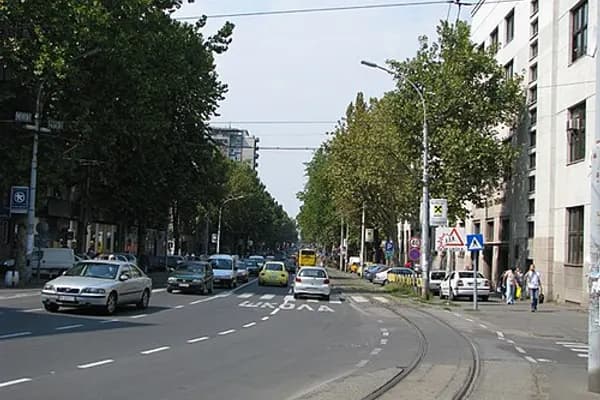
Dorćol begins already some 700 meters north of Terazije, the central square of Belgrade. It can roughly be divided into two sections, Gornji (or Upper) Dorćol (formerly known as Zerek), which covers the area from Academy Park to Cara Dušana street, and Donji (or Lower) Dorćol, formerly called Jalija, which occupies the area between Cara Dušana, Bulevar despota Stefana and the right bank of the Danube. It borders (and largely overlaps) the neighborhoods of Stari Grad and Jevremovac (east and south) and the fortress of Kalemegdan (west). The population of the neighborhood in the widest sense was 22,707 in 2002.
History
Roman period
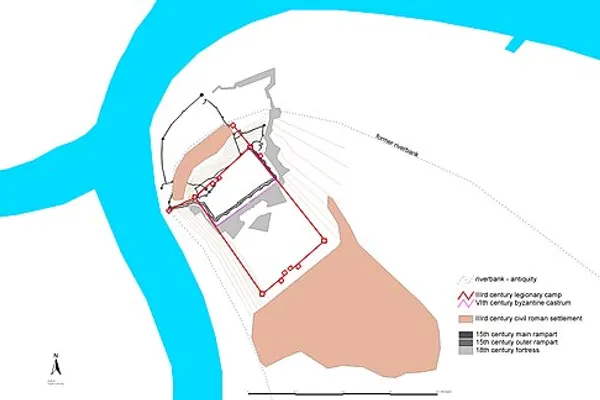
The predecessor to Belgrade was Singidunum, a Celtic and, later, Roman fortified town. The original earthen and wooden fort stretched around Studentski Trg and Knez Mihailova Street. The oldest Roman graves were discovered in this section, dated to the 1st and early 2nd centuries. During the period of the Roman Empire, the Danube was much wider and modern Lower Dorćol didn't exist. Upper Dorćol was included in the city. The civilian zone spread from Kralja Petra Street, over both the Sava and Danube banks to Kosančićev Venac, extending in a series of necropolises from Republic Square, along the Bulevar kralja Aleksandra all the way to the Mali Mokri Lug. The highest, ending section of Upper Dorćol was part of the central axis of the city grid in the direction of modern Uzun Mirkova-Vasina-Republic Square. The necropolis at Republic Square contained well-shaped graves from the 1st century AD. In general, the largest section of the civilian settlement was situated between modern Simina Street in Dorćol, Brankova Street in Savamala and Zeleni Venac, and Republic Square.
On the crossroads of Gospodar Jevremova and Kneginje Ljubice streets, a house of worship dedicated to the Greek goddess Hecate, a sort of "descent of Hades", was discovered in 1935. As foundations for a new building were being dug, a 1.5m (4ft 11in) long architrave beam, with an inscription in Latin dedicated to Hecate, was discovered at the depth of 2.5m (8ft 2in). The inscription was written by Valerius Crescentio, a legionary of the Legio IV Flavia Felix, in the service of the emperor Maximinus Thrax. It is roughly dated to c. 235 AD. It disappeared after it was discovered but was found decades later and handed over to the National Museum in Belgrade. It is a rare finding of Hecate in Serbia. Her cult wasn't developed in this area, and she was mostly identified with the Roman goddess Diana, worshiped in the region as the protector of silver mines. The entire surrounding slope around the Gospodar Jevremova was a necropolis, so the temple was probably part of it since Hecate's temples were usually built on cemeteries. The beam ends in a step-like manner, so the temple was probably built in the Ionic order rather than the Tuscan order, which would be expected in Singidunum. Impressions of anta capital and their size on the lower side of the beam point to the existence of two columns and probably a rectangular gable above it. There is a possibility that due to the terrain, the temple was actually dug into the slope.
The northern section of Academy Park was excavated in 1968 during the building of a furnace oil tank for the boiler room of Belgrade's City Committee of League of Communists, which were located nearby. Under the lawn, the remnants of the ancient Roman thermae were discovered, including the frigidarium (room with cold water), laconicum (room with the warm water where people would sweat and prepare), and caldarium (room with two pools of hot water). The site became an archaeological dig in 1969 and 8 rooms in total were discovered, including the remains of the brick furnace that heated the water. It was a public unisex bath dated to the 3rd or 4th century. The entire area of the park is actually within the borders of the "Protected zone of Roman Singidunum". It is situated in the area that used to be the civilian sector of the city, outside the fortress. The remnants were visible until 1978 and due to the lack of funds to continue excavations or to cover it with a roof or marquee, the remains were conserved and buried again.
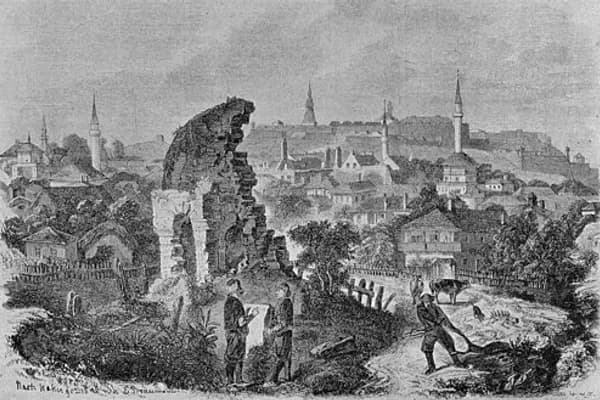
Remnants of the Roman castrum from the 2nd century were discovered beneath Tadeuša Košćuškog Street during the reconstruction in June 2009. They were conserved and reburied. In Cincar Jankova Street, five graves from the late 1st century were discovered so as three canals. As later development of Belgrade destroyed over 80% of the cultural layer within the current protected zone of Ancient Singidunum, that is, of the civilian settlement and necropolises, there are only three sections that were excavated, conserved, and reburied, two of them being in Upper Dorćol (Academy Park and Tadeuša Košćuškog), the third being Park Proleće on the opposite side of the central slope.
Medieval period
During the reign of Despot Stefan Lazarević, in the late 14th and early 15th centuries, the settlement was an outer suburb of Belgrade. The settlement hosted a Ragusan merchant colony, so a modern street, roughly in this area, was named Dubrovačka in the late 19th century.
Ottoman period
The name of the neighborhood comes from Turkish words dört (four) and yol (road), literally meaning "four roads" or colloquially "intersection (of four roads)", "crossroads". There are several towns and villages with the same name in Turkic speaking areas, like Dörtyol in Turkey or Dyurtyuli in Bashkortostan, Russia.
In 1522, the Ottomans opened a kafana in Dorćol, considered the oldest such venue in Europe. It served only Turkish coffee. After recapturing Belgrade from the Austrians in 1739, Kafana Crni Orao (Kafana Black Eagle) was opened at the corner of the modern streets of Kralja Petra and Cara Dušana. It was the first such facility with the recorded word kafana in its name. Apart from coffee, nargile was also on offer.
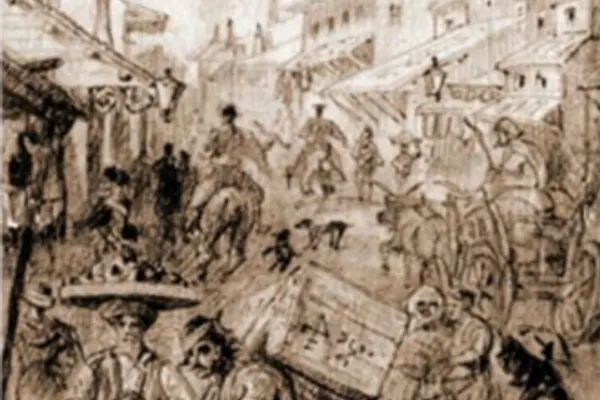
During the Turkish rule of Belgrade, Dorćol was a well known trading center, with many markets and traders of different nationalities. Among others, it was a center of Belgrade's Jewish community, who settled in Belgrade in the early 16th century, a remnant of which is the modern Jevrejska ("Jewish") street in Dorćol. The area of Jalija, or Lower Dorćol, below the Duga čaršija (Long Çarşı), modern Cara Dušana, and the Danube was dotted with numerous mosques, each having its own mahallah. One of the mahallahs was Jewish. A synagogue was built in the neighborhood in the 16th century. After Belgrade became a capital of independent Serbia, Dorćol kept its multinational character for a long time. Apart from Serbs, Jews, and Ottomans, later settlers also included new Ragusan settlers after the Candian war, Greeks, Italians, Germans, Russians, Cincars, Armenians, Bosnian Muslims, and Albanians, so Dorćol was described as a "Babylonian mixture of people, religions, and languages".
Dorćol was the location of famous farmers market, Bit-Pazar. The central thoroughfare in the neighborhood was hence named Bitpazar(ska), and it divided upper (Zerek) and lower (Jalija) sections of the neighborhood. During the Austrian occupation from 1718 to 1739, it was renamed Dunavska Street. The street is today called Cara Dušana. In 1783, a Sheikh Mustafa's Turbesr was built in the neighborhood, within the complex of the Dervish tekija. It survived until today, and was reconstructed. In June 2019 in the turbe, for the first time after 236 years, a group of Dervish performed a religious ritual in Belgrade.
Austrian period
During the Austrian occupation of northern Serbia in 1717-39, Belgrade was divided by the governing Austrian authorities into six districts: Fortress, Serbian Town (modern Kosančićev Venac), German Town (modern Dorćol), Lower Serbian Town (Savamala), Karlstadt (Palilula), and the Great Military Hospital (Terazije-Tašmajdan).
German Town is today referred to as Baroque Belgrade. In this couple of decades, Austrians turned Belgrade from an Oriental town into a modern, European one, including several grandiose projects. German Town was divided into blocks and built according to the most modern rules of the Baroque architecture of the day. A series of houses with Baroque façades were built along the straight streets. Official buildings included hospitals, barracks, pharmacies, brewery, saltern, monasteries, schools and several official palaces. Also, it was the seat of the Prince Eugene of Savoy's court. For the first time, settlements outside of the fortress, German and Serbian towns, were fenced with the protective ramparts and gates which were connected by the four main city roads. As the Turks completely withdrew, Austrians settled people from all over the Habsburg Monarchy, including many merchants, traders, and artisans, but also war veterans and poor people. Chronicles record that the first theatrical shows were organized in this period, as they mention "comedies" being performed in some of the former mosques, which were abundant in Dorćol.
Several hospitals were established in German Town, including the Capucines' hospital. The Capucines were granted permission to do missionary work in Belgrade on 23 August 1718, on the Emperor's decision. They were given one of the mosques, which they adapted and dedicated to the Virgin Mary. On the city plans, their monastery is located just within the outer walls, next to the Emperor's Gate. They possibly arranged the Bajram-beg mosque, also known as the Stambol mosque, below the modern National Theatre in Belgrade, approximately on the location of the modern Church of St. Alexander Nevsky. The Capucines had only nine monks by 1725 which was quite insufficient for their duties. They were handling all the Catholics in the occupied area, proclaimed by the Austrian court as the Kingdom of Serbia. They also took religious care of the soldiers who were scattered over the region, but they only had two parochial priests. Still, they converted over 1,000 imperial soldiers from Protestantism to Catholicism. They originally took care of the ill all over Belgrade, in the fortress, existing hospitals, and private houses. In the letter of an unknown city clerk from 10 November 1736, sent to the Vicar Provincial of the order in Vienna, it was mentioned that the Capucines asked for the field hospital to be established. It would take care of the soldiers and have a place for 1,500 people. The military commander of Belgrade agreed, providing permanent pay and food for the monks who would treat the soldiers. There was enough space next to their monastery for such a facility. Still, the care of the soldiers was first offered to the Jesuits, but they refused. Names of two especially dedicated Capucine priests are preserved in the documents: Father Oswaldus and Father Chrysogonus.
However, the local population wasn't welcomed in German Town, though they welcomed Austrians as their Christian liberators. Division of Belgrade into German and Serbian towns was just the first step. German settlers asked the Austrian emperor on 8 April 1718 to allow only German Catholics to settle in German Town, to expel 40 Serbian families who already lived there, and to also expel or move into ghettos all Serbs, Armenians, Greeks, and Jews present there before the Austrians came. Germans openly stated that the local population, which lived there during the Ottoman period, moved into the largest and most beautiful Turkish houses, which Germans wanted for themselves. Emperor Charles VI granted almost the same rights to both towns, but on the pretext that they were fully separate. Statute of German Town stipulates that "Serbs, Armenians, and Greeks" will be tolerated only in separate municipalities. Non-German nationalities were finally completely expelled from German Town in 1726, when some estates were bought off, but the majority of people were relocated forcefully by the Austrian gendarmerie colonel Von Burg. By the end of their rule, there were massive differences between two parts of Belgrade, as the Austrians made no effort at all to cultivate Serbian Town, which remained an Oriental settlement, while German Town grew larger, both in area and population; new palaces, squares, and streets were built; and the fortress was reconstructed.
Belgrade remained rich in kafanas in this period. There were almost 200 kafanas and meyhanas, and production of alcoholic beverages in the city bloomed. Rakia was mainly produced by the local Jewish population, while beer was produced by both Jews and German migrant brewers. Brothers Jakov and Abraham Kepiš, grain merchants from Timișoara, built a large brewery close to Long Street, central in the neighborhood (modern Dušanova Street). It was situated on the location of the former Turkish cemetery, between modern Jevrejska, Braće Baruh, and Visokog Stevana streets. A massive, L-shaped building had one floor, an attic, and a basement under the entire yard. When the Ottomans retook Belgrade, they demolished or closed all breweries.
The Roman Catholic Church dedicated to Saint Peter the Apostle, at the corner of modern Dušanova and Cara Uroša Streets, began in 1732. After Austria lost the Austro-Turkish War of 1737–1739, northern Serbia, including Belgrade, was returned to the Turks. One of the provisions of the 1739 Treaty of Belgrade stated that Austria had to demolish all the fortifications and military and civilian buildings it had constructed during the occupation. Many Baroque buildings were demolished, including most of the hospitals. However, Austria didn't demolish the buildings outside the fortress walls. That way, the House at 10 Cara Dušana Street, built from 1724 to 1727, in the neighborhood of Dorćol also survived, being today the oldest house in Belgrade. Population also withdrew back to Austria, so the chronicles report that the Turks encountered only 8 Serbs and 45 Jews in the town. The Turks re-Orientalized Belgrade almost completely.
Encyclopedic content adapted from the Wikipedia article on Dorćol, used under CC BY-SA 4.0.