About the neighborhood
Commercial District in Minnesota, United States
Dinkytown is a commercial district within the Marcy-Holmes neighborhood in Minneapolis, Minnesota. Centered at 14th Avenue Southeast and 4th Street Southeast, the district contains several city blocks occupied by various small businesses, restaurants, bars, and apartment buildings that house mostly University of Minnesota students. Dinkytown is along the North side of the University of Minnesota Twin Cities East Bank campus.
Notable landmarks
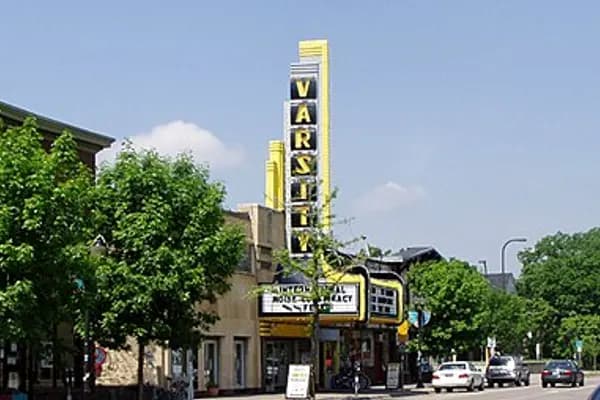
Notable landmarks include the Dinkydome (a former theological seminary converted to a food court, which sometime later was converted into loft space), the Loring Pasta Bar (formerly Gray's Campus Drug and also the building where Bob Dylan lived in Minneapolis), Al's Breakfast (arguably the city's smallest restaurant), and the Varsity Theater. It's also the location of the second store opened by Richard M. Schulze called "Sound of Music", which later became Best Buy and is now closed.
Notable establishments
The former Marshall-University High School on the corner of 14th Avenue and 5th Street was closed in 1982 due to changing city population demographics and was purchased and converted into the University Technology Enterprise Center (UTEC) for startups. The building was razed in 2013, and today the location is home to The Marshall, an apartment building for University students. The Chateau co-op built their brutalist-style 22-story apartment in 1973 at 13th Avenue Southeast and 5th Street Southeast.
History
The City of Minneapolis' Heritage Preservation designated a portion of the area as the Dinkytown Commercial Historic District in 2015, due to its significance in the history of streetcar development. The historic district covers an area roughly two blocks around, surrounding the intersection of 14th Avenue Southeast and 4th Street Southeast.
The name Dinkytown is of uncertain origin, although it was in definite use by 1948, when the Dinkytown Business Association formed. Stories regarding the origin of the name include:
The streetcars, called Dinkys, that used to provide transit throughout the area.
The theatre in Dinkytown had only four rows of seats, and for years was known as "The Dinky Theater." Shortly thereafter, it was just "The Dinky."
It's a small (dinky) town-like area; everything is within walking distance.
The Loring Pasta Bar, previously Gray's Drug on 14th Avenue Southeast and 4th Street Southeast, has the name of an early owner carved in cement over the doorway: "Grodnik." Theories claim this means a small (or dinky) town, under the claim that "Grod" means "town" and "-nik" is the diminutive form. Another possible translation (from Polish and Belarusian) is "gardener"; "grod" meaning "garden", and"-nik" as a person-reference, giving "one who gardens".
References
External links
Marcy-Holmes Neighborhood Association Dinkytown is a commercial district, and one of the 5 character areas, of the Marcy-Holmes neighborhood.
Lileks.com -- University of Minnesota pages—contains information and reminiscence about Dinkytown, by Star Tribune columnist James Lileks
The Dinkytown Project
Dinkytown Hub Archived 2015-04-12 at the Wayback Machine Contains information about Dinkytown including a complete list of all businesses.
Further reading
Designation Study for Dinkytown Historic District Archived 2017-02-02 at the Wayback Machine
Violent, colorful protests in Dinkytown in 1970 at the Wayback Machine(archived February 9, 2012)
Deprecated link at archive.today(archived January 15, 2008)
AthleticsCampusStudent life GAPSA
Minnesota Daily
Minnesota Republic
Radio K
Solar Vehicle Project
The Wake
Minnesota Centennial Showboat
History Shyamala Rajender v. University of Minnesota
Starvation Experiment
People Alumni
Faculty
Presidents
Founded: 1851
Students: 54,890
Endowment: 3.281 billion
Category
Commons
Encyclopedic content adapted from the Wikipedia article on Dinkytown, used under CC BY-SA 4.0.
What makes Dinkytown special
Dinkytown stands out among Minneapolis’s neighborhoods for its distinctive character: minneapolis' student quarter. Ranked #5 in Minneapolis, it offers the kind of experience that defines a great city trip — a place where the streets themselves tell a story and every block rewards curiosity.
Best for
Our take on Dinkytown
Dinkytown occupies a distinctive place in Minneapolis's neighborhood landscape. It is the kind of district that rewards travelers who venture beyond the obvious choices — quieter than the tourist-facing areas, richer in local character, and full of the small details that make a city trip memorable.
What makes Dinkytown exceptional is the density of its cultural life. Art galleries, independent bookshops, small theaters, and creative studios are woven into the fabric of the neighborhood rather than clustered in a single zone. You encounter culture here by accident, which is how the best cultural experiences always happen.
Our editors recommend budgeting at least half a day here — enough time to walk the main streets, sit down for coffee, and discover the side streets where Dinkytown's real character lives.
Living in Dinkytown
Dinkytown is connected to the rest of Minneapolis by public transit, and most visitors find it straightforward to reach from the city center or airport. Once you arrive, the neighborhood is best explored on foot — the scale is human and the streets reward wandering.
Day-to-day life in Dinkytown has the rhythm of a genuine residential neighborhood. You will find grocery stores, pharmacies, cafés with morning regulars, and the kind of small independent shops that only survive where locals support them. For visitors, this means the infrastructure you need — good coffee, a decent meal, a quiet place to sit — is always within a short walk.
Accommodation in Dinkytown ranges from boutique hotels to short-term rentals. We generally recommend staying within the neighborhood itself rather than commuting from a hotel elsewhere in Minneapolis — the experience of waking up inside a great neighborhood is fundamentally different from visiting one as a day trip.
What locals say about Dinkytown
Long-term residents of Dinkytown tend to describe their neighborhood with a mix of pride and protectiveness. Like any district with genuine character, Dinkytown inspires loyalty — the kind of place people move to and never quite leave, or leave and spend years trying to get back to.
The creative community in Dinkytown is genuine, not aspirational. Residents include working artists, writers, musicians, and designers who chose the neighborhood because it supported their work — affordable studio space, a community that values craft, and enough foot traffic to sustain independent galleries and shops.
Compared to the more famous districts in Minneapolis, Dinkytown has maintained a lower profile, which many residents consider an advantage. The neighborhood evolves gradually rather than being reshaped by sudden attention, and the result is a community that still feels organic rather than curated.
Visitor tips
- Dinkytown is located in Minneapolis, United States. The neighborhood is accessible by public transport, taxi, or rideshare from most parts of the city.
- Morning is often the best time to explore — the streets are quieter, the light is better for photography, and cafes are at their most welcoming.
- Wear comfortable walking shoes — the best way to experience Dinkytown is on foot, wandering the side streets and discovering what lies around each corner.
- Save the neighborhood's location on your phone before you arrive. Offline maps are especially useful for navigating the smaller side streets.