About the neighborhood
Road and neighborhood in Kuala Lumpur, Malaysia
3°08′40″N 101°41′51″E / 3.144444°N 101.697500°E / 3.144444; 101.697500
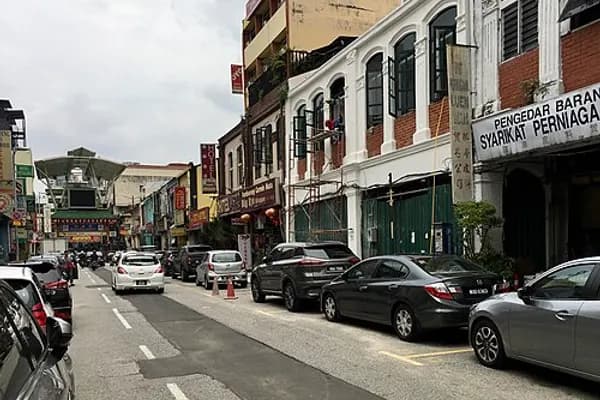
Petaling Street (Malay: Jalan Petaling, Simplified Chinese: 茨厂街, Traditional Chinese: 茨廠街, pinyin: Cíchǎng Jiē, Cantonese jyutping: ci cong gaai) is a Chinatown located in Kuala Lumpur, Malaysia. The vicinity is also known as Chinatown KL. Haggling is a common sight here, and the place is usually crowded with locals, as well as tourists.
The area has dozens of restaurants and food stalls, serving local favourites such as Hokkien mee, Ikan Bakar (barbecued fish), asam laksa and curry noodles. Reggae Bar Chinatown is located here. Traders here are mainly Chinese but there are also Indian, Malay, and Bangladeshi traders. It is also known for street prostitution.
History and development
The original Chinatown is centred on Market Square, Jalan Tun H.S. Lee (or High Street). The High Street was popular as it was higher than the rest of the town and thus less prone to floods. This led the wealthier population to build their shophouses here. As a result, the more ornate shophouses were built north of Jalan Cheng Lock and closer to the High Street business centre.
Kuala Lumpur was a typical "pioneer" town around the start of the 20th century. The population was predominantly male, and they were typical of the rough and tough pioneers of those times. The men were mainly Cantonese and Hakkas who had come to the city because of the tin trade, working as coolies in the mines. They were governed by a Chinese Kapitan or headman. The most famous Chinese Kapitan was Yap Ah Loy, a Hakka.
In the 1860s to 1870s, the Selangor Civil War erupted between rival Malay factions, as well as within the Chinese community that were allied to them. The Chinese community split along partisan lines between the Hokkien Ghee Hin and the Hakka Hai San secret societies. When the British authorities realised that the war disrupted their economy and supply chains, they decided to enter the war. As a result, many buildings were destroyed or severely damaged.
During the civil war, the tin mines were abandoned. The neglect during this time caused them to become flooded. After the war (and when the miners returned), they found that the mines were now unworkable due to flooding. Yap Ah Loy persuaded the miners and coolies to remain in KL and persuaded the Malays in the surrounding districts to grow rice and other garden products. He opened a tapioca mill in Petaling Street where the tubers from his farms were brought to be ground into flour. Petaling Street is called 'Chee Cheong Kai' in Cantonese, meaning Starch Factory Street.
Features
There used to be a McDonald's on the 1st shop lot of Petaling Street (facing Foch Avenue (Jalan Tun Tan Cheng Lock)) before it ceased operations several years ago. Nearby is a Chinese bookstore, as well as food stalls selling a variety of local food like Hainanese chicken rice and noodles. One famous Wanton Noodle shop, called Koon Kee Too, is located near the intersection inside Petaling Street. Also nearby are the Jamek Mosque, an old mosque of Moorish architecture, as well as the Central Market, all accessible within walking distance.
One of Kuala Lumpur's famous landmarks, the Sri Mahamariamman Temple, Kuala Lumpur, is located along with Jalan Tun H.S. Lee. It is one of KL's oldest and richest Hindu temples, attracting many devotees and tourists daily.
Another notable landmark within the area is Kwai Chai Hong (Chinese: 鬼仔巷) located along Lorong Panggung. It is a back alley behind the shophouses with lots of mural arts managed by Bai Chuan Management Sdn Bhd to make use as a tourist attraction. The name translates literally as Little Ghost Lane or Little Demon Lane in English. The alley features 6 artistic interactive murals with QR codes placed on the walls of each mural about historic life of residents around the block back in the days.
Development
In 2003, Petaling Street underwent a major RM11 million facelift when two large Chinese arches to welcome visitors were placed at either end of the street. A green roof cover was constructed, covering the whole road, dubbed the "Green Dragon". The street is now totally pedestrianised and transformed into a pedestrian shopping mall. The Street is regarded as a heritage site.
Film
Although not shot on site, Malaysia's 2011 kungfu comedy film, Petaling Street Warriors, is set against the backdrop of Petaling Street in the year 1908.
Transportation
The street is accessible within walking distance from the following rail stations:
Northwest from Plaza Rakyat LRT station (interchange with Merdeka MRT station);
South from Masjid Jamek LRT station;
Northeast from Pasar Seni LRT/MRT station – connected to KTM Kuala Lumpur; and
North from Maharajalela Monorail station.
Image gallery
Wikimedia Commons has media related to Petaling Street.
References
External links
Kwai Chai Hong official website
Tourism Malaysia – Petaling Street
Travel Guide with Photos – EscapeHunter.com
Geographic data related to Petaling Street at OpenStreetMap
Encyclopedic content adapted from the Wikipedia article on Chinatown, used under CC BY-SA 4.0.
What makes Chinatown special
Chinatown stands out among Kuala Lumpur’s neighborhoods for its distinctive character: kl's lively old core. Ranked #3 in Kuala Lumpur, it offers the kind of experience that defines a great city trip — a place where the streets themselves tell a story and every block rewards curiosity.
Best for
Our take on Chinatown
Chinatown is one of the strongest neighborhoods in Kuala Lumpur, and it consistently appears in our editors' personal favorites lists. It may not always get the same attention as the city's most famous district, but among travelers who know Kuala Lumpur well, Chinatown is often the first recommendation.
What makes Chinatown worth the visit is the texture of daily life here. It is a neighborhood that functions for the people who live in it — not just for the visitors who pass through. The shops serve local needs, the restaurants feed local appetites, and the streets have a rhythm that reflects genuine community rather than tourism infrastructure. That is the quality our editors prize most, and Chinatown has it in abundance.
Our editors recommend budgeting at least half a day here — enough time to walk the main streets, sit down for coffee, and discover the side streets where Chinatown's real character lives.
Living in Chinatown
Chinatown is connected to the rest of Kuala Lumpur by public transit, and most visitors find it straightforward to reach from the city center or airport. Once you arrive, the neighborhood is best explored on foot — the scale is human and the streets reward wandering.
Day-to-day life in Chinatown has the rhythm of a genuine residential neighborhood. You will find grocery stores, pharmacies, cafés with morning regulars, and the kind of small independent shops that only survive where locals support them. For visitors, this means the infrastructure you need — good coffee, a decent meal, a quiet place to sit — is always within a short walk.
Accommodation in Chinatown ranges from boutique hotels to short-term rentals. We generally recommend staying within the neighborhood itself rather than commuting from a hotel elsewhere in Kuala Lumpur — the experience of waking up inside a great neighborhood is fundamentally different from visiting one as a day trip.
What locals say about Chinatown
Long-term residents of Chinatown tend to describe their neighborhood with a mix of pride and protectiveness. Like any district with genuine character, Chinatown inspires loyalty — the kind of place people move to and never quite leave, or leave and spend years trying to get back to.
What locals appreciate most about Chinatown is its consistency — the feeling that the neighborhood works the same way on a Tuesday morning as it does on a Saturday night. It is not a place that performs for visitors and then goes quiet. The rhythm is genuine, the community is real, and the daily experience of living here is what draws people and keeps them.
Compared to the more famous districts in Kuala Lumpur, Chinatown has maintained a lower profile, which many residents consider an advantage. The neighborhood evolves gradually rather than being reshaped by sudden attention, and the result is a community that still feels organic rather than curated.
Visitor tips
- Chinatown is located in Kuala Lumpur, Malaysia. The neighborhood is accessible by public transport, taxi, or rideshare from most parts of the city.
- Morning is often the best time to explore — the streets are quieter, the light is better for photography, and cafes are at their most welcoming.
- Wear comfortable walking shoes — the best way to experience Chinatown is on foot, wandering the side streets and discovering what lies around each corner.
- Save the neighborhood's location on your phone before you arrive. Offline maps are especially useful for navigating the smaller side streets.