About the neighborhood
Canal in Paris
The Canal Saint-Martin (French pronunciation: kanal sɛ̃ maʁtɛ̃) is a 4.6km (2.86 mi) long canal in Paris, connecting the Canal de l'Ourcq to the river Seine. Nearly half its length (2,069 metres (2,263yd)), between the Rue du Faubourg du Temple and the Place de la Bastille, was covered in the mid-19th century to create wide boulevards and public spaces on the surface. The canal is drained and cleaned every 10–15 years, and it is always a source of fascination for Parisians to discover curiosities and even some treasures among the hundreds of tons of discarded objects.
History
Gaspard de Chabrol, prefect of Paris, proposed building a canal from the river Ourcq, 100km northeast of Paris, to supply the city with fresh water to support a growing population and help avoid diseases such as dysentery and cholera, while also supplying fountains (including the monumental Elephant of the Bastille) and allowing the streets to be cleaned. Construction of the canal was ordered by Napoleon I in 1802 and construction took place until 1825, funded by a new tax on wine.
The canal was also used to supply Paris with grain, building materials and other goods, carried on canal boats. Two ports were created on the canal in Paris to unload the boats: Port de l'Arsenal and the Bassin de la Villette.
By the 1960s, traffic had dwindled to a trickle and the canal narrowly escaped being filled in and paved over for a highway.
Route
The entrance to the canal from the vast terminal basin (Bassin de la Villette) of the Canal de l'Ourcq is at a double lock near the Place de Stalingrad. Continuing towards the river Seine, the canal is bordered by the Quai de Valmy on the right bank and the Quai de Jemmapes on the left, passing through three more double staircase locks before disappearing under the three successive voûtes (tunnels) – du Temple, Richard-Lenoir and Bastille – to emerge in the Port de l'Arsenal, the principal port for boats visiting and residing in Paris.
Tourism
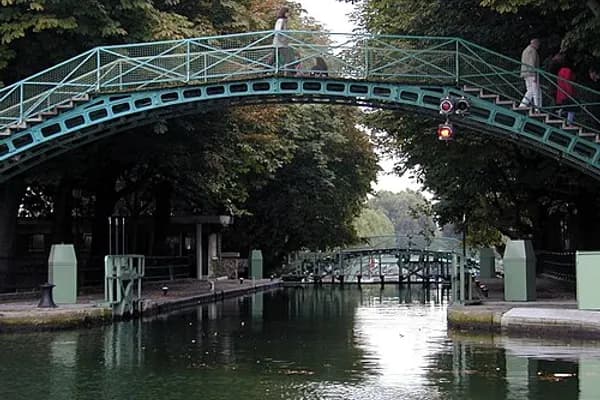
Today, the canal is a popular destination for Parisians and tourists. Some take cruises on the canal in passenger boats. Others watch the barges and other boats navigate the series of locks and pass under the attractive cast-iron footbridges. There are many popular restaurants and bars along the open part of the canal, which is also popular with students.
Métro stations
The canal can be accessed from the following Paris Métro stations: Stalingrad, République, Goncourt, Jacques Bonsergent, Jaurès.
In popular culture
Art
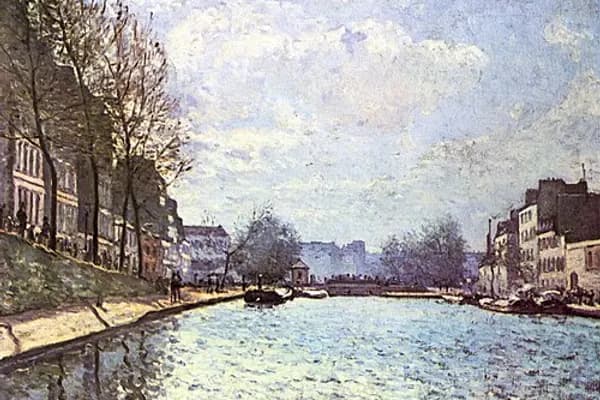
The canal inspired painters such as Alfred Sisley (1839-1899). In the present day, many intricate works of graffiti are visible along the canal, and there is a large multimedia art space on its banks at the former municipal undertakers building at 104 rue d'Aubervilliers ('104').
Film and television
The canal was the setting in part for Jean Vigo's film L'Atalante in 1934.
The canal is shown in the 1938 film Hôtel du Nord, directed by Marcel Carné.
In Les Malheurs d'Alfred (1972), Pierre Richard and Anny Duperey meet each other at the beginning of the film, thinking of committing suicide in the canal.
The French police series PJfr uses an external shot of a building at 52 rue Bichat, located next to the canal, as the frontage of the police station. Cars were often shown exiting the building and the canal and adjacent neighbourhood were used as backdrops for scenes.
The canal appears in Jean-Pierre Jeunet's famous 2001 film known in English as Amélie, in which the title character is shown enjoying one of her favourite activities: skipping stones at the locks of the canal.
The canal was used as an escape route for Ethan Hunt and his team in the 2018 film Mission: Impossible – Fallout.
The canal was used by John Wick as a route to get closer to Saint-Eustache in the 2023 film John Wick: Chapter 4.
The canal was used in the 2024 film Under Paris.
Music
Édith Piaf sings about the canal in the song "Les mômes de la cloche", written by Vincent Scotto and Decaye, music by Médinger, in 1936.
Courteeners song "The Dilettante" mentions the canal and talks of the pleasant atmosphere surrounding it.
Literature
Georges Simenon's novel Maigret and the Headless Corpse (Maigret et le corps sans tête) is set in and around the canal.
Gallery
References
External links
Wikimedia Commons has media related to Canal Saint-Martin.
Paris - Canal de l'Ourcq, Canal Saint-Denis and Canal Saint-Martin maps and information on places, ports and moorings on the canals, by the author of Inland Waterways of France, Imray
Navigation details for 80 French rivers and canals (French waterways website section)
Blog of the Canal Saint-Martin quarter (in French)
Canal Saint-Martin map Archived 2015-06-10 at the Wayback Machine (in French)
The sunken treasures of a Paris canal
Encyclopedic content adapted from the Wikipedia article on Canal Saint-Martin, used under CC BY-SA 4.0.
What makes Canal Saint-Martin special
Canal Saint-Martin stands out among Paris’s neighborhoods for its distinctive character: where paris comes to picnic. Ranked #2 in Paris, it offers the kind of experience that defines a great city trip — a place where the streets themselves tell a story and every block rewards curiosity.
Best for
Our take on Canal Saint-Martin
Canal Saint-Martin is one of the strongest neighborhoods in Paris, and it consistently appears in our editors' personal favorites lists. It may not always get the same attention as the city's most famous district, but among travelers who know Paris well, Canal Saint-Martin is often the first recommendation.
What makes Canal Saint-Martin worth the visit is the texture of daily life here. It is a neighborhood that functions for the people who live in it — not just for the visitors who pass through. The shops serve local needs, the restaurants feed local appetites, and the streets have a rhythm that reflects genuine community rather than tourism infrastructure. That is the quality our editors prize most, and Canal Saint-Martin has it in abundance.
Our editors recommend budgeting at least half a day here — enough time to walk the main streets, sit down for coffee, and discover the side streets where Canal Saint-Martin's real character lives.
Living in Canal Saint-Martin
Canal Saint-Martin is connected to the rest of Paris by public transit, and most visitors find it straightforward to reach from the city center or airport. Once you arrive, the neighborhood is best explored on foot — the scale is human and the streets reward wandering.
Day-to-day life in Canal Saint-Martin has the rhythm of a genuine residential neighborhood. You will find grocery stores, pharmacies, cafés with morning regulars, and the kind of small independent shops that only survive where locals support them. For visitors, this means the infrastructure you need — good coffee, a decent meal, a quiet place to sit — is always within a short walk.
Accommodation in Canal Saint-Martin ranges from boutique hotels to short-term rentals. We generally recommend staying within the neighborhood itself rather than commuting from a hotel elsewhere in Paris — the experience of waking up inside a great neighborhood is fundamentally different from visiting one as a day trip.
What locals say about Canal Saint-Martin
Long-term residents of Canal Saint-Martin tend to describe their neighborhood with a mix of pride and protectiveness. Like any district with genuine character, Canal Saint-Martin inspires loyalty — the kind of place people move to and never quite leave, or leave and spend years trying to get back to.
What locals appreciate most about Canal Saint-Martin is its consistency — the feeling that the neighborhood works the same way on a Tuesday morning as it does on a Saturday night. It is not a place that performs for visitors and then goes quiet. The rhythm is genuine, the community is real, and the daily experience of living here is what draws people and keeps them.
Like any neighborhood that has earned attention, Canal Saint-Martin is navigating the tension between popularity and preservation. Rents have risen, new businesses have arrived, and long-time residents occasionally grumble that the neighborhood is not what it was. But the fundamentals — the walkability, the food, the community — remain strong, and most locals we speak to believe the neighborhood is still gaining more than it is losing.
Visitor tips
- Canal Saint-Martin is located in Paris, France. The neighborhood is accessible by public transport, taxi, or rideshare from most parts of the city.
- Morning is often the best time to explore — the streets are quieter, the light is better for photography, and cafes are at their most welcoming.
- Wear comfortable walking shoes — the best way to experience Canal Saint-Martin is on foot, wandering the side streets and discovering what lies around each corner.