About the neighborhood
Neighborhood in New Orleans, Louisiana, United States
Bywater is a neighborhood of the city of New Orleans. A subdistrict of the Bywater District Area, its boundaries as defined by the City Planning Commission are: Florida Avenue to the north, the Industrial Canal to the east, the Mississippi River to the south, and the railroad tracks along Homer Plessy Way (formerly Press Street) to the west. Bywater is part of the Ninth Ward of New Orleans. It includes part or all of Bywater Historic District, which is listed on the National Register of Historic Places.
During New Orleans Mardi Gras, the Society of Saint Anne marching krewe starts their procession on Mardi Gras morning in Bywater and gathers marchers as it travels through the French Quarter, ending at Canal Street. This walking parade of local residents, artists, and performers is preceded by the Bywater Bone Boys Social Aid and Pleasure Club (founded 2005), an early-rising skeleton krewe made up of writers, tattoo artists, painters, set designers, musicians, and numerous other pre7 a.m. revelers.
After Hurricane Katrina, many survivors flocked to the area as it was less affected by the storm, due to the slightly higher elevation closer to the Mississippi river. Bywater became part of what was known as the "Sliver by the River," meaning neighborhoods that saw no flooding, including Faubourg Marigny, the French Quarter and Irish Channel neighborhoods, and parts of the lower Garden District including St. Charles Avenue.
Geography
Bywater is located at 29°57′46″N 90°02′24″W / 29.96278°N 90.04000°W / 29.96278; -90.04000 and has an elevation of 3 feet (0.9m). According to the United States Census Bureau, the district has a total area of 1.33 square miles (3.4km), 0.94 square miles (2.4km) of which is land and 0.39 square miles (1.0km) (29.32%) of which is water.
Adjacent neighborhoods
Desire Area (north)
Lower Ninth Ward (east)
Holy Cross (east)
Mississippi River (south)
Marigny (west)
St. Claude (west)
Florida Area (west)
Boundaries
The traditional boundaries of Bywater are: the Mississippi River to St. Claude Avenue, and the railroad tracks along Homer Plessy Way (formerly Press Street) to the Industrial Canal. Press Street's name came from a cotton press (known elsewhere as a cotton compress) which operated here during the 19th century. The Bywater/Marigny stretch of Press Street was changed to Homer Plessy Way in 2018 to memorialize Homer Plessy, the plaintiff in Plessy v. Ferguson, the 1896 decision of the U.S. Supreme Court that upheld the constitutionality of racial segregation laws for public facilities.
Demographics
As of the census of 2000, there were 5,096 people, 2,263 households, and 1,030 families residing in the neighborhood. The population density was 5,421 inhabitants per square mile (2,093/km).
As of the census of 2010, there were 3,337 people, 1,763 households, and 573 families residing in the neighborhood. The population density was 3,550 inhabitants per square mile (1,370/km).
History
The area now known as Bywater was mostly plantation land in the colonial era, with significant residential development beginning the first decade of the 19th century as part of what was known as "Faubourg Washington," part of the predominantly Francophone "downtown" section of New Orleans. Many people from France, Spain, and the French Caribbean settled here. During the century, it grew with both white Creoles of French and Spanish descent, as well as mixed-race Creoles of French, Spanish, African, and Native American descent. They were also joined by immigrants from Germany, Italy, and Ireland.
Bywater is home to the site at which Homer Plessy was removed from an East Louisiana Railroad car for violating the separate car act, an event that resulted in the Plessy v. Ferguson case and the legal doctrine of "separate but equal." Today, a historical marker stands at the intersection of Press Street and Royal Street to commemorate the event.
There was little distinction between this area and what became known as the Lower 9th Ward until the Industrial Canal was dredged in the early 20th century, dividing the two.
A generation knew the area as the "Upper 9th Ward," but as other parts of the 9th Ward above the Canal farther from the River became developed, a more specific name was needed. Inspired by the local telephone exchange designation of Bywater, which fit the neighborhood's proximity to the River and the Canal, the neighborhood was known as "Bywater" by the 1940s.
Real estate development and speculation surrounding the 1984 Louisiana World Exposition prompted many long-term French Quarter residents to move down river, at first into Marigny. By the late 1990s the bohemian, artistic type of communities such as were found in the French Quarter mid-20th century had spread to Bywater, and many long-neglected 19th-century houses began to be refurbished.
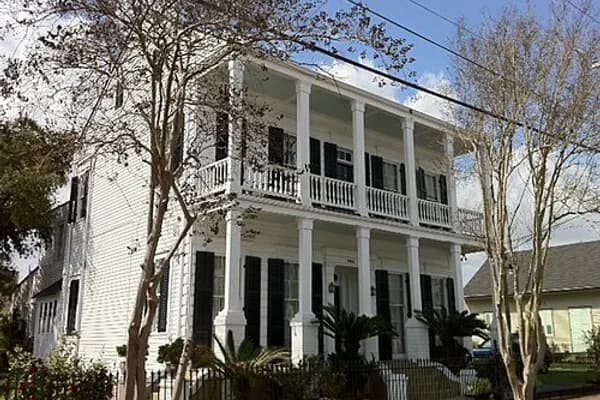
Bywater and neighboring Faubourg Marigny are two of the most colorful neighborhoods in the city. The architectural styles borrow heavily from the colonial French and Spanish and have elements of Caribbean vernacular architecture. This blending over the last three centuries has resulted in an architectural style unique to the city of New Orleans.
As the section of Bywater on the River side of St. Claude Avenue was one of the few portions of the 9th Ward to escape major flooding in the aftermath of Hurricane Katrina, it has made steady progress toward recovery, more so than many other parts of the city.
Notable people
Sallie Ann Glassman artist, Voodoo priestess
Dave Pirner of the 1990s Grunge band Soul Asylum
Ani DiFranco singer/song writer
See also
Neighborhoods in New Orleans
References
External links
Wikimedia Commons has media related to Bywater, New Orleans.
Wikivoyage has a travel guide for New Orleans/Bywater.
St. Roch Cemetery in the Bywater
Bywater Neighborhood Association
St. Claude Arts District
Faubourg Marigny Improvement Association
New Orleans EastWest BankWards 1st
2nd
3rd
4th
5th
6th
7th
8th
9th
10th
11th
12th
13th
14th
15th
16th
17th
FootnotesOrleans Parish and the City of New Orleans are coextensive. ‡This populated place also has portions in an adjacent parish or parishes.
Encyclopedic content adapted from the Wikipedia article on Bywater, used under CC BY-SA 4.0.
What makes Bywater special
Bywater stands out among New Orleans’s neighborhoods for its distinctive character: colorful shotgun houses and creative energy. Ranked #3 in New Orleans, it offers the kind of experience that defines a great city trip — a place where the streets themselves tell a story and every block rewards curiosity.
Best for
Our take on Bywater
Bywater is one of the strongest neighborhoods in New Orleans, and it consistently appears in our editors' personal favorites lists. It may not always get the same attention as the city's most famous district, but among travelers who know New Orleans well, Bywater is often the first recommendation.
What strikes us most about Bywater is the depth of its food culture. This is not a neighborhood with a few good restaurants — it is a neighborhood where eating well is woven into daily life, where the corner places are as good as the destination spots, and where you could eat every meal for a week without repeating yourself or being disappointed.
Our editors recommend budgeting at least half a day here — enough time to walk the main streets, sit down for coffee, and discover the side streets where Bywater's real character lives.
Living in Bywater
Bywater is connected to the rest of New Orleans by public transit, and most visitors find it straightforward to reach from the city center or airport. Once you arrive, the neighborhood is best explored on foot — the scale is human and the streets reward wandering.
Day-to-day life in Bywater has the rhythm of a genuine residential neighborhood. You will find grocery stores, pharmacies, cafés with morning regulars, and the kind of small independent shops that only survive where locals support them. For visitors, this means the infrastructure you need — good coffee, a decent meal, a quiet place to sit — is always within a short walk.
Accommodation in Bywater ranges from boutique hotels to short-term rentals. We generally recommend staying within the neighborhood itself rather than commuting from a hotel elsewhere in New Orleans — the experience of waking up inside a great neighborhood is fundamentally different from visiting one as a day trip.
What locals say about Bywater
Long-term residents of Bywater tend to describe their neighborhood with a mix of pride and protectiveness. Like any district with genuine character, Bywater inspires loyalty — the kind of place people move to and never quite leave, or leave and spend years trying to get back to.
The creative community in Bywater is genuine, not aspirational. Residents include working artists, writers, musicians, and designers who chose the neighborhood because it supported their work — affordable studio space, a community that values craft, and enough foot traffic to sustain independent galleries and shops.
Compared to the more famous districts in New Orleans, Bywater has maintained a lower profile, which many residents consider an advantage. The neighborhood evolves gradually rather than being reshaped by sudden attention, and the result is a community that still feels organic rather than curated.
Visitor tips
- Bywater is located in New Orleans, United States. The neighborhood is accessible by public transport, taxi, or rideshare from most parts of the city.
- Morning is often the best time to explore — the streets are quieter, the light is better for photography, and cafes are at their most welcoming.
- Wear comfortable walking shoes — the best way to experience Bywater is on foot, wandering the side streets and discovering what lies around each corner.
- Save the neighborhood's location on your phone before you arrive. Offline maps are especially useful for navigating the smaller side streets.