About the neighborhood
District of Kyoto, Japan
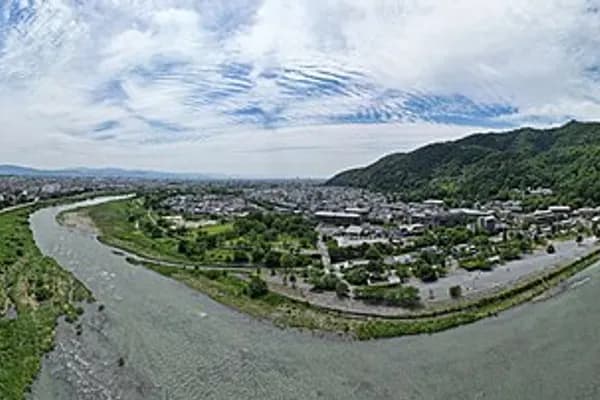
Arashiyama (嵐山, Storm Mountain) is a district on the western outskirts of Kyoto, Japan. It also refers to the mountain across the Ōi River, which forms a backdrop to the district. Arashiyama is a nationally designated historic site and place of scenic beauty.
Notable tourist sites
Arashiyama Bamboo Grove (a.k.a. the Sagano Bamboo Forest)
The Iwatayama Monkey Park on the slopes of Arashiyama. Over 170 monkeys live at the park. While the monkeys are wild, they have become accustomed to humans. The park is on a small mountain not far from the Saga-Arashiyama rail station. Visitors can approach and photograph the monkeys. At the summit is a fenced enclosure where visitors can feed the monkeys.
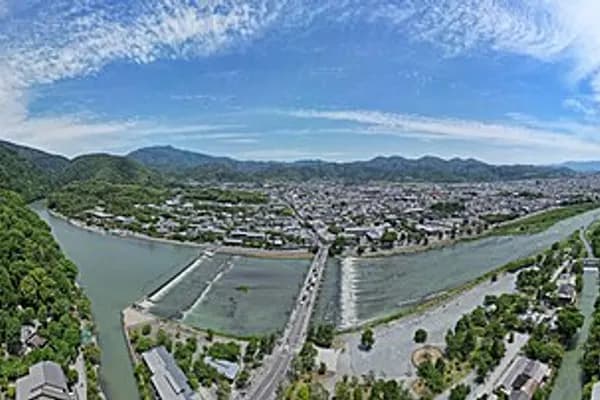
The Moon Crossing Bridge (渡月橋, Togetsukyō), notable for its views of cherry blossoms and autumn colors on the slopes of Arashiyama
The tombstone of the Heike courtesan Kogo of Sagano
Tenryū-ji, the main temple of one of the 15 branches of the Rinzai school, one of the two main sects of Zen Buddhism in Japan
The hamlet of Kiyotaki, a small scenic village at the base of Mt. Atago, the home to a notable Shinto shrine.
Matsunoo Taisha, a shrine half a mile south of the area, is home to a blessed spring. It is one of the oldest shrines in the Kyoto area, founded in 700. The alleged restorative properties of the spring bring many local sake and miso companies for prayers that their product will be blessed.
Kameyama Park has a stone commemorating Zhou Enlai's visit to Arashiyama. He was moved by the cherry blossoms and mountain greenery. The four poems he wrote about his visit are engraved on a stone monument: "Arashiyama in the Rain."
Ōkōchi Sansō, the Japanese-style home and gardens of the film actor Denjirō Ōkōchi.
Cherry trees bloom in spring and leaves turn red in autumn.
Transport
Arashiyama is a walkable area accessible by the Keifuku Electric Railroad (via Arashiyama Station (Keifuku)) from central Kyoto or by the Hankyū Arashiyama Line (via Arashiyama Station (Hankyu)) from Katsura Station, with connections from Osaka and Kyoto. Additionally, the JR Saga-Arashiyama Station is located in the district's suburbs.
Togetsukyō
Togetsukyō (渡月橋) is a bridge across the river. It is the subject of one of the Famous Views of the Sixty-odd Provinces ukiyo-e prints. The Japanese used mostly concrete in 1934 to rebuild the Togetsu Bridge, unlike the original destroyed wooden version of the bridge from 836.
The river has three different names that denote its upper, middle, and lower stretches. It is called the Ōi River (大堰川, Ōi-gawa) in the upper course (not to be confused with the homophonously named Ōi River (大井川, Ōi-gawa), further to the east in Shizuoka Prefecture), the Hozu River (保津川, Hozu-gawa) in the middle course, and the Katsura River (桂川, Katsura-gawa) in the lower course.
References
External links
Kyoto/Arashiyama travel guide from Wikivoyage
Pictures of Kyoto, Arashiyama (including Sagano, Katsura river, Takebayashi Street)
35°00′54″N 135°40′14″E / 35.015096°N 135.670667°E / 35.015096; 135.670667 (Arashiyama Park)
35°00′46″N 135°40′40″E / 35.012864°N 135.67775°E / 35.012864; 135.67775 (Togetsukyō)
35°01′08″N 135°40′53″E / 35.018761°N 135.681389°E / 35.018761; 135.681389 (JR Station)
35°00′56″N 135°40′42″E / 35.015437°N 135.678306°E / 35.015437; 135.678306 (Randen Station)
35°00′35″N 135°40′56″E / 35.009859°N 135.682347°E / 35.009859; 135.682347 (Hankyū Station)
Wikimedia Commons has media related to Arashiyama.
Encyclopedic content adapted from the Wikipedia article on Arashiyama, used under CC BY-SA 4.0.
What makes Arashiyama special
Arashiyama stands out among Kyoto’s neighborhoods for its distinctive character: bamboo groves and temple mountains. Ranked #2 in Kyoto, it offers the kind of experience that defines a great city trip — a place where the streets themselves tell a story and every block rewards curiosity.
Best for
Our take on Arashiyama
Arashiyama is one of the strongest neighborhoods in Kyoto, and it consistently appears in our editors' personal favorites lists. It may not always get the same attention as the city's most famous district, but among travelers who know Kyoto well, Arashiyama is often the first recommendation.
What makes Arashiyama worth the visit is the texture of daily life here. It is a neighborhood that functions for the people who live in it — not just for the visitors who pass through. The shops serve local needs, the restaurants feed local appetites, and the streets have a rhythm that reflects genuine community rather than tourism infrastructure. That is the quality our editors prize most, and Arashiyama has it in abundance.
Our editors recommend budgeting at least half a day here — enough time to walk the main streets, sit down for coffee, and discover the side streets where Arashiyama's real character lives.
Living in Arashiyama
Arashiyama is connected to the rest of Kyoto by public transit, and most visitors find it straightforward to reach from the city center or airport. Once you arrive, the neighborhood is best explored on foot — the scale is human and the streets reward wandering.
Day-to-day life in Arashiyama has the rhythm of a genuine residential neighborhood. You will find grocery stores, pharmacies, cafés with morning regulars, and the kind of small independent shops that only survive where locals support them. For visitors, this means the infrastructure you need — good coffee, a decent meal, a quiet place to sit — is always within a short walk.
Accommodation in Arashiyama ranges from boutique hotels to short-term rentals. We generally recommend staying within the neighborhood itself rather than commuting from a hotel elsewhere in Kyoto — the experience of waking up inside a great neighborhood is fundamentally different from visiting one as a day trip.
What locals say about Arashiyama
Long-term residents of Arashiyama tend to describe their neighborhood with a mix of pride and protectiveness. Like any district with genuine character, Arashiyama inspires loyalty — the kind of place people move to and never quite leave, or leave and spend years trying to get back to.
What locals appreciate most about Arashiyama is its consistency — the feeling that the neighborhood works the same way on a Tuesday morning as it does on a Saturday night. It is not a place that performs for visitors and then goes quiet. The rhythm is genuine, the community is real, and the daily experience of living here is what draws people and keeps them.
Like any neighborhood that has earned attention, Arashiyama is navigating the tension between popularity and preservation. Rents have risen, new businesses have arrived, and long-time residents occasionally grumble that the neighborhood is not what it was. But the fundamentals — the walkability, the food, the community — remain strong, and most locals we speak to believe the neighborhood is still gaining more than it is losing.
Visitor tips
- Arashiyama is located in Kyoto, Japan. The neighborhood is accessible by public transport, taxi, or rideshare from most parts of the city.
- Morning is often the best time to explore — the streets are quieter, the light is better for photography, and cafes are at their most welcoming.
- Wear comfortable walking shoes — the best way to experience Arashiyama is on foot, wandering the side streets and discovering what lies around each corner.
- Save the neighborhood's location on your phone before you arrive. Offline maps are especially useful for navigating the smaller side streets.