About the neighborhood
Light rail system in Cologne, North Rhine-Westphalia, Germany
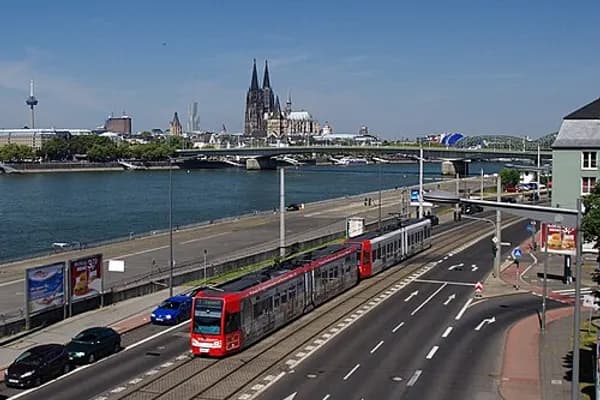
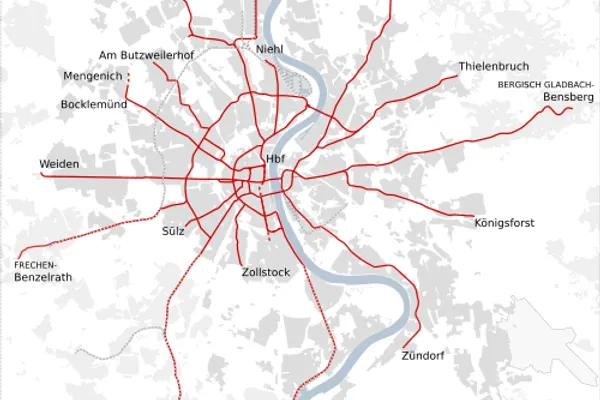
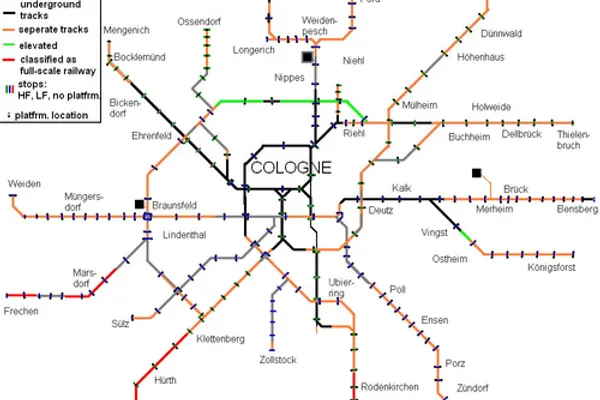
The Cologne Stadtbahn is a light rail system in the German city of Cologne, including several surrounding cities of the Cologne Bonn Region (Bergisch Gladbach, Bonn, Bornheim, Brühl, Frechen, Hürth, Leverkusen-Schlebusch, Wesseling). The term Stadtbahn denotes a system that encompasses elements of trams as well as an underground railway network (U-Bahn) and interurban rail, even including three lines that are licensed as heavy rail and used by freight trains as well as Stadtbahn vehicles. Two of these lines connect the Cologne Stadtbahn to the Bonn Stadtbahn. These lines (16 and 18) are jointly operated by both cities' transport authorities, resulting in both systems and the lines connecting them sometimes collectively referred to as Stadtbahn Rhein-Sieg.
The Cologne Stadtbahn is operated by the Kölner Verkehrsbetriebe (KVB) and the Bonn Stadtbahn is operated by the Stadtwerke Bonn (SWB – City of Bonn Utilities Division). The KVB and SWB are members of the Verkehrsverbund Rhein-Sieg (VRS – Rhein-Sieg Transit Authority), formed in 1987 to consolidate the transit authorities in the metropolitan Cologne area and operate a joint fare structure. There are 236 stations along 199km (124mi) of tracks, of which 42 are underground in 28km (17mi) of tunnels.
History
Horsecar and tram (1877–1960s)
The Cologne Stadtbahn traces its history to the first horsecar lines that started operating in 1877. Within a few years, several companies had built an extensive network. Because none of these companies showed interest in electrifying their lines, the city of Cologne bought them on 1January 1900, and by 1907 all horsecar lines had been electrified or replaced by other services. Additional lines were built until 1912, including Vorortbahnen to surrounding villages outside the city limits. Outside the city center, these lines had segregated right-of-way and were more similar to "real" railroads than to trams.
The dense tram network in the city center that had been present before World War II was only partially rebuilt afterwards, and the Hauptbahnhof (Central Station) was not linked to important places like Neumarkt and Heumarkt for the time being. This was partly due to the plans to make Cologne a car friendly city which meant that old tramways (like the north–south one) were replaced by bus service; and also due to the planned widening of vehicles which wouldn't have fit through some of the narrow streets previously served by trams. Another question was the connection between the two banks of the Rhine which had been provided by the Hohenzollern-, Mülheim- and Deutzer Brücke, that were all destroyed during the war. A decision was taken to dedicate the Hohenzollern Bridge solely to interregional services, while the new Severins Bridge was only finished in 1959, allowing a restructuring of tram lines.
Upgrade to a Stadtbahn (1960s–present)
Already in 1956, the transportation plan of the city council intended a newly built tunnel through the city center in the north–south direction. An overground routing along the Nord-Süd-Fahrt (North-South-Road) would not have served many central areas and was rejected. The tunnel was not planned as a U-Bahn as in many other cities, but rather as an underground tram. This meant a design similar to overground trams with small turning radii, short distances between stops and low-floor platforms. At the end of the tunnels the trains were supposed to run as trams on the streets again, but in many places the trams were already separated from car traffic anyways. For this type of system – tunnels in highly congested areas, elsewhere mostly on or next to streets – the term Stadtbahn was later created. Similar concepts to separate rail and car traffic were later used in many cities in North Rhine-Westphalia and adjacent foreign cities (Brussels, Antwerp).
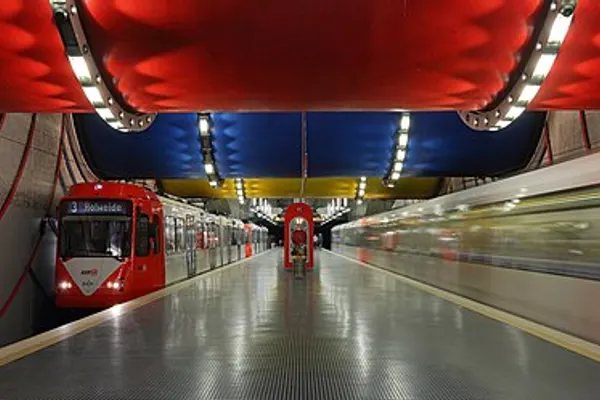
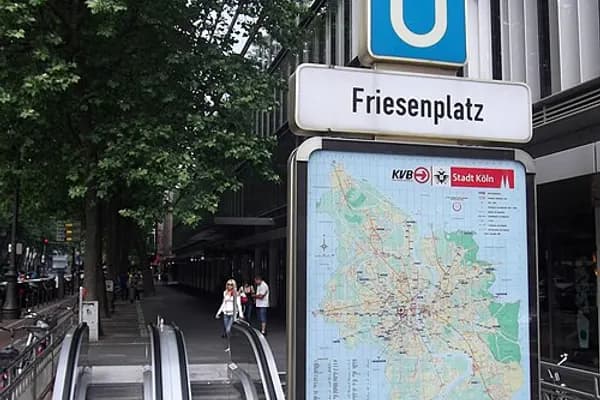
The term Stadtbahn is not regularly used, as the system is mostly referred to as U-Bahn and sometimes Straßenbahn (tram) by officials and the KVB, and most underground stations are also marked by a big white U on blue background which refers to U-Bahn. Most people in Cologne speak about the U-Bahn or Straßenbahn, or just about the train or the KVB.
When construction of the first tunnel started in 1963, there was no promise of the state NRW or the federal government to finance the project, and in the worst case the city would have had to pay completely on their own. With this background, the building of the Innenstadttunnel (city center tunnel) was begun. The tunnel opened in parts between 1968 and 1970 and was designed to be continued later, when more money and higher demand could make it necessary. This was the reason why no traditional U-Bahn (metro) was built in Cologne, which is as of 2023 the largest city in Europe not to have one. Nearly all tunnels completed afterwards aren't new routes, but rather overground sections of existing lines moved to the underground.
Beneficial to the expansion of the Stadtbahn were the Vorortbahnen that mostly ran on the right side of the Rhine and usually had their own right-of-ways. Another advantage was the previous use of 2.5m (8ft 2in) wide trains instead of the usual 2.3m (7ft 7in) other cities used for their trams, which made the adjustment for the new 2.65m (8ft 8in) wide Stadtbahnwagen B easier.
After the Vorgebirgsbahn of the Köln-Bonner Eisenbahnen started serving Barbarossaplatz over Luxemburger Straße in 1898, the Rheinuferbahn used rail tracks of the trams from its start in 1906, beginning the mix of trams and interregional rail. The Köln-Frechen-Benzelrather Eisenbahn, which opened in 1893, was modified from metre-gauge to standard-gauge in 1914, and has been operated by the KVB since 1955 using EBO certified vehicles. The integration of the Rheinuferbahn and Vorgebirgsbahn was already planned in the mid-1960s, but had to be put off due to a lack of vehicles that could run on interregional rail and partially tunneled Stadtbahn.
As seen in other cities, the changing ideas on efficient traffic systems lead to differing needs for the system. An example of this is the length of the platforms. While the first platforms were designed for two coupled 30m (98ft) wagons, later the state NRW required space for three or sometimes four Stadtbahnwagen B, which lead to platforms of up to 110m (360ft) in length. The usually much shorter overground platforms currently only allow two wagons of collective 58m (190ft) length. Another changing factor was the routing itself: the curve radii were enlarged and at-grade crossings avoided. The outer parts of the tunnel network are designed for up to 70km/h (43mph), but the distance between stations is more similar to the previous tram network, which is why the top speed is rarely reached.
There is no plan for the final state of the network as in the U-Bahn of Berlin, Munich or Nuremberg. The lines and tunnels were built in the order which made most sense to relieve traffic at the time. Because of this and the financial insecurity if the state or federal government would finance more projects, many ramps going from the tunnels to the overground were built only provisorily to enable a later continuation of the tunnels, but no underground stations were designed to become multi-level stations serving different directions.
Initially the mixed use of trams and Stadtbahnen only allowed for low-floor platforms with a height of 35cm (14in), which meant that the high-floor Stadtbahnen had to be (and still are) equipped with stairs. In 1985 the first part of the network was built that was only accessible for high-floor trains with a platform height of 90cm (35in).
Since the summer of 2006, no more trams are in use in Cologne. But in the 1990s, the city council had decided to only convert part of the network for use with high-floor trains, that has since been upgraded almost completely. The first few lines were converted to low-floor operations in 1994, another few in 2003. This led to the curiosity that at some platforms the earlier-built escalators don't end at platform level, but a few steps above it, as it had been intended to raise those platforms to 90cm (35in).
Underground construction in downtown Cologne, one of Germany's oldest cities, is often obstructed by archeologists' legal rights to dig in all future building sites within the medieval city limits before all heavy construction machinery.
Current routes
Because the light rail network evolved from the tram network instead of replacing it, there were numerous stations served by both light rail and tram vehicles for almost three decades. While high platforms for step less entry into light rail vehicles could be built on the outer branches, stations in the city center had to have low platforms to support trams as well. The introduction of low-floor technology in the early 1990s promised wheelchair-accessible entry throughout the network without having to build several hundred high platforms. To allow the introduction of low-floor trains without having to demolish existing high platforms, the network was divided into two sub-networks of different floor heights.
On weekdays, all lines are served in 5 to 10minute intervals from 6am to 8pm, with little or no service between around 1am and about 4.30am, and usually 15minute intervals in the late night and early morning, as well as on Sundays. On weekends, there is an hourly service throughout the night. Because several lines overlap on the routes through the city center, some stations are served by up to 30 trains per hour in each direction.
Low-floor lines
East-West lines
The first step towards a low-floor light rail network was concentrating four lines on similar routes into a common east–west-corridor in 1994. These lines were quickly equipped with low platforms 35cm (14in) above street level on every single station. While there are some stretches that can be described as classic tramway lines, the majority of the east–west-network has been upgraded to a high standard with long sections having segregated right-of-way, justifying the term "low-floor light rail" (Niederflurstadtbahn).
In 2006, during the 2006 FIFA World Cup, route 1 was extended to Weiden-West, via Schulstraße, which connects to the RheinEnergieStadion.
In 2007, Line 8, which previously operated during peak hours, stopped service. All its runs were integrated into the schedules of Lines 7 and 9.
: Weiden West (S-Bahn)– Junkersdorf– Rheinenergiestadion– Aachener Straße/Gürtel– Rudolfplatz– Neumarkt– Bf Deutz/Messe– Kalk– Brück– Refrath– Bensberg
: Frechen– Marsdorf– Aachener Straße/Gürtel– Rudolfplatz– Neumarkt– Poll– Porz– Zündorf
: Sülz– Zülpicher Straße/Gürtel– University– Zülpicher Platz– Neumarkt– Bf Deutz/Messe– Kalk– Vingst– Ostheim– Rath/Heumar– Königsforst
Ring lines
When it became clear to city authorities that the construction of a large number of additional high platforms was not financially feasible, other options were investigated. It was deemed most economical to create a second low-floor network and equip the remaining lines with high platforms. Between the stations "Ebertplatz" and "Barbarossaplatz", there are two possible routes. It was decided that the future low-floor lines would be concentrated in the tunnel underneath the Cologne Ring road, while high-floor lines would use the tunnel under the Central station.
This change was implemented in December 2003, after the high platforms at the Hansaring station were removed. In 2006, the tracks of the Chorweiler station were raised with additional gravel. Since then, all "Ringe" lines are operated with low-floor vehicles. In 2007, Line 6, which had only operated during peak hours, was replaced by additional trains of Line 15.
: Merkenich– Fordwerke– Wilh.-Sollmann-Straße– Ebertplatz– Friesenplatz– Barbarossaplatz– Eifelstraße– Zollstock
: Chorweiler– Longerich– Wilh.-Sollmann-Straße– Ebertplatz– Friesenplatz– Barbarossaplatz– Eifelstraße– Chlodwigplatz– Ubierring
High-floor lines
The high-floor network consists of all lines operated by "classic" light rail vehicles with a floor height of roughly one meter above street level. Since separation from the low-floor network, high platforms are being built in stations in the city center at one or two per year. As of 2022, the most frequented stations have been upgraded except for the Barbarossaplatz station.
Since the construction of temporary platforms at the Severinstraße station while the actual station gets modernized and connected to the North-Southern tunnel, lines 3 and 4 are Cologne's first HF lines completely equipped with level entrance. The western branch of Line 5 still has two stops (Subbelrather Straße/Gürtel and Nußbaumerstraße, both shared with Line 13) with low platforms, the rest of its stations were made high-floor when the line was extended into the Butzweilerhof industrial area.
Line 13 is also called the "beltway" (Gürtel) line because it is the only line that does not touch the city center. Line 13 is also called the Outer Ring line, while Lines 12 and 15 together can be called the inner ring line. Most of the line runs along a series of roads of the same name. The northern part of Line 13 is built as an elevated railway. High-floor platforms are still very rare on this line, because it shares three platforms (Dürener Straße, Wüllnerstraße, Aachener Straße/Gürtel) with the low-floor line 7 and many parts of the platforms are lined with old trees, making the upgrade more difficult.
Since the timetable change on 13 December 2015, a section of the north–south rail has been operated by line 17. From Severinstraße it runs through the newly built tunnel to Bonner Wall, after which it joins line 16 at Schönhauser Str. and runs alongside it to Rodenkirchen Bf. In the morning and evening peak (07:00 to 08:00 and 16:30 to 18:00), the line runs further to Sürth.
Lines 16 and 18 are the longest lines in the network, connecting Cologne to Bonn via railway lines.
: Mengenich– Bocklemünd– Venloer Straße/Gürtel– Hans-Böckler-Platz– Friesenplatz– Neumarkt– Severinstraße– Bf Deutz/LANxess Arena– Buchheim– Holweide– Dellbrück– Thielenbruch
: Bocklemünd– Venloer Straße/Gürtel– Hans-Böckler-Platz– Friesenplatz– Neumarkt– Severinstraße– Bf Deutz/LANxess Arena– Mülheim– Höhenhaus–Dünnwald– Schlebusch
: Sparkasse Am Butzweilerhof– IKEA Am Butzweilerhof– Alter Flughafen Butzweilerhof– Rektor-Klein-Straße– Margaretastraße– Iltisstraße– Lenauplatz– Nußbaumerstraße– Subbelrather Str./Gürtel– Liebigstraße– Gutenbergstraße– Hans-Böckler-Platz– Friesenplatz– Appellhofplatz– Dom/Hbf (Central Station)– Rathaus– Heumarkt
: Sülzgürtel– Zülpicher Straße/Gürtel– Dürener Straße/Gürtel– Aachener Straße/Gürtel– Venloer Straße/Gürtel– Subbelrather Straße/Gürtel– Nußbaumer Straße– Escher Straße– Neusser Straße/Gürtel– Amsterdamer Straße/Gürtel– Slabystraße– Mülheim– Buchheim– Holweide
Encyclopedic content adapted from the Wikipedia article on Altstadt, used under CC BY-SA 4.0.